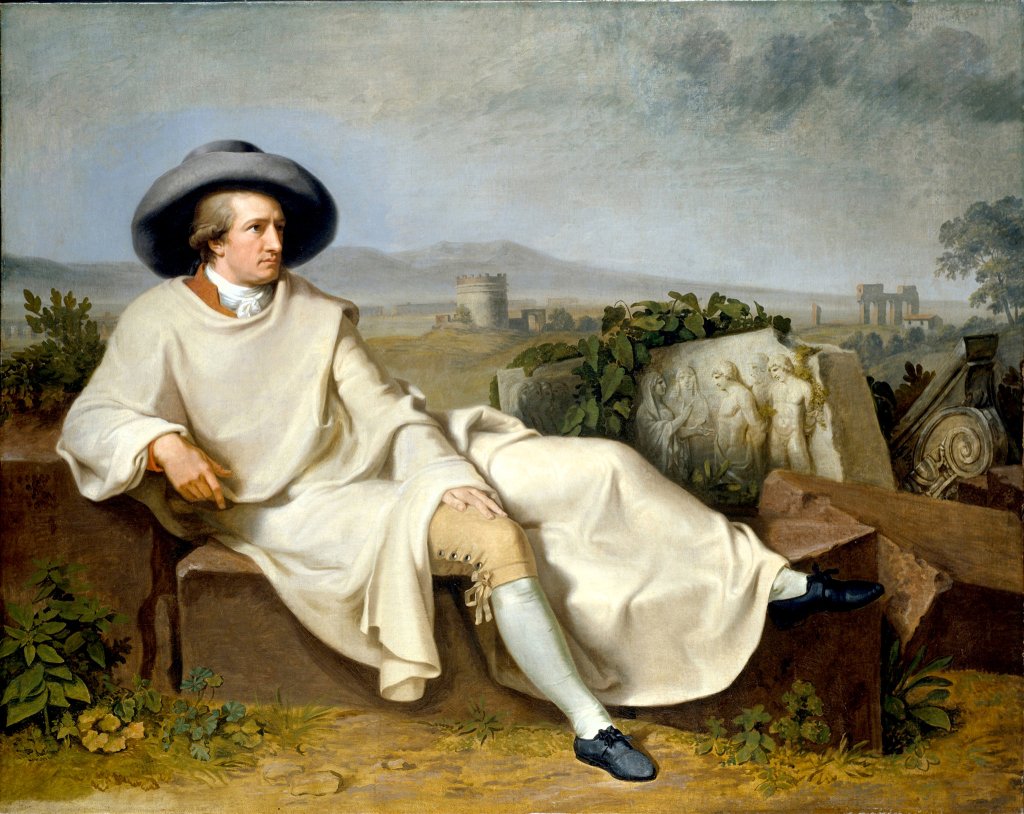
“The safest general characterization of the European philosophical tradition is that it consists of a series of footnotes to Plato.”
–Alfred North Whitehead

Eins und Alles _ Goethe

My German is schrecklich, but since I couldn’t find any translations I liked, I spent the afternoon struggling with Goethe’s poem “Eins und Alles” (“One and All”), with a dictionary and several other translations in tow. What follows is my best attempt to render this Englishly. I am convinced that translation is impossible, but I am compelled to try anyway. (German speakers, please tell me where I’m way off!)

Finding oneself amidst the infinite, 

The individual would gladly disappear

That all discomfort may dissolve.

No more burning wishes, wild wanting;

No more annoying demands, rigid rules:

To give oneself up is a joy. 

Soul of the World, come, permeate us! 

Help us wrestle with the World-Spirit,

Raise our powers to its heights.

Goad us as kindly spirits, 

Gentle guiding masters, 

To that which creates and created everything.

And remaking what has been made,

So that it does not fossilize,

Eternally working, vitalizing activity.

What was not, now wants to become

Virgin suns, vibrant earths,

And never rest.

It must remain in motion, actively creating, 

First forming, then transforming; 

It appears still only for a moment. 

The eternal lures everything onward:

Because all things must decay into nothing,

If they want to persist in being. 


Posted

in

by

Tags:

Comments

3 responses to “Eins und Alles _ Goethe”

  1. Johannes J. Avatar

    Hi Matt,
    thanks for your translation! The poem was not familiar to me. Great expression of a process ontology. I don’t even remotely know and understand Gothe`s thinking as you do, but as a German speaker I would state that only minor nuances are lost. I cannot assess your decisions of artistic expression though.
    Only two instances stood out form me. Line 2.6 “Zu dem, der alles schafft und schuf.“ more literally states “That which creates and created everything” and contains a hint that creation has not only been created but is being created permanently. That seems to be an important detail in a poem on change as the only way of being. Another detail might be in line 3.3 “Wirkt ewiges lebend’ges Tun.“ More literally it says “Operates eternal, vitalizing action.” This might express that it’s the action itself that operates eternally..
    Thanks again for your promotion of evolutionary process thinking!!

    Greetings from South Germany
    Johannes

    1. Matthew David Segall Avatar

      Thank you! I appreciate your expression of these nuances.

  2. Noel C Avatar
    Noel C

    (The first take of my post didn’t align as a poem. Take two. If it doesn’t align properly, at least I hope the quality of the translation comes across.) I came across this translation in the early 1980s. I can’t speak to the accuracy of the original German, but it reads beautifully as a poem in English:

    One and All

    In boundlessness to lose and find

    Themselves, the single are inclined,

    Shedding the irksome bond, the tight.

    Free of strong willing, wild desiring,

    Imperious must and hard requiring,

    In our unselfing we delight.

    World soul, you come, flow into us!

    Then with the world’s own spirit thus

    To grapple is our highest call.

    Good spirits, master-minds indeed

    Gently, by sympathy, will lead

    To him who made and still makes all.

    To recreate the once created,

    Lest it grow rigid, crenellated,

    Is live, eternal doing’s end.

    And what was not, now craves new birth

    As a pure sun, a colorful earth –

    Never to rest, never to pend.

    No, active, it shall stir, create,

    First shape itself and then mutate;

    It only seems to pause, hang still.

    The eternal works in all that’s wrought:

    For all to nothingness is brought

    If changeless being is its will.

What do you think?