
On Wednesday evening (March 13) at Grace Cathedral, was in dialogue with the Rt. Rev. Dr. Marc Handley Andrus, Bishop of the Episcopal Diocese of California; Brian Behlendorf, CTO of Open Wallet Foundation; and Zann Gill, author, former research scientist on collaborative intelligence at NASA, and a founder of Generative AI Lab & Library in an effort to explore the future impact of AI, from three perspectives: technology, the humanities, and religion. Here’s the recording of the event:
Below are some preliminary thoughts, which I originally recorded as an iPhone notewith voice-to-text and then fed into my GPT (Auto Matt) with the following prompt: “turn this transcript into a readable essay. don’t skip any sentences. get as close to verbatim as possible while writing in complete sentences.”
In any discussion about artificial intelligence (AI), it’s vital from the outset to recognize that human consciousness—our thinking, feeling, and willing—is not merely an information processing or computational phenomenon. Consciousness, along with thinking, feeling, and willing, is invisible and undetectable by any device that neuroscientists or physicists might devise. This invisibility highlights a fundamental distinction at the very start of conversations about AI.
When considering the emergence of conscious AI or genuinely intelligent AI, it’s essential to reflect on the nature of intelligence itself. Intelligence, including human intelligence, may be considered artificial in some respects, as it is augmented by language. Language, even in its oral form, externalizes thought into a physical medium, a process further extended by writing, especially alphabetic writing. Thus, digital forms of artificial intelligence represent the latest evolution of intelligence, which has always been, to some degree, artificial.
However, this discussion aside, the crux of the matter is consciousness. The question shouldn’t be whether machines will become conscious, as they are information processing devices and consciousness transcends such a mechanistic understanding. Instead, we should ask how this new extension of human consciousness into digital technologies will alter our consciousness. How are we being transformed by our interaction with these machines? If we start to believe that a computer could become conscious, we might be inadvertently diminishing our understanding of human beings to that of machines. The challenge, then, is not to anthropomorphize machines but to appreciate the spiritual aspect of human existence that technology cannot capture.
Materialist explanations of consciousness support the illusion that machines could become conscious, at least in principle. This perspective assumes that assembling large language models and video processors could somehow fabricate a thinking, conscious machine. However, this view overlooks the intensive depth of human thinking, feeling, and willing, reducing them to mere information processing, which is a significant oversight.
Understanding the brain already requires more than just considering it as an information processor or a piece of organic matter. To truly grasp its nature, we must consider the brain’s embeddedness within the entire body and its evolutionary history. Our bodies are ecosystems comprising various cells, with only about a tenth containing human DNA. The rest are part of a microbial ecosystem interacting with our human cells. Thus, we are a living society of occasions of experience, to use Whitehead’s terms, rather than a mere assemblage of computationally describable components. The brain cannot be simplistically divided into software and hardware. In the living world (the only world we could ever know), mind and matter are not so easily separated. Instead, they are entangled phases in an unbroken creative process.
Despite the physicalist view of human beings, I will argue that we are essentially spiritual beings. This assertion does not conflict with scientific understandings from neuroscience, physics, or psychology. We can still discuss the soul and spirit without contradicting scientific knowledge. These layers of our being remain invisible to the measurement tools of contemporary science because consciousness itself is the measurer, not just another natural phenomenon. While consciousness is not supernatural, a proper understanding of nature must account for the transcendental status of consciousness and rationality. Science cannot explain consciousness by referring to something outside of consciousness, which would itself be non-conscious. Such an approach misunderstands the very conditions that make science possible in the first place.
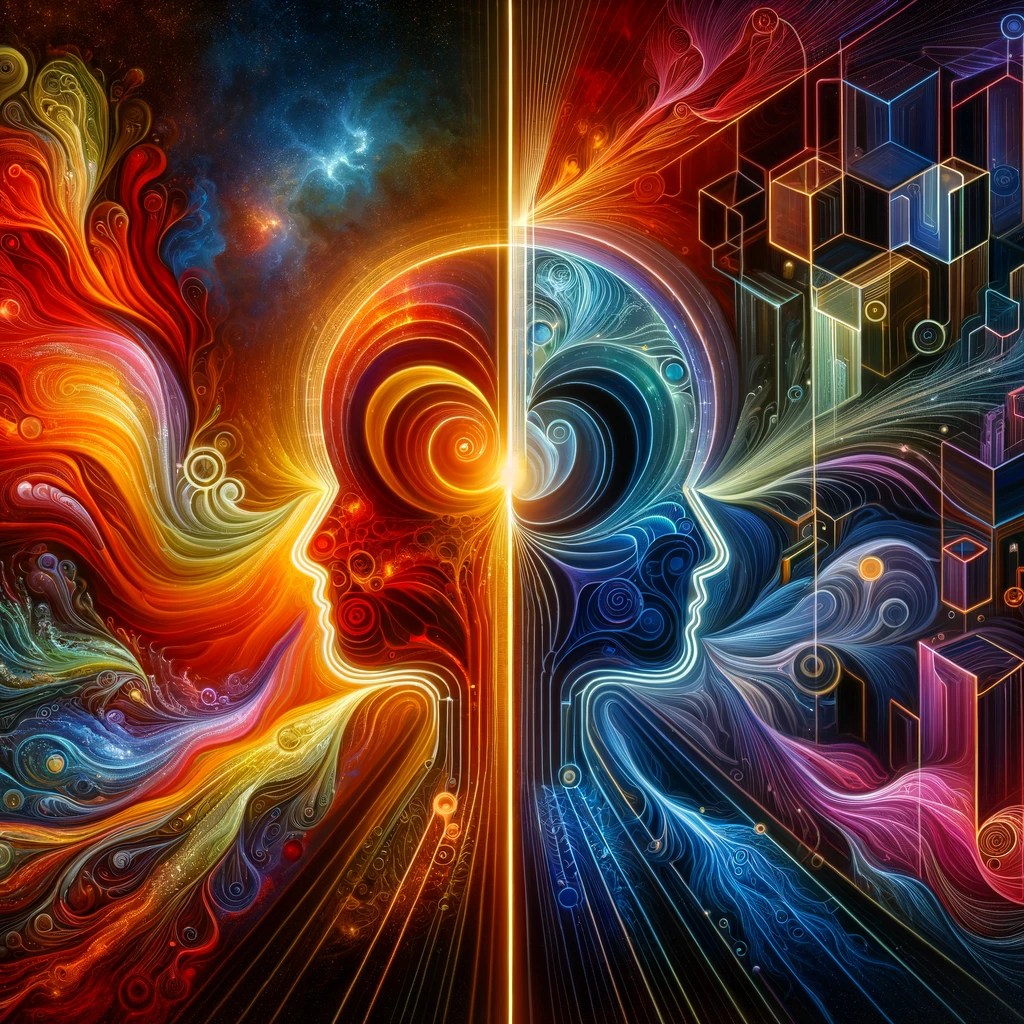
Here is the image my GPT created for this transcript:


 Footnotes2Plato
What do you think?