
Last Tuesday, on Mary Magdalene’s Feast Day, I walked as a pilgrim with about a dozen others from Lewes train station to St. Peter’s Church in Firle along part of a historic route called the Old Way in the south of England that stretches from Winchester in Hampshire to Canterbury in Kent.

I slept in St. Peter’s that night. The vicar Peter Owen Jones delivered the following sermon for us. He began with a reading of John 20:1-18:
Early on the first day of the week, while it was still dark, Mary Magdalene came to the tomb and saw that the stone had been removed from the tomb. So she ran and went to Simon Peter and the other disciple, the one whom Jesus loved, and said to them, “They have taken the Lord out of the tomb and we do not know where they have laid him.” Then Peter and the other disciple set out and went toward the tomb. The two were running together, but the other disciple outran Peter and reached the tomb first. He bent down to look in and saw the linen wrappings lying there, but he did not go in. Then Simon Peter came, following him, and went into the tomb. He saw the linen wrappings lying there and the cloth that had been on Jesus’ head, not lying with the linen wrappings, but rolled up in a place by itself. Then the other disciple who reached the tomb first also went in, and he saw and he believed. For as yet they did not understand the scripture that he must rise from the dead. Then the disciples returned to their homes.
But Mary stood weeping outside the tomb. As she wept, she bent over to look into the tomb, and she saw two angels in white, sitting where the body of Jesus had been lying, one at the head and the other at the feet. They said to her, “Woman, why are you weeping?” She said to them, “They have taken away my Lord, and I do not know where they have laid him.” When she had said this, she turned around and saw Jesus standing there, but she did not know that it was Jesus. Jesus said to her, “Woman, why are you weeping? Whom are you looking for?” Supposing him to be the gardener, she said to him, “Sir, if you have carried him away, tell me where you have laid him, and I will take him away.” Jesus said to her, “Mary.” She turned and said to him in Hebrew, “Rabboni!” which means “Teacher.” Jesus said to her, “Do not hold onto me, because I have not yet ascended to the Father. But go to my brothers and say to them, ‘I am ascending to my Father and your Father, to my God and your God.’” Mary Magdalene went and announced to the disciples, “I have seen the Lord,” and she told them that he had said these things to her.
He then added:
“There is so much in those four hundred words, and I will just talk about two things.
The first is that at that point, humanity—all of us—we are not alone anymore. From that point onwards, we are not alone. We are connected by love to all that lives on the sweetest of planets. We are connected by love to all that exists in the realms of space.
And secondly, the greatest of human experiences is the experience of love. Mary Magdalene and Jesus Christ were in love.
And finally, perhaps now we are moving from a time where we place the divine persona much closer now than we have ever dared to do so. The ancient ideas of God, the Beloved, being somewhere else are now beginning to tatter and fray. We realize—we’re beginning to understand—that we are as a people, as beings, we are symbionts. And by that I mean that we cannot breathe, we cannot see, and we cannot function without the myriad of other life forms within us. And that each life form is in essence divine energy, as we are. And that realization perhaps will move us—I hope will move us—into the future of which yet we do not know. But the promise of that reality is the great hope for us all.”
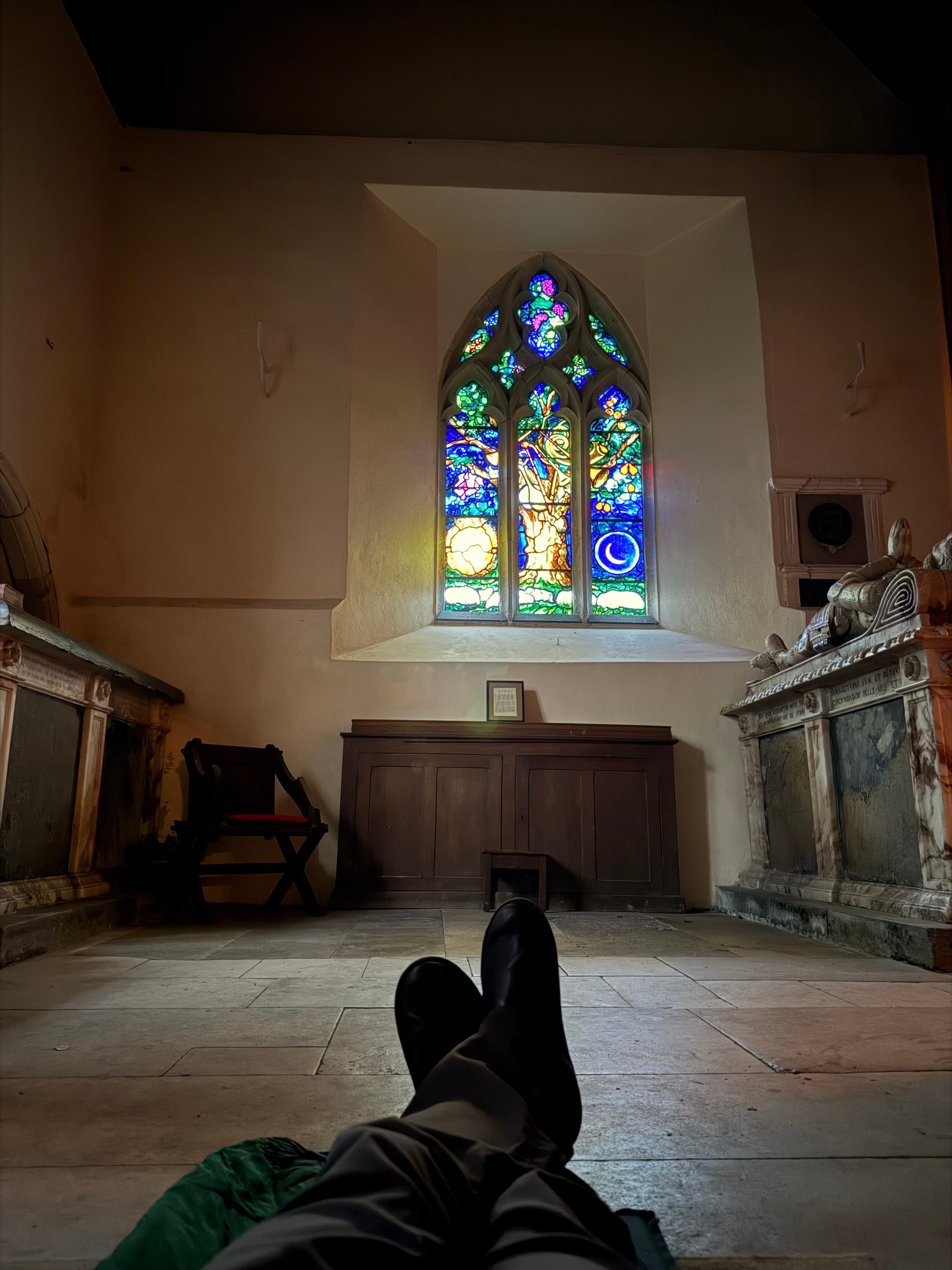
This sets the context for the poem below, which recounts some of what I was contemplating that night as I lay beneath this stained glass window, designed by John Piper:
Flung inside-out
to the edgy core
of the Fractal
field of feelings
that entwines us,
I kneel
before the fiery
Former of forms.
Ever bending back,
ever flowering forth:
You are seed and soil,
origin and return,
wound and womb,
Your end enfolded
in Your beginning.
Sancta Maria Magdalena,
Apostle of Apostles, First Seer,
let me feast with You, lamb-like
beneath Your Tree of Life,
naked in Your lunar mind-womb
warmed by His solar light.
Myrrh-bearing Maiden, let me breathe
the fragrant fumes of Your Heaven.
Teach me patience for the dew-condensed perfume
of Your promise, gathered on grass
in the hush of dawn.
Sing into me:
“We are
all one—
yet not a one the same.”

Each heart a spiral orb pinched in plasmic weave,
a pulsing spark curled close
round Mary’s magnet touch.

She knew
Love.
"Rabboni!"
Her blessing binds us
in shining song,
reminds us of the First Day’s desire:
the verdant void’s great yearning
that, through nova’s cry
and dust’s descent,
it might fall as flesh
to walk the Earth.
To be human
is to wear a mask
no other being dares bear.
We echo one another
into shapes of soul,
sounding depths of birth and death
even angels only dream.
This mortal mask,
conceals a mirror-mind
cradling the starry sky in its I.
Fashioned in the forge, we die to know,
we walk without wings upon the water
integral with the evolution of the earth.
And still, we wonder,
as She did, searching in the dark,
bearing witness to the empty tomb.
“Woman, why are you weeping?"
He said in the form of a Gardener.

The stone rolled back,
the linen folded,
the angels waiting
not above us but within us.
She turned,
and Love spoke Her Name.
And since then, we are never alone.

We are held—each of us—
by the breath of the Beloved.

“Do not cling to me.”

I am
web-woven
of root and star and Word.

God is not elsewhere.
We are in the garden now.
We are the womb of the world to be.
Let us let go of God, as She did.
Not a new religion,
but a renewal of relation.

“I have seen the Lord”:
He was buried in the soil,
is risen in the stranger,
as in the lover,
and lives
in the selfless self
we are becoming.


 Footnotes2Plato
.jpg)
What do you think?