
You can listen to my conversation with Ingrid over on her Forest of Thought podcast, or read the revised transcript of my remarks below. We recorded this in Claremont, CA back in June at the “Is It Too Late?” conference on ecological civilization (you can watch my conference presentation on Whitehead’s advice for the business mind here).
“Philosopher” is a title I once watched a mentor of mine decline. When I introduced him before a talk and called him a philosopher, he blushed and corrected me: he was “just a professor of philosophy.” I was confused. For him, “philosopher” was an honorific to be bestowed, not claimed. I’ve always related to the term differently. To call oneself a philosopher is not to declare oneself a sage; it is to confess a love of wisdom and a commitment to seek it. The claim is not “I have wisdom,” but “I am in love with it.” There is no hubris in that. So yes, I am willing to adopt the title—and to take philosophy as more than a profession, more than the solving of abstract puzzles or the performance of linguistic analysis. Those can be interesting, but they miss philosophy in its ancient sense: a spiritual practice, a way of life, and a way of existing in relation to the mystery of being a living and dying creature.
I have been walking that path for a long time. As a seven-year-old, I confronted my mother’s death and was torn up by grief. Soon thereafter I realized that I, too, would die. That second realization struck me differently. It seemed impossible that consciousness should simply end. My identity might transform, but sheer cessation of consciousness did not make sense to me. I didn’t have the language for it then, but I was beginning to inhabit life philosophically.
Plato has Socrates say in the Phaedo, just before drinking the hemlock, that philosophy is a preparation for dying. I remind myself of this often. Death is tragic, but it is also the source of life’s meaning, its “end” in more sense than one. If we live our lives backward from the perspective of death, we might stand a better chance of becoming virtuous.
I feel lucky to be a professor of philosophy. It is more than a job; I would be doing this even if I weren’t paid—perhaps living in a barrel like Diogenes—but, either way, remaining a student forever. I never wanted to leave school, so becoming a professor meant I don’t have to.
The process approach to philosophy reaches back before Plato to the so-called pre-Socratics, the physiologoi. Heraclitus says that all things flow—panta rhei—and that we cannot step into the same river twice. He also says the cosmos is an ever-living fire. Ongoing transformation is the only constant, and the “ever-living” already suggests a panpsychist orientation: the universe pervaded by vitality.
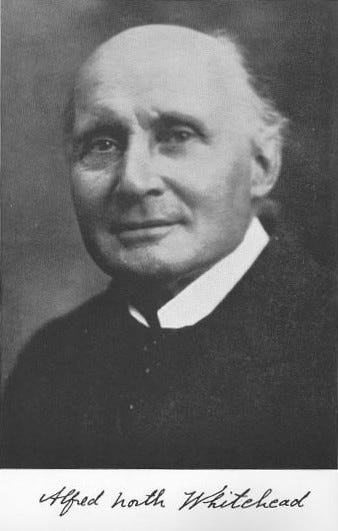
Thousands of years later, Alfred North Whitehead lived through what we might call the second scientific revolution. Relativity and quantum theory shattered the old mechanistic materialism—at least, they should have. Whitehead saw that mechanism no longer made sense, given what science itself had discovered. He set to work on a new metaphysical substructure for science to replace the seventeenth-century frame. Instead of treating emotion, value, and all the qualities Galileo dismissed as “secondary,” Whitehead argues that qualitative feeling, affect, and value are fundamental to the universe. If we want what is most basic, we should attend to our visceral feelings, our emotions, moods, and their fluctuations. These are revelatory of the real, not extraneous frosting.
That is challenging for the materialistic, engineering mindset that approaches science as a means of mastery and control. The science Whitehead envisions is about entering into durable relationships with the world. Knowledge becomes a matter of building alliances with other kinds of beings. The more secure and reciprocal the alliance, the more valid the knowledge. When a biochemist studies microorganisms, the resulting knowledge is not simply extracted by the human; it is co-created by the human scientists and the microorganisms with whom they collaborate. Knowing becomes collaborative and interspecies.
This integrative—or integral—vision resonates with the founding ethos of my university, which is deeply influenced by Sri Aurobindo’s integral yoga. Integral education brings together body, mind, and spirit. Spirit needs the body as much as the body needs spirit; intellect is only one aspect of knowing reality. We need transcendence and immanence, the somatic and the spiritual, not as opposed dualisms but as mutually arising dimensions. In education, this means that feeling, emotion, intuition, imagination, and kinesthetic ways of knowing are not secondary to intellect; they are crucial ingredients in understanding the world.
Whitehead’s own path is instructive. He studied mathematics at Trinity College, Cambridge, and became a professor there for twenty-five years. Bertrand Russell was first his student and then his collaborator; together they wrote Principia Mathematica, which helped inaugurate the analytic approach that still dominates much academic philosophy. In the 1910s, as Einstein’s relativity took hold, Whitehead—long fascinated by the relation between mathematics and physics—was among the few in the English-speaking world who grasped the four-dimensional geometry developed by Minkowski and used by Einstein. He began drifting from pure mathematics toward philosophy, asking what relativity meant for metaphysics. Was it idealist? Did it demand some other framework? Whitehead was a realist, but an experiential realist. He refused to let the new physics do violence to common-sense experience. He sought to integrate the best science with the presuppositions of human life: agency, consciousness, and their intrinsic place in nature.
By the early 1920s he had made a name for himself as a philosopher. Harvard invited him, at age sixty-three, to teach philosophy. In the fall of 1924, he gave his first philosophy course, confessing it was also the first he had ever attended. He had, however, been developing his ideas for decades, and now he could work them out in class. Student lecture notes, recently published, let us watch his mind in motion.
In 1925 he published Science and the Modern World, both a history of science and the first clear articulation of his metaphysics, what he called “organic realism” of “the philosophy of organism.” He reimagined nature as an ecology of organisms at every scale, from subatomic particles to galaxies. Biology studies the middle-sized organisms; particle physics studies the smaller; astrophysics studies the larger. An organism, for him, is any self-organizing system with a horizon of experience. He had already noticed that materialism leaves no place for consciousness; the scientists who describe the mechanistic universe leave no place for their own intelligent agency in the world they describe. One is left with an incoherent dualism or with the attempt to explain away consciousness—an odd move, since without conscious intelligent organisms there could be no science. Process and Reality (1929) carries the system to its height: a grand, empirically sensitive metaphysics that gathers the special sciences, religious experience, aesthetics, and the arts into a comprehensive cosmology. He was truly integral in bringing science, religion, and art back together.
Whitehead, however, published in an unseasonable moment. As Process and Realityappeared, Heidegger’s Being and Time and Wittgenstein’s Tractatus were already pushing philosophy away from speculative metaphysics and cosmology. The twentieth century turned increasingly analytic (in the English speaking world) and phenomenological (on the Continent), bracketing questions about nature and the cosmos in favor of language, logic, or human situatedness. Whitehead was marginalized for most of the century. That is changing. His time may be now.
Much controversy arises when experience is extended beyond humans or even mammals. Many will grant consciousness to mammals and birds; more biologists today are open to a minimal sentience in single-celled organisms, though not all agree. Attribute experience to atoms, stars, or galaxies, and charges of anthropomorphism fly. The late David Ray Griffin, a Whitehead scholar and co-founder of the Center for Process Studies, coined “panexperientialism” to distinguish Whitehead’s view from panpsychism. “Psyche” or “soul” suggests consciousness; “experience” is more neutral. Whitehead repeatedly reminds us that most experience is not conscious. Human consciousness is derivative and somewhat peripheral: a narrowing of attention toward what Whitehead calls in his technical terminology “propositional feelings,” or “affirmation-negation contrasts.” Consciousness is useful, obviously, but also limiting. Beneath consciousness lies experience as the transmission of feeling from moment to moment: inheriting a past and anticipating a future. Even a hydrogen atom, by virtue of its causal relations, inherits a past and anticipates a future. As beings become more complex—physiologically and neurally—the duration and intensity of the tension between past and future dilate. At higher degrees of dilation we get something like consciousness. At the microphysical level there is little “time” to choose among possibilities—yet even quantum theory leaves room for minimal decisions, since, for example, we cannot predict precisely when a radioactive atom will decay or which slit an electron will pass through.
Whitehead’s central concept for how novelty appears is concrescence—literally, a “growing together.” In each moment, the many become one and are increased by one: the many potentials carried from the past grow together into a new actuality that achieves a unique perspective on the universe, then perishes and offers itself to future becomings. God, for Whitehead, is not an exception to this metaphysics but its exemplary case. The difference is that God’s concrescence is everlasting. God’s life is imperishable; all finite becomings occur within God, who is continually enriched and surprised by what creatures co-create.
Concrescence puts evolution on a fully general footing. Darwin gives us variation, selection, and reproduction. In Whitehead’s scheme, reproduction is the inheritance of the past; variation is the ingression of novel possibilities into each act of becoming; and selection is not merely the environment’s external “death penalty” but also an organism’s internal, value-laden decision among alternatives. Whitehead grants creatures genuine agency and selective capacity.
Is concrescence continuous or discrete? Both. Metaphysics, Whitehead says, is an experiment in language, an attempt to craft categories adequate to experience. Nothing we say will capture reality fully, but the attempt matters. Concrescence names discrete acts of becoming—it is the process whereby individual perspectives are produced—but each act is the growing-together of myriad prior acts. Individuality and community are correlative: individuals are made of their relations, and those relations are themselves achievements of individuals.
Whitehead is sharply critical of the idolatrous image of God as cosmic emperor, which he views as a projection of ancient patriarchal political hierarchies onto the heavens. Scripture, he insists, contains another image: God as the “fellow sufferer who understands,” whose power is love and persuasion rather than coercion. Whitehead’s God is not omnipotent. There are infinitely many creative possibilities. God is the first creature of Creativity, the primal valuer who irradiates the realm of possibility with love and thus sets the base note that all subsequent creatures improvise upon. Each emergent creature feels Creativity through God’s mediating valuation. God, Whitehead says, holds up a mirror to each creature, reflecting its own greatness back to it, granting it a divine image of what it could be. Creatures then decide freely how to respond.
Alongside this primordial nature is God’s consequent nature: a cosmic memory that does not allow any achieved value to be lost. The primordial nature addresses a cosmological question. It answers to why order and harmony, rather than chaos, prevail in some degree. The consequent nature answers an existential longing: that what is good be gathered and made whole, even amid the wreckage of history. Hence Whitehead can say that God is “the poet of the world,” luring creation toward truth, beauty, and goodness. The highest beauty realizable in this world-in-process is tragic beauty: not despair, but the teary-eyed splendor of finite striving for the good within real limits. “The dream of youth” (primordial) yields “the harvest of tragedy” (consequent).
What follows for science? A Whiteheadian science would be more relational, attending to how knowledge is co-created through alliances with the nonhuman world. This does not mean discarding current methods, but recognizing them as a subset of science rather than its whole. There is no such thing as value-free neutrality. Every fact is a function of how we attend to the world, and attention is guided by values. Science is a cultural practice rooted in history and thus subject to bias. Funding regimes oriented to corporate profit and military might distort inquiry, narrowing questions to what can be monetized or weaponized. We lose truth that way. Whole domains are dismissed as “impossible” and therefore unworthy of study. Whitehead suggests that if his cosmology were taken seriously, what we now call “parapsychological” would become psychology proper. Sympathy is a basic form of resonance; before we can communicate with mouth squeaks, we must attune emotionally. We inhabit a subtle field of feeling that materialism cannot make sense of. Even so-called psychokinesis is ordinary from another perspective: what do we call the movement of any limb? Materialist explanations here are not especially convincing.
For spirituality, Whitehead offers a capacious metaphysical home in which the world’s traditions can recognize themselves. Non-theistic paths such as Buddhism may find affinity with Creativity and the interrelatedness of all things. The Abrahamic traditions face Whitehead’s challenge to omnipotence. Many seek a “large and in charge” deity to keep them safe. “My sky daddy is bigger than yours.” Whitehead’s vision is more mature: God needs us. Divine power is the worship God inspires, a persuasive vision we are free to realize, or reject. To the extent that our will is guided by love, we manifest God’s will; God becomes more powerful through our loving action. To the extent that we act from fear and hate, divine power in the world diminishes. The universe as divinely envisioned cannot be actualized by God alone. For me, this is more compelling than a picture of a world created ex nihilo by fiat, with creatures left to appease an absolute sovereign.
This process vision also reframes personal identity. We are new in each moment. My relation to my own past and my relation to you differ by degree of intimacy, not by kind. As friendships and loves deepen, streams of identity fuse; individuality is constituted by communion. Such a view is liberating, especially for those carrying trauma. Each moment brings a divine injection of possibility. What we were is not what we are; we can become otherwise. The future is open-ended. The only certainty is that something new will happen.
We gathered at this conference aptly titled “Is It Too Late?” under the shadow of planetary collapse. The Holocene stability that made agriculture and civilization possible is ending. We are being matured by the Earth, willing or not. Perhaps as old securities fail, we will become more amenable to a process-relational vision: philosophy as preparation for living and dying well; science as alliance; spirituality as responsive love; identity as the ever-renewed achievement of the many becoming one and being increased by one, again and again, worlds without end.
 Footnotes2Plato
What do you think?