
I’ve discussed the return of Platonism in biology before. The following recounts some of what I discussed with Bonnitta Roy as a visitor at The Pop-Up School earlier today.
The main driver of the Platonic turn in the life sciences is Michael Levin’s remarkable lab research on bioelectric patterning in morphogenesis. He is now framing this as a Platonic research program and claiming that both biological form and organismic agency ingress from a realm beyond physical spacetime, with external bodies functioning as “thin user interfaces.”
I’ve been in dialogue with Mike for several years. I am excited by his research and theory papers, but my task here is to reflect on his metaphysical moves. I end up wanting to pull things back toward a process-relational (Whiteheadian) reformed Platonism that honors the influence of a structured continuum of possibilities without assigning agency to abstract patterns as such. To do that would be, as Whitehead warned, a fallacy of misplaced concreteness.
…
Levin is right to resist genetic reductionism and to insist that organismic agency drives morphology. His lab’s xenobots and anthrobots foreground a crucial point: you can re-compose living tissues into novel embodiments that reliably discover/create forms and aims never selected for by ancestral lineages. When a xenobot displays novel capacities, that “cost” wasn’t paid by phylogenetic selection. Hence his claim that there must be an ordered latent pre-space of possibilities from which such definite patterns can be drawn.
…
Where I part company is the leap that makes the patterns the agents, with bodies as “thin clients.” Levin uses “interface” in a technical sense: think 1970s terminals, thin clients front-ending a distant mainframe. His warning is that if you theorize only the front end, you’ll misdiagnose the system. Fair enough. My worry is the slide from “front end” to “mere puppet,” as if agency lives elsewhere and bodies are but “scratchpads.” That bifurcation repeats the old split I’d want to overcome. I want a reformed Platonism in which organisms are the present locus of decision even as they orient by a structured realm of relevant possibilities. There is a real, living constellation of forms, but its patterns are not puppeteers.
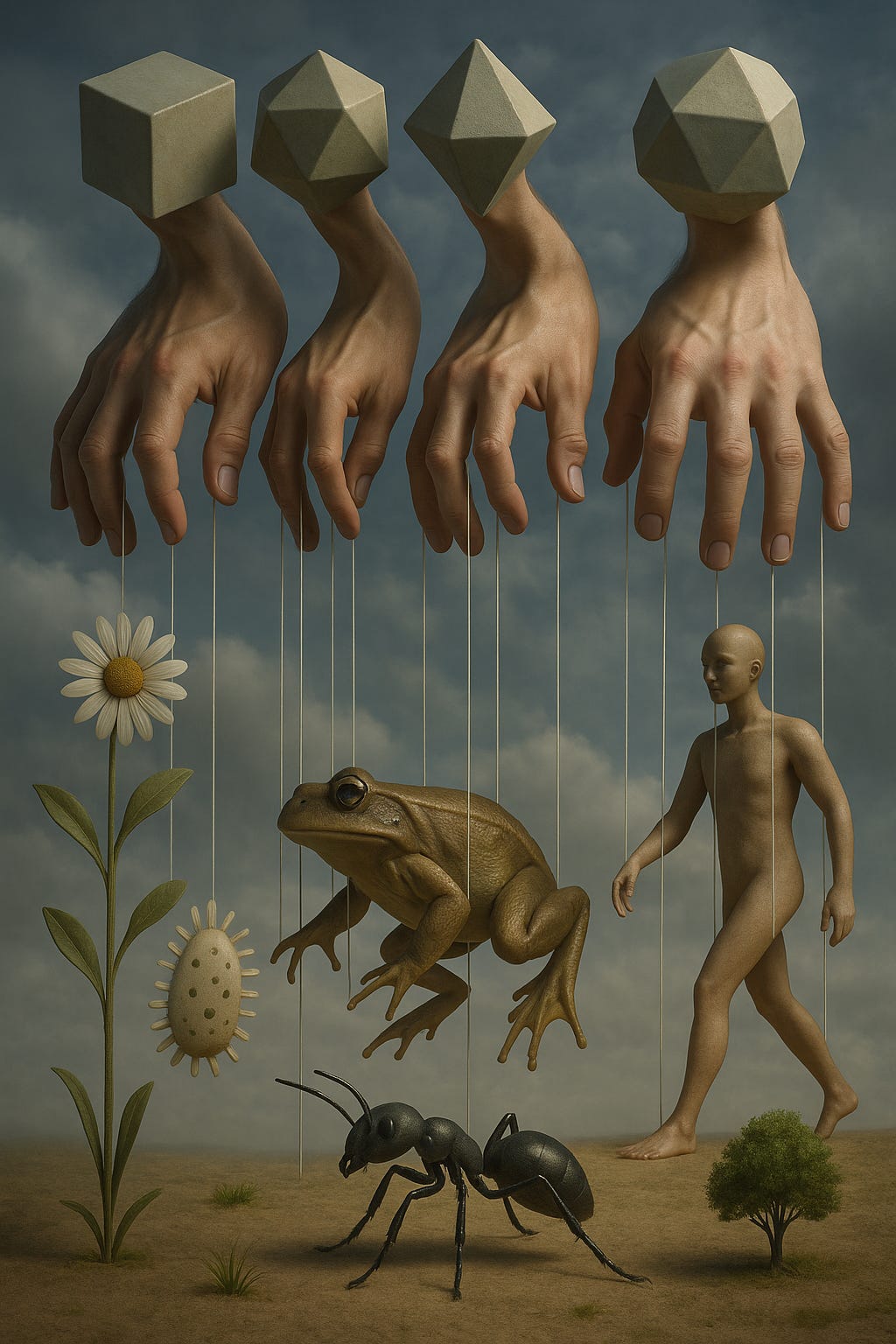
Aristotle’s formal and final causes become relevant again. The mechanistic picture traded almost exclusively in efficient causes (pushes from behind). But organisms grow and move themselves in response to lures, or pulls from ahead. Still, we need not, and should not, place all the agency “above,” in an abstract heaven of Ideas. Agency is realized by organisms, here and now, as they inherit, invent, and transform themselves.
…
As a Whiteheadian, I’m very interested in mereotopology, the study of relations between wholes and parts. Topology is the study of topos, meaning “place.” It offers a more concrete approach than what we usually call geometry. Topology is not metrical: you don’t need rulers, coordinates, or fixed scales. Aside from a select set of human beings, organisms don’t make decisions using meter sticks. Cells, as they engage in embryological development, are not calculating one another’s coordinates. The engineering mindset that imagines DNA as a set of instructions for computing where each cell needs to be at each moment mistakes an algorithmic blueprint for a felt field.
A topological lens lets us say why. We begin as one cell. That cell divides. Development is not an accumulation of discrete parts that finally produces an organism; it is a whole that differentiates into parts. The whole precedes the parts. In mereotopological terms, boundaries are not rigid seams but dynamic neighborhoods that thicken and thin as the organism negotiates its own becoming. Parts are not little machines bolted together, they are regions of a living gradient, transiently stabilized by ongoing relations within the whole.
If we approach development with an overly mechanistic, engineering frame, we will always try to assemble the whole from pre-made components, a geometric picture that presumes we can measure everything in advance and assign each piece its coordinate. A topological approach is more organic. It is about feeling one’s place in a gradient—just as each cell feels the shape of the bioelectric field around it. Gradients are evaluative fields. They do not merely constrain but invite and goad. Following Whitehead, we can say the cell prehends its neighborhood; it feels relevant features of the past environment (relevant relative to the field of adjacent possibilities haloing it), and then decides.
This is not to deny the role of molecular interactions, genes, proteins, or signaling cascades; it is to place them within an organismic topology. To treat DNA as if it calculated coordinates is to mistake a syntax for a semantics and a semantics for a lived pragmatics. The organism is not passively implemented by code, it actively metabolizes information—transforms signals into felt relevance, writing itself as it reads. The causal story is thus not a one-way push from molecules upward. Formal and final causes re-enter the scientific scene as pattern and aim: the embryo’s morphogenetic “sense” of limb versus tail, of axis, polarity, proportion.
If the whole precedes the parts, then parts inherit their significance from the processual patterns they help maintain. Boundaries are functional rather than merely physical: they are where an organism maintains contrast in order to keep communicating across it. A bone is not a brick or beam, it is a regionalization of the organism’s stress-lines and flow. A nerve plexus is not wiring, it is a confluence where multiple gradients are braided for resonant action.
This reframing also touches physics. We habitually treat space-time as a metric container. But geometry is a tool for our purposes, not the essence of the real. Topology precedes geometry in experience: before we measure, we orient. Before we count, we connect. If the biological world is best understood in terms of its mereotopological neighborhoods and gradients, we should not be surprised that physical space-time, too, can be approached as a relational topology within which metrical structures are selected by organisms for the problems at hand. Multiple geometries can model one and the same physical situation; none is the “be-all.” The organism’s way of knowing—feeling its way along gradients—hints at a deeper kinship between biological and physical order than measurement alone discloses.
Returning to development, this topological sensibility clarifies why field effects—bioelectric potentials, morphogen gradients, tissue-level tensions—are not organizational afterthoughts. They are the medium of agency at the scale where the organism’s aims become operative. The engineering picture asks: where is the program that specifies the coordinates? The topological picture reveals how the whole conserves itself by continually differentiating. The first expects precision placement; the second expects robust flexibility, error-correcting morphogenesis, graceful accommodation to perturbation, local innovations that the whole can integrate.
It also clarifies why “information” talk is often so ambiguous. If by information we mean passive data awaiting a receiver, we have already flattened what makes communication so miraculous. In living organisms, information is observer- and situation-relative, realized only in the act of what
Bonnitta Roy calls the covariance between agent and environment. A gradient “means” climb or descend only for a system that has a meaningful way to couple with it. In this sense, information is not stored, it is enacted. The organism brings virtual possibilities into play by co-varying with what matters in its neighborhood. The “map” of development is not a static diagram of destinations; it is the ongoing many-leveled resonance of a whole that knows itself only by continuing to become itself.
Whitehead’s language helps keep these threads together. Each moment in the life history of an organism is a concrescence: physical prehensions of what has been, conceptual prehensions of what could be, unified by an evaluative decision that becomes a new fact. The organism’s mereotopology is nothing other than the pattern of these decisions accumulated as habit and revisable by novel feeling. Parts are habits in place; wholes are habits that hold. A formal cause is the pattern that makes sense of the parts; final cause is the lure that keeps the pattern from collapsing into repetition.
This is relevant for biology and for physics, yes—but also for our metaphysics. If we start from felt topology rather than imposed geometry, we recover agency without superstition, form without reification, and law without the illusion that measurement is more real than meaning. The organism teaches biology (and physics) its first lesson in the very way it comes to be: the whole precedes the parts.
I share Levin’s resistance to equating the latent ordered space with information understood as passive data. To build on something I’ve heard
Gregg Henriques say, information is not information unless it is metabolized. Whitehead’s term prehension helps here: organisms feel the world in both modes—physically, by taking up what has already happened, and conceptually, by entertaining relevant possibilities not yet actual—and they transmute these feelings into a new (f)act. Prehension is like eating data, transforming it into oneself even as one is transformed by it. Agency isn’t beamed in from above but enacted as decision in concrescence.
Wherever organismic relations reliably co-vary, information is realized. That’s how measurement really works and why there is no absolutely “external” observer.
…
Levin invites us to draw a distinction between physical constraints and what we might call biological capacities. This immediately raises the question of whether formal causes (the organizing patterns) and final causes (the lures of value or ends) that seem minimally operative in the physical world become more salient in the biological world. There are phases in the history of the universe—earlier phases of cosmogenesis that we now quarantine under “physics”—where the scene is dominated by regularities we call laws (or, for process thinkers, widespread habits). But if we rewind almost 13.7 billion years to the first atoms, the tale looks different. That first hydrogen atom—proton and electron entering, as it were, into a symbiogenetic relation—was not the execution of a pre-written script. It was a creative act, the expression of a new capacity for enduring existence. What now presents itself to us as a constraint was once an achievement. The “given” is sedimented genesis.
Follow that sedimentation forward. Across eons, achievements congeal into the scaffolding that constrains and enables subsequent novelty. Four and a half billion years ago, on this planet, a new kind of organization emerged that inherited these prior accomplishments as boundary conditions and springboards. On this view, there is no sharp ontological line between nonliving and living; there is a continuum of organization wherein formal and final causation gradually come into focus as organisms learn to exploit and recompose the constraints bequeathed by physics and chemistry. Biology, on this reading, is not merely pushed from behind by efficient causes, it is also pulled from ahead by ideals of form and by valuations that organisms enact.
I hesitate with regard to Levin’s talk of organisms as “interfaces” if it implies a bifurcation: on one side passive material bodies, on the other a deeper, disembodied stratum of agential patterns. We need a better distinction. Cosmology is the history of contingent creative events—the story of how capacities become constraints become new capacities. Metaphysics seeks invariant principles—categories such as process, form, value, relation—that render that history intelligible without freezing it. If we conflate these, we’ll be tempted either to reify pattern into an abstract agency “above” matter or to reduce agency to an appearance somehow emergent from brute mechanism.
A richer picture is closer to the ground. My physical body is something like the fruiting body or mushroom sprouting from a deep mycelial network: most of what is causally relevant to the present concrescence of each moment of my experience ramifies beyond the boundary of my skin—temporally (ancestral achievements, developmental trajectories, cultural inheritances) and spatially (microbiomes, ecological networks, the social and technological surround). Attend only to the mushroom and you miss the tangle of mycelium; attend only to the mycelium and you miss the mushroom. The right lesson is not to exile agency to an abstract heaven of patterns but to embrace a more richly textured ontology: graded layers of organization and efficacy—physico-chemical habits; bioelectric fields; sensorimotor schemas; symbolic and aesthetic orders; perhaps even etheric and astral layers—stacked and interpenetrating.
In Whitehead’s terms, organisms exist in the thick present inherit the past (physical prehensions) while feeling lures from relevant possibilities (conceptual prehensions). Formal and final causes—form and aim—are not aloof puppeteers pulling the strings from another dimension; they are the modes of agency internal to organic occasions of experience, the ways a living nexus leverages constraints into capacities. What looks like law from the outside is, in origin, a habit acquired by successful acts of integration. What looks like passive material from one scale is, at another, a society of agents negotiating gradients and values.
…
Do we need Whitehead’s realm of eternal objects ordered by a divine entity? Not as a pre-patterned cosmological program that determines actuality. But for metaphysics, yes: we need a name for the structured pre-space or topos of adjacent possibilities that organisms can draw upon, preventing the future from collapsing into the past. Crucially, in Whitehead the “eternal” is not a frosty stockroom of pre-made potentials. In his Harvard lectures, he suggests that the realm of forms alters in its reference to temporal occasions—“the light of realization casts the shadow of truth back upon the realm of eternal objects,” enriching it. Put simply, eternity grows. There was a time with no elephants; there will be a time when they go extinct; but there will never be a time when there never were elephants. Realization weaves durable fact-values into the weft of possibility.
…
Levin understandably stresses mathematical order. But aesthetic and ethical forms matter, too. Scientific inquiry is lured by the beauty and goodness of truth. Possibility is not cold combinatorics; it is graded by worth. Whitehead’s “primordial valuation” (his “primordial nature of God”) is simply an account of how an otherwise unstructured infinitude becomes organized by relevance for finite agents.
Because of covariance, tugging on one eternal object never brings only that one to the party, it arrives with an entourage. Whitehead names these patterned entourages “abstractive hierarchies.” The point may be easier to see with the example of color. “Red,” “blue,” “green” don’t hover indistinctly as isolated possible shades. They’re interdefined within a web of relations that has both experiential depth and historical weight behind it. At least for Goethe, color is not what appears when a prism decomposes “white light.” The prima facie neatness of Newton’s spectrum depends on a contrived geometry of apertures and screens. For Goethe, color is an edge phenomenon emerging where light and darkness meet. Light and dark are thus more primordial in the hierarchy than the chromatic hues they support.
Yellow and blue then appear as more elemental polarities than green, which is not primitive in the same sense: it arises out of the mixture of blue and yellow. That chromatic genealogy is an expression of how possibilities hang together among themselves. If I “pull on” or ingress green into experience, I have—whether I am conscious of it or not—already pulled on blue and yellow in the background. Green covaries with them. That is precisely how an abstractive hierarchy works: the availability of one form presupposes a constellation of correlated forms and contrasts that give it sense.
Notice what follows. First, the continuum of possibility is not a free-floating menu of forms independent of actuality. Our visual system’s opponent processes, the polarities we discover in practice through media and light, and the lived phenomenology of edges and gradients—all of this tunes which colors are salient and how they can be composed. Second, the definiteness of possibility cannot be reduced to any single actual occasion either. When green ingresses into a present act of seeing, it does so by drawing upon a relational matrix—light/dark, yellow/blue—that outruns the moment and yet is concretely felt within it. In Whitehead’s terms, the eternal objects an occasion conceptual prehends are covariant: they come in patterned constellations.
So covariance here names the fact that eternal objects are never available à la carte. They arrive in families, layered by rank and dependence, with some simpler possibilities functioning closer to the roots of the hierarchy and others expressing contrasts or mediations. This is how to think a structure of definite possibilities that is neither detached from the actual world nor collapsed into it: the world’s achievements and our organismic apparatus co-shape the very palette of forms that can be felt, chosen, and realized.

 Footnotes2Plato
What do you think?