
I wish I didn’t care that Nick Fuentes’ star continues to rise. I wish it didn’t matter. But I fear Christian nationalist Joel Webbon may be right when he says (in the first of a series of new interviews) that Fuentes is “not merely the most controversial man in America” but for men under 45 “the most significant.” Why? Because whether grassrooted or astroturfed or both, he has been algorithmically anointed as the voice of something liberalism could never adequately address, only repress. An archetypal power has been re-awakened in the white American id, and it is not only immune to but seems to feed on the sanctimony of all the usual liberal attempts at inoculation against it. Condemnation and deplorablization do not disinfect it but act as accelerants.
“Nick Fuentes and the Hollow Soul of America”
Hopefully the collective psyche of this nation awakens from the nightmare of MAGA before Fuentes becomes conservatism’s new kingmaker. As I argued in my November post (see link above), Fuentes’s rise is significant not as a cause but as a symptom. Our country, and our fledgling planetary civilization, have entered a period of cascading instability with no clear horizon of resolution. Pressures are converging from all sides: political despair, marked by the evaporation of any widely trusted authority; cultural exhaustion, marked by the decay of shared sources of spiritual meaning; economic exploitation, marked by obscene concentrations of wealth alongside pervasive precarity; and ecological collapse, marked by the destabilization of the very conditions for organic life. Among many other consequences, these forces are driving self-identified Christian men away from the teachings and example of Christ and toward a developmentally regressive, resentment-fueled, idolatrous fusion of politics and religion.
Liberal societies no longer possesses adequate symbolic or ritual means of metabolizing collective wounds or of holding together humanity’s diverse yet convergent aspirations. These repressed spiritual energies do not disappear. They are displaced and so disfigured. They reappear in distorted guises.
Nick Fuentes is not an alien pathogen infecting an otherwise healthy social organism. Like so many young American men, he is high on the noxious fumes released by neoliberal economic precarity and algorithmic outrage amplification. He is a function of the long failure of Enlightenment modernity to reckon with the darker, chthonic, religious dimensions of the human psyche. He crudely expresses a hunger that liberalism refuses to acknowledge and so cannot satisfy.
Christians are not wrong to insist that there is a spiritual basis to modern democratic constitutional political orders. A politics grounded in mutual recognition of the freedom and justice due to individual persons does not arise from procedural neutrality alone. It presupposes a prior attunement to the theological meaning and spiritual value of personhood. The freedoms enshrined in constitutional democracies (eg, freedom of conscience, speech, association, religion, personal property, and bodily integrity) are not just social conventions. They rest on a deeper refusal to desacralize the human being by reducing persons to cultural or legal constructs, economic commodities, racialized biologies, or scientific instruments subject to state domination. I discuss this in my process-theological response to Nazi legal philosopher Carl Schmitt’s apology for Christo-fascism.
Modern states should exist, if at all, only to protect the divinely granted and so inalienable rights of persons. Doing so means sometimes restraining unruly persons who infringe upon the rights of others. One does not have the liberty to annihilate another’s liberty; one does not have the right to violate another’s right to life, personal property, or bodily integrity. For these foundational legal reasons, and as follows from the Biblical commandments to love and not to kill one another, no state should have the right to impose the death penalty, but only to arrest and humanely attempt to rehabilitate criminals.
Law in free, self-governing societies is not meant to be an expression of private power but a public articulation of mutual restraint grounded in reciprocal recognition of the soul-spiritual dignity of every human person. Those who show themselves to be incapable of this recognition are rightly removed from society to protect others and humanely encouraged to repent and rehabilitate. This is why I cannot accept the death penalty, whether defended theologically or pragmatically. A state tasked with protecting life cannot credibly claim the moral authority to take life, except in the most narrowly defined contexts of immediate defense. Killing criminals, even murderers, whether through capital punishment or vigilantism, is a clear violation of any Christ imitating ethic. In Webbon’s conversation with Fuentes, this difference surfaced briefly when Fuentes expressed greater reluctance about capital punishment than Webbon’s biblicist confidence would allow.
This recognition can not be monopolized by a single religious tradition. The sacredness of personhood has been profoundly inscribed in the symbolisms of many wisdom lineages: the Christian doctrine of the imago Dei, Buddhist accounts of Buddha-nature, Islamic understandings of the soul’s divine origin, Hindu conceptions of the atman, various Indigenous rituals of reciprocity, and even secular philosophical traditions that insist upon the irreducibility of persons to mere means. Their core convergence is not abstract but in their shared acknowledgment that the human being exceeds any role, function, or identity imposed from without.
Christian nationalism collapses into contradiction. The sanctity of the person as such is the same spiritual intuition that forbids the state from enforcing Christianity. A politics rooted in mutual recognition of the human spirit (ie, “love God” and “love thy neighbor”) cannot, without betraying itself, constrain the religious expression of others or condition civic equality on doctrinal conformity.
The American constitutional order, for all its historical failures and exclusions, was animated at least aspirationally by this distinction. The prohibition against establishing a national religion was not an admission of nihilism but an acknowledgment that genuine faith and love of Christ cannot be compelled by military police.
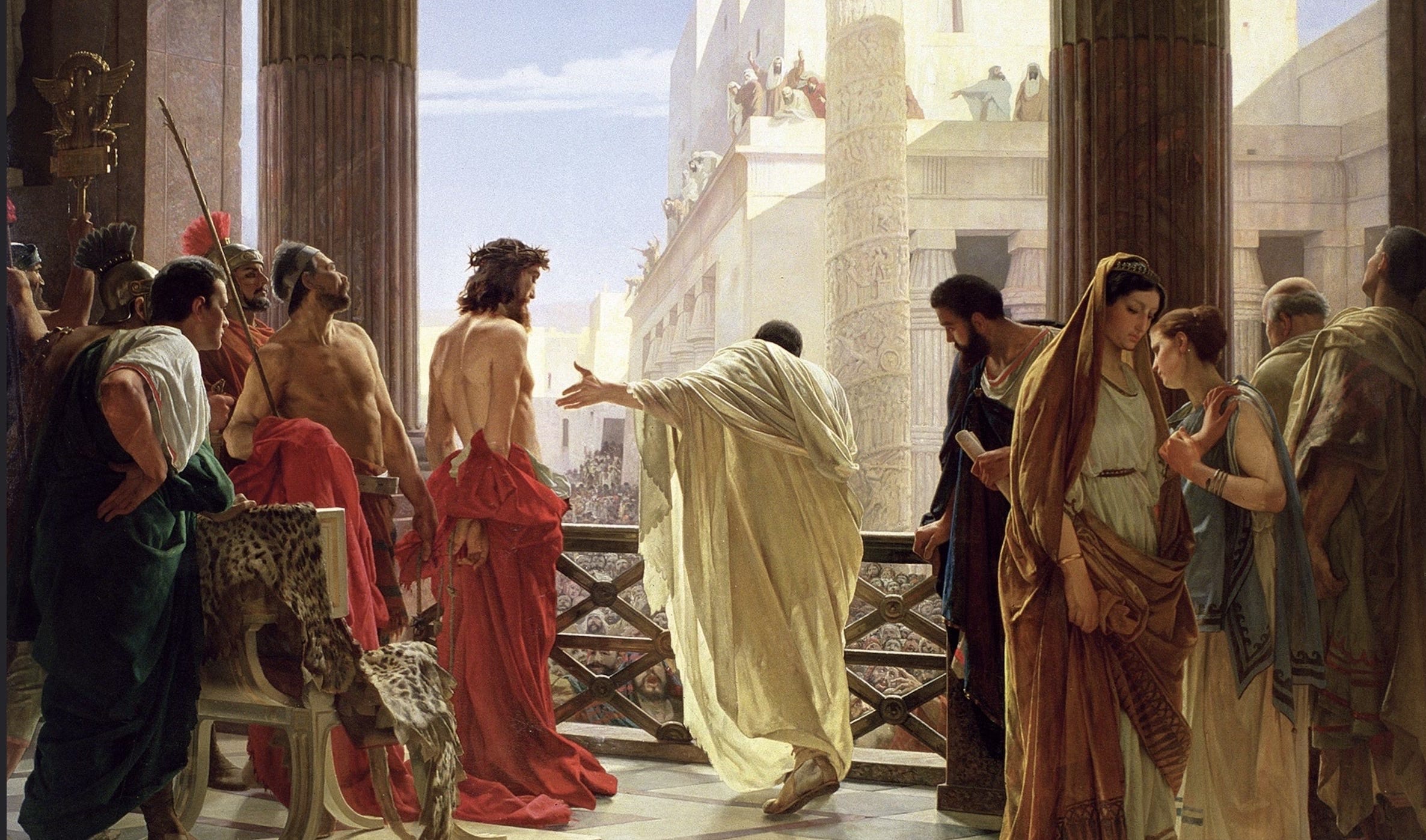
Christian nationalism shrinks Christ from one of world history’s most potent sources of moral transformation into a convenient ideological apparatus of political control. It thus turns Love into an idol. Christian nationalism is a symptom of unprecedented spiritual disorientation in a society that has rapidly lost confidence in liberal political abstractions, and, in its panic, is reaching for a new sacralization of power. Anti-liberal white Christian men must acquire the religious humility to avoid mistaking their own graven image of a Caesar-God for the infinite Life and loving Creator of all souls. Conflating church and state not only violates the freedoms of non-Christians but destroys Christianity. As if “America first” were an adequate application of loving kenosis.
I quote from Alfred North Whitehead’s Final Interpretation of God and the World in Process and Reality (1929), p. 342-343:
The notion of God as the ‘unmoved mover’ is derived from Aristotle, at least so far as Western thought is concerned. The notion of God as ‘eminently real’ is a favourite doctrine of Christian theology. The combination of the two into the doctrine of an aboriginal, eminently real, transcendent creator, at whose fiat the world came into being, and whose imposed will it obeys, is the fallacy which has infused tragedy into the histories of Christianity and of Mahometanism.When the Western world accepted Christianity, Caesar conquered; and the received text of Western theology was edited by his lawyers. … The brief Galilean vision of humility flickered throughout the ages, uncertainly. In the official formulation of the religion it has assumed the trivial form of the mere attribution to the Jews that they cherished a misconception about their Messiah. But the deeper idolatry, of the fashioning of God in the image of the Egyptian, Persian, and Roman imperial rulers, was retained. The Church gave unto God the attributes which belonged exclusively to Caesar.
In the great formative period of theistic philosophy, which ended with the rise of Mahometanism, after a continuance coeval with civilization, three strains of thought emerge which, amid many variations in detail, respectively fashion God in the image of an imperial ruler, God in the image of a personification of moral energy, God in the image of an ultimate philosophical principle. Hume’s Dialogues criticize unanswerably these modes of explaining the system of the world.
The three schools of thought can be associated respectively with the divine Caesars, the Hebrew prophets, and Aristotle. But Aristotle was antedated by Indian, and Buddhistic, thought; the Hebrew prophets can be paralleled in traces of earlier thought; Mahometanism and the divine Caesars merely represent the most natural, obvious, idolatrous theistic symbolism, at all epochs and places.
The history of theistic philosophy exhibits various stages of combination of these three diverse ways of entertaining the problem. There is, however, in the Galilean origin of Christianity yet another suggestion which does not fit very well with any of the three main strands of thought. It does not emphasize the ruling Caesar, or the ruthless moralist, or the unmoved mover. It dwells upon the tender elements in the world, which slowly and in quietness operate by love; and it finds purpose in the present immediacy of a kingdom not of this world. Love neither rules, nor is it unmoved; also it is a little oblivious as to morals. It does not look to the future; for it finds its own reward in the immediate present.
Webbon’s first interview with Fuentes felt like an attempt to re-align American Catholics and Protestants for a renewed Christo-fascist final battle against disenchanted secular materialist relativism. If there is a future for free democratic life in this country, it will not be secured by repressing difference into dogmatic religious uniformity, nor by retreating into a liberalism so thin that it forgets the sacred ground of its own commitment to rights.
The choice we face is between a politics that treats persons, including the Earth itself, as irreducible centers of value that command respect, and a politics that seeks to fix order through state violence and cultural domination.
Our predicament is larger than a culture war. It is ontological. The presently unfolding eco-social mutation is not another technical problem to be solved by better policy. It is an apocalyptic revelation of what our consciousness has become, of how we have learned to attend, what we have learned to value, whom we have learned to exclude.

 Footnotes2Plato
What do you think?