
We finished our Hartmut Rosa reading group this morning (recordings are available here). I am grateful for Tripp Fuller’s invitation to study this text. It was my first time reading Rosa, and I found his sociological intervention convergent with many of my own ways of thinking. As I’ll relate below, Tripp and I had no trouble finding connections to Whitehead’s cosmology.
Some of the essays we read in Rosa’s collection, Time and World, were published over two decades ago. All were written before the Covid-19 pandemic. So it is no surprise that some of what Rosa says about capitalism already feels a bit dated. Even if this is true, that his examples could become dated so quickly only proves his point: modern societies are accelerating exponentially. Rosa (like Marx) talks about capitalism undermining its own conditions of possibility. But capitalism is mutating not because workers suddenly gained class consciousness and seized the means of production, but because working as such is becoming less and less meaningful, offering a shrinking sense even of identity and little promise of material or spiritual improvement for oneself or one’s progeny. The proletariat have become the precariat. When Max Weber analyzed the Protestant work ethic and the spirit of capitalism, there was still a sense however fraught that workers could be granted identities that afforded meaningful participation in a shared project to build the future, some believable promise of a better world for their kids.
That sort of “American dream” has by now gone up in smoke. The industrial capitalist liberal political order no longer exists. We are already well into what Yanis Varoufakis calls techno-feudalism, where the power of media platforms and AI surveillance systems shape life in ways that make the old moral drama of worker versus capitalist feel quaint in comparison. Things are moving fast, faster than our moral, social, and spiritual vocabularies can metabolize them.
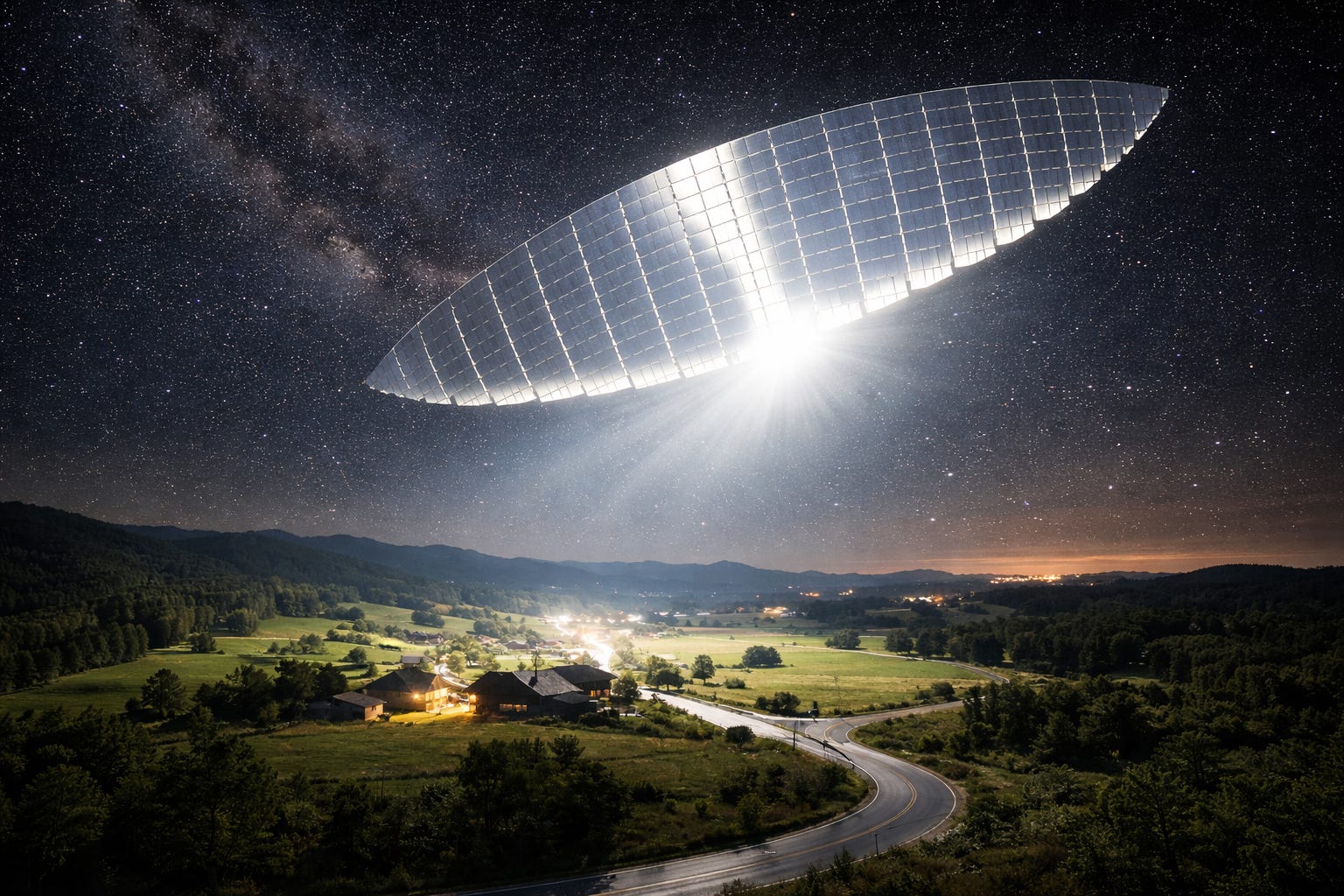
A frighteningly topical example crossed my feed this morning: a Washington Postenvironment section piece with the ominous title “Good night, stars: We are on the cusp of turning darkness into day.” It really brings home the urgency of the questions Rosa is trying to get us to confront. The article describes fast-tracked FCC applications tied to SpaceX and another company called Reflect Orbital. The proposal is to put large mirrored satellites into orbit to reflect sunlight back to Earth to extend day into night, bathing cities in light to power solar panels 24/7, increase productivity, provide heating, etc. Today’s Lords of Tech are literally planning to stop the Sun in its tracks to prevent the day from dying. I guess the fantasy is that if it’s day all the time, and if our minds are akin to LLMs anyway, why not just find a way to dispense with sleep? Who needs rhythm? (Hint: “Life is rhythm.” -Whitehead). Why not delete one more boundary of creatureliness in an attempt to harness the wheels of time itself?

Little forethought appears to have been given to the spiritual and psychological consequences of losing the night sky. One of the most reliable sources of resonance I know of—if it isn’t cloudy and I’m outside the city—is the night sky. It happens almost immediately whenever I look up and see the stars, the moon, the planets, the Milky Way. I am swallowed up in sublime wonder. The night sky is a standing invitation into humility, awe, and a mysterious sense of intimate belonging to the All despite its vastness. Those of us who live amid light pollution already experience a kind of deprivation, an occlusion of an essential human experience (though maybe other creatures also on occasion find themselves starring at the stars!).
I remember an interview with Marshall McLuhan from the early 1970s. Sputnik had gone up in 1957. By the early 70s many satellites were already whizzing around overhead. McLuhan was asked something like, “What’s happening to our experience of nature?” and he answered, “There is no more nature.” As soon as satellites began to be launched into orbit, nature was replaced by art. The whole Earth, he suggested, had now been enclosed within technology. When there were only a handful of satellites, that sounded like hyperbole. Today it is a grim reality.
“Perhaps the largest conceivable revolution in information occurred on October 17, 1957, when Sputnik created a new environment for the planet. For the first time, the natural world was completely enclosed in a man-made container. At the moment that the earth went inside this new artifact, Nature ended and Ecology was born. ‘Ecological’ thinking became inevitable as soon as the planet moved up into the status of a work of art.”
-Marshall McLuhan, 1973.
Where can we turn for resonance in such a situation, if even the difference between day and night is being canceled?
Rosa distinguishes his broader concept of resonance from the Hegelian concept of recognition. Hegel’s theme of mutual recognition in the social sphere (ie, struggles for dignity, rights, equality, justice) naturally calls up activist struggles against entrenched institutional power. Recognition can be fought for. It can be demanded, legislated.
But, according to Rosa, there can be no “resonance activists.” That would be to adopt an instrumental stance toward resonance, as if it were subject to commodification or proceduralization. Rosa seems to believe that resonance requires a vulnerability that is structurally different from the posture adopted in political struggle. We absolutely must fight for recognition wherever it is denied; and yet that battle easily forms into habits of shielding, hardening, and narrowing—all contributing to undermining the conditions of resonance. And yet, as a group member who lives in Minneapolis shared, sometimes activism seeking recognition (in this case for the humanity of immigrants and activists themselves) can itself become a form of horizontal resonance.
Still, I see Rosa’s point. We need recognition, and we often need to fight for it. But we also need resonance, and we cannot force it. How, then, do we cultivate the conditions for resonance without turning it into yet another domination project?
Rosa’s answer is partly methodological and disciplinary. He calls for a new kind of sociology, a critical but also normative social theory capable of identifying the conditions that make eusocial, eudaemonic forms of resonance more likely, without pretending to manufacture resonance directly. It’s an ambitious proposal. But beyond becoming a new kind of sociologist, how do we move the project forward culturally, politically, spiritually?
One of Rosa’s most helpful clarifications in the final chapter is his insistence that alienation is, in some sense, a developmental achievement. We should not romanticize resonance as though the goal is to dissolve into it forever. That’s no better than the techno-lords trying to wipe away the horizon to prolong the day. We need the ability to withdraw, abstract, objectify—to do science, to build institutions, to become free, loving selves capable of individuation and communal reasoning. Rosa is not an anti-modern reactionary. It’s a both-and move: maintain what has been won, especially in the sphere of recognition (individual rights, mutual respect, pluralism), while recovering what has been lost (the felt, responsive, meaningful bond between psyche and cosmos).
…
Rosa refers to feelings a lot. Whitehead developed a metaphysical sense of “feeling” that goes far beyond the usual private psychological meaning. He called it “prehension” (Read my essay “Whitehead’s Radical Notion of Prehension“). When we say, in everyday modern speech, “facts don’t care about your feelings,” we are already operating inside a metaphysics that severs fact from value, actuality from experience. But in Whitehead’s ontology, what is a fact? A fact is a “drop of experience” realizing value for itself, ie, some measure of self-enjoyment. Every fact is a concrescence: the growing together of feelings into a subjective perspective, itself achieving a kind of objective immortality as it transitions into data for subsequently concrescing subjectivities. When Rosa talks about feeling, it often remains at the psychological level. Every time he mentions it I find myself wishing he’d bring Whitehead into the conversation. Then we might expand beyond the private interiority of the self into resonance with the cosmos at large.
It’s a picture perfect snapshot of the problem Rosa is diagnosing: an accelerating, post-capitalist, techno-feudal political economy whirling us into proposals whose narrow instrumental, utilitarian rationality is treated as self-justifying, while the deeper questions—What kind of beings are we? What rhythms does a soul require to remain sane? What are our lives on this planet for?—are either illegible or, if noticed at all, dismissed as delusional.
“There’s nothing out there, or even in here,” as Douglas Rushkoff put it recently. But even the Team Human champion Rushkoff retreated at one point, in his recollections of meeting Richard Dawkins at Epstein parties, to the admission that these deeper possibilities of human life may indeed be just delusions:

“That inner sense is spiritual. It’s moral. It’s a delusion even. But it’s one we depend on not to sink into sociopathic behavior.” (21:54)
Rushkoff wrote about why his name appears in the Epstein files—mostly, he says, because of email chains started by a literary agent where Rushkoff was CC’d along with Epstein and dozens of other important intellectuals, where they were asked to comment on current events. Rushkoff recounts attending a few Epstein-funded parties in the 1990s where major voices were present—Richard Dawkins among them, and Naomi Wolf, as well. Rushkoff describes arguing with Dawkins about his selfish gene theory, insisting there is more to human agency than what was determined by the drive for genetic propagation. Dawkins dismissed him as naïve, idealistic. He was laughed into submission by Dawkins’ materialist crew.
Then, at a subsequent party, Rushkoff received a plus-one. In those kind of social environments, a plus-one isn’t just a nice gesture, it’s a status test. You’re being entrusted to curate the room. He brought his lesbian intellectual friend, a scrappy writer hungry and eager to challenge Dawkins. Rushkoff’s editor pulled him aside and said, essentially: What are you doing? Look around. You’re supposed to come with a hot girl!He reflected on the way that the objectifying mentality is not only about objectifying nature but also about objectifying women.
Rushkoff then shifts into a more vulnerable mode, admitting how as a young man breaking into that high profile scene, he began to doubt himself. Maybe Dawkins was right. Maybe evolutionary psychology is true. Maybe the only game in town is gene propagation and memetic competition. Maybe his resistance was just romantic fantasy.
This is exactly the kind of modern spiritual dilemma described by Charles Taylor in A Secular Age. In that book he describes a new condition in which belief in God is no longer an atmosphere, no longer taken for granted, but becomes a contestable, expendable belief, discarded under the weight not only of scientific reductionism and economic rationality, but of the multiplication of alternative forms of (mis)enchantment. Even if you are still a person of faith, you are now forced to live with the sense that alternatives are plausible. Doubt seeps in everywhere. What Taylor calls the “immanent frame” presses in on us, suffocating us even as it defines an ever-expanding list of lifestyle options and identities.
Taylor’s central intervention in A Secular Age is to contest the triumphalist “subtraction story” often told by scientific naturalists: the myth that religion faded simply because science advanced and we no longer needed superstitious explanations. Taylor argues that modernity was not primarily a matter of installing a cognitive upgrade, ie, adopting a better, more secular, more empirically tested and rationally coherent set of ideas. Modernity was primarily a moral and even ontological and not merely an epistemological transformation, a shift in our inner and outer senses of the cosmos’ and of our own life’s possibilities. Modernity widened the field of options and made nihilism not only thinkable but livable, at least for a time, until the alienation grew too severe to medicate. Instead of disenchantment being a simple loss of myth and magic replaced by sober scientific truth, Taylor suggests something like misenchantment, or the emergence of surrogate enchantments like money, technology, celebrity, the endless allurements of the attention economy… It is not so much that magic and myth have receded in our hypermodern world, but that they have become even more confusingly reified and literalized in the form of fetishized screens, AI psychosis, transhumanist immortality cults, and resurgent nationalist ideologies, to name a few examples.
Taylor’s account of this transformation is not merely another “history of ideas,” as if moderns just swapped out bad ancient and medieval theories for better ones. Taylor is offering a story of the evolution of consciousness, a deeper shift in the structure of perception itself, the whole Gestalt of the self-world relation, the roots of our relation to reality before we begin to reflect. Around 1500, a cultural shift began whereby the human being comes increasingly to experience itself as a private subject set over against an objectified, dead, and predictable world. Participatory resonance diminishes, but something new is gained: a capacity for freedom, for individuation, for reflective distance. The evolution of consciousness is always loss and gain together, never simple progress.
Taylor’s organic view of language is one of the richest points of connection to Whitehead. The common-sense modern picture, especially among scientific materialists, is that language is an instrument used by isolated rational subjects to name things, control things, and communicate information to other subjects. Taylor aruges that this is a deep distortion and misunderstanding of the constitutive role of language in human life. Drawing on Herder, Humboldt, Hamann, and the romantic expressivist tradition, he argues that the self-world relation is itself shaped by linguistic expression. Language alters perception, alters our sense of self and world. We do not begin as language-using subjects describing objects but become subjects and create objects only by learning language. The ways we speak shape the ways we think and experience.
Whitehead’s little book Symbolism contains a revolutionary theory of perception that challenges the uprooted epistemology of all modern philosophy, rationalist, empiricist, and critical alike. Whitehead shows how Descartes as well as Hume and Kant agree that our access to nature comes through the five senses alone. Whitehead calls that “perception in the mode of presentational immediacy.” Beneath that, he insists, is another mode that modern philosophers have entirely neglected: “perception in the mode of causal efficacy.” This is where his expansive conception of feeling or prehension becomes metaphysically significant. The energetic occurrences of the world are continually flowing into us; we imbibe the world-vibration. The human subject does not pre-exist but emerges out of this nexus of environing feelings, moment by moment.
It follows that meaning is not something we project onto an otherwise meaningless world. The meaning of the world comes into us, and then we interpret it in different ways. There’s a beautiful moment in Symbolism where Whitehead talks about poets. For most of us, the word “tree” symbolizes the real trees out in the forest. But for the poet, who goes walking in the woods to find new lines, the trees symbolize the words. The direction reverses. The world becomes meaningful first, and language becomes a way of mimicking that meaning, not imposing it. Trees can function as symbols just as much as the word “tree.”
When I was first studying philosophy and mysticism, I tended to think language got in the way of experience. The obligation to speak in sentences felt like a prison sentence. Over time I discovered an alternative relation to words, relating to language no long as a limit but as strings on a wind-harp. Language can be our way of listening to the world and singing with it. We’re not describing and controlling reality by pinning labels on it. Nature’s meanings celebrate themselves in our expressions.
…
“How does it feel to be on your own, no direction home, a complete unknown, like a rolling stone?” Dylan wasn’t thinking of Whitehead when he wrote those lyrics. But Whitehead lets us ask the question cosmologically: how does it feel to be a stone rolling down a hill? What if gravitation is not only something a physicist calculates to hurl satellites into orbit but also the most universal gradient of feeling we have yet discovered?
Rosa and Taylor would enjoy, I think, a strong dose of Whitehead. Their project is not only social and historical. It is already cosmological. The conditions for resonance are not merely institutional or psychological. They are metaphysical, spiritual, even.
When words are reduced to private propaganda and LLM cliché, when life is deemed determined by fitness landscapes, and the night sky itself is threatened with erasure, we are forced into a most important inquiry: at this urgent juncture in human and geological history, what kinds of practices, arts, rituals, communities, and philosophies might help us remain vulnerable enough to still be touched by the wildness of the world while also preserving the hard-won achievements of individual freedom and mutual recognition? That is the question I find myself tending today.
 Footnotes2Plato
What do you think?