
I don’t think the copyright gods would frown on me reposting the late Bill Thompson’s blog reply to me June 11, 2013. It is available here on the Way Back Machine. He was responding to a philosophical memoir about my encounter with evil in Israel that I’d titled “Thinking the Holocaust With Schelling.”
THOUGHTS ON EVIL, June 11, 2013
By William Irwin Thompson
Dear Matt, [Matthew Segall, Doctoral Candidate at the California Institute of Integral Studies in San Francisco] That was a good essay on Evil posted on your BLOG, Footnotes 2 Plato (https://footnotes2plato.com/2013/06/13/thinking-the-holocaust-with-schelling/), if I may be paradoxical about such a serious issue.
I make a similar point, but, of course, like the blade of grass at your feet you mention, also take a different tack into the resisting wind. See MY 1976, EVIL AND WORLD ORDER, p.83 f., and then again in my novel, ISLANDS OUT OF TIME, 1985. I see now why you wanted to go to CIIS when I hoped you could get a fellowship to the University of Chicago. The new CIIS seems to have worked out very well for you.
Ever since the hominization of the primates, the survival of the group has been based on identity, and identity-formation was based on the creation of an “other” in which “we” could be figured against a “them.” So chimps and elephants can empathize with a fellow member of their group and seek to console them. To enhance group solidarity chimp males will go on hunting trips in groups where they will seek out an Other in the form of Colobus monkeys. When these monkeys scream as the chimps dismember them and eat them alive the chimps do not empathize with the monkeys but rather most probably feel the companionship and solidarity with their group that will be needed in the future to defend themselves against enemies. This is the Bruderbund, the famous comradeship of the men in the German Wehrmacht, or even in the JDF persecuting the Palestinians. In order for these normal German or Israeli soldiers to do evil they must be good to one another.
This loyal behavior is the social evil that is part of the identity formation of the binary “Us” and “Them.” But there is a higher and more scary evil that is Metaphysical Evil–the evil not so much of the Wehrmacht but the SS. Just as Hitler was an artist manque’, so the metaphysically evil person is a mystic manque’. He hates God and His ego trip of the Higher Plan in which all is made nice in the end. The metaphysical evil person thrusts each murdered baby in God’s face and says: “Is it worth it if it is based on this?”
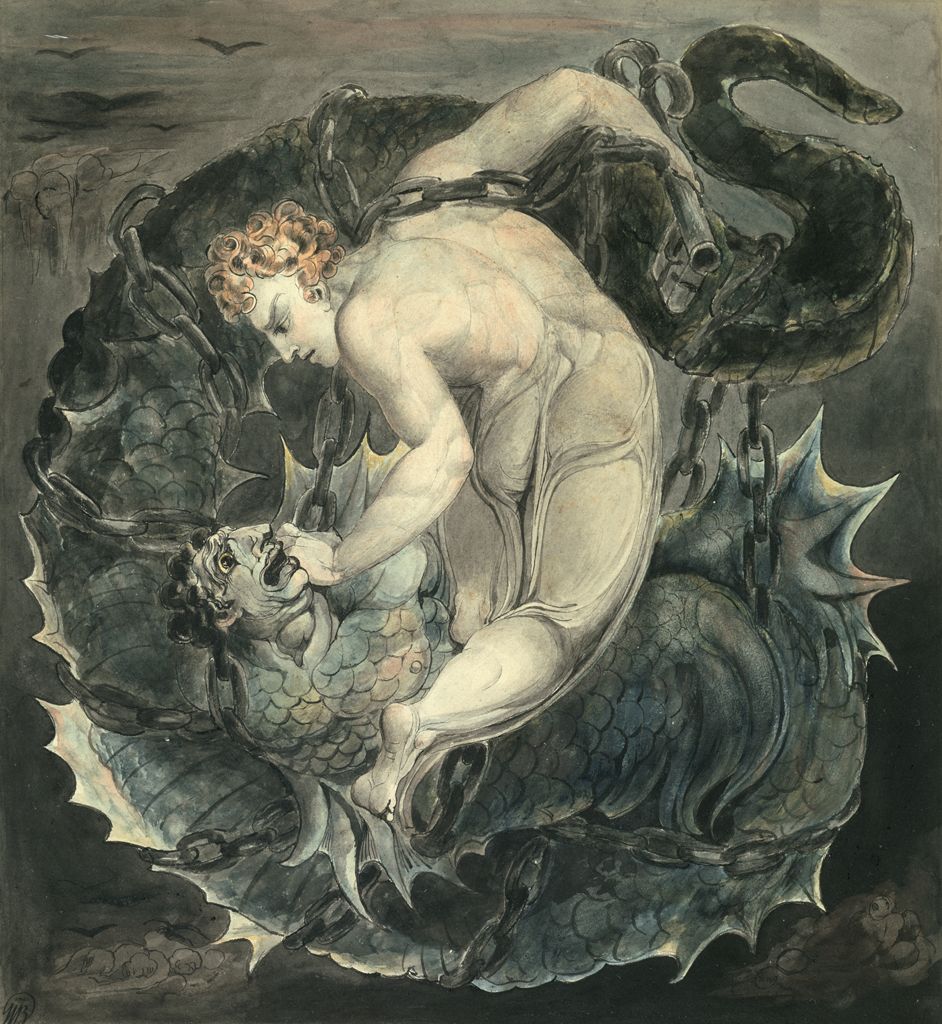
Just as mystics feel an ecstatic union with Godhead in Love, so the mystic manque’ feels the ecstasy of the Hatred of God. Heinrich Himmler reveled in occult and esoteric mysteries that were parodies of the Rosicrucian underground. Evil, of course, requires something to violate, so the “Devil is the Ape of God” and cannot create, for to create would be to fall into the metaphysical sin of Being–of God’s disgusting Existence that is based on suffering. Because the metaphysically evil person is not simply following orders and staying in ranks with his group, he is scary to the ordinary folk who conform to norms, whatever they are. This is why villains so fascinate us, and why evil characters hold our attention. William Blake noticed this paradox when he read Milton’s Paradise Lost: that his Satan was fascinating but his God was a pompous ass and an inflated windbag. Notice in Blake’s image above how St. Michael the Archangel fighting Satan has become a Yin/Yang mandala of the mutual entanglement of Light and Dark.
But Blake’s art can also lead us to a deeper understanding of the cultural phenomenology of myth and art. In telling stories the artist can become a shaman or medium and draw off deeper levels under the more limited surface- consciousness so that in telling one story, he or she is also telling another and larger story. The story of the battle of St. Michael the Archangel with Satan is also the story of the evolution of the solar system recast into a dream narrative. Like all Creation stories, from the Babylonian Semitic Enuma Elish to the Judaic Semitic Genesis, or Hesiod’sTheogeny, the story is not a literal but a figurative and metaphoric rendering of the emergence of our ordered world from chaos. St. Michael is the sun and Satan is the primordial and dark gaseous nebula, and the “war in heaven” is a rendering of the swirling bumper car battles before there emerged a sun, planets, and a Kuiper Belt of planetoids, asteroids, and cosmic car wrecks. Similarly, the story of Eve being taken out of Adam is a story of the moon being taken out of the primordial Earth from the collision of Thea with Earth. When a fundamentalist takes myth literally, he is thinking like a simple-minded superstitious peasant and is completely lacking in an understanding of the shamanic nature of under-consciousness transmissions, story-telling, and art. Blake is a perfect example of the archaic shamanic artist living in the midst of the Industrial Revolution.
Because “We become what we hate,” the tragic wheel spins round and Satan paradoxically becomes Christic and feels our cosmic suffering and takes on a soteric life in Hell to negate God’s ego trip. And in the moral paradoxes of the West Bank settlers, one can imagine a karmic “likely story” in which Nazis reincarnate as JDF soldiers shooting Palestinian teenagers or bulldozing to death protestors. The only way off this metaphysical moebius strip of Samsara, in which the President, the NSA and the CIA violate the Constitution in fighting terrorism and become an infected force for evil themselves, is to get off the wheel of love and hate as identity-formation to ascend into Universal Compassion.


 Footnotes2Plato

Leave a reply to Roy Smith Cancel reply