
Over the weekend, I gave a talk at the Mysteries of Technology Conference: “Etheric Imagination as Participatory Knowing“
Unfortunately, I had to skip a few slides due to time constraints, so I wanted to share those ideas here. Below is something of an addendum to that talk, so a lot of what follows will make more sense if you watch it (or read the transcript) first.
Video transcript:
First, let’s consider William James. I believe he was too quickly dismissed by Rudolf Steiner. Steiner references James and pragmatism in Riddles of Philosophy, a book he held in high regard and edited multiple times. However, I think Steiner misunderstood what James and other pragmatists like Charles Sanders Peirce were really suggesting. I want to show how, in fact, James was more aligned with the spiritual scientific perspective that Steiner advocated than Steiner himself may have realized.
In his lectures, Steiner discusses the various senses and organs of perception that connect us to different elements of nature. He describes how human beings do not only have eyes for light vision and a warmth sense for cosmic warmth, but also lungs, a larynx, and ears that allow us to engage with the airy or gaseous element of nature. Our eyes connect us to the light ether, while our physical bodies are connected to the warmth ether. Through our lungs, larynx, and ears, we participate in the air element, and these organs, according to Steiner, function as a single organ of perception. Together, they enable us to experience sound or tone in a way that is distinct from our perception of light and heat.
When we breathe, our lungs inhale and exhale, and the diaphragm massages our internal organs, causing the pressure in our cerebrospinal fluid to rise and fall with each breath. The brain, which floats in this fluid, moves in rhythm with our breathing. Steiner argues that there is an airy essence to consciousness, intimately tied to the life rhythm of our breathing.
This idea reminds me of William James and his famous closing paragraph from the article “Does Consciousness Exist?”
James writes:
“Let the case be what it may in others, I am as confident as I am of anything that, in myself, the stream of thinking (which I recognize emphatically as a phenomenon) is only a careless name for what, when scrutinized, reveals itself to consist chiefly of the stream of my breathing. The ‘I think’ which Kant said must be able to accompany all my objects, is the ‘I breathe’ which actually does accompany them. There are other internal facts besides breathing…, and these increase the assets of ‘consciousness,’ so far as the latter is subject to immediate perception; but breath, which was ever the original of ‘spirit,’ breath moving outwards, between the glottis and the nostrils, is, I am persuaded, the essence out of which philosophers have constructed the entity known to them as consciousness.”
In this essay, James argues that consciousness does not exist as a thing but rather as a process, a function, a lived-through reality, a thinking activity. This aligns in many ways with what Steiner proposes. As Matthew Barton notes in the foreword of The Philosophy of Freedom, this book is rooted in the German idealist tradition of Fichte, Schelling, Hegel, Goethe, and Schiller. However, one could effectively communicate Steiner’s ideas about freedom, thinking, activity, and intuition by rewriting them in the language of the American pragmatist philosophical tradition, arriving at the same core spiritual insights. This task remains to be done.
Steiner’s understanding of the organs of perception that connect us to the airy element of nature is profound. He suggests that these organs—lungs, larynx, and ears—allow us to float in the airy element, enabling us to distinguish ourselves from the aural, tonal environment. This is because our ears, as musical instruments, play inner music that resonates or dissonates with the outer music, the song of the spheres, thus allowing us to perceive in the airy element by way of this differentiation.
Steiner and James both emphasize that there is no such thing as sensation in general. Eyes and ears inhabit dramatically different worlds. But we are not outside of things looking in through a periscope; rather, as Steiner claims that what you experience in your soul is not a mere effect of vibrations in your brain. All phenomena exist in sympathy with one another and are entangled in various ways. Everything breathes together, as Plotinus put it. Resonance, whether in lyre strings, tuning forks, or attuned brains, is a universal phenomenon.
Steiner delves into the physiology of the inner ear, comparing it morphologically with the physiology of the eye. He reminds us not to remove an organ from its Gestalt. The ear, for example, can only hear external sounds by comparing them with the inner rhythm of our own breathing and the oscillation of cerebrospinal fluid that accompanies it. This differentiation between outer and inner rhythms is also connected with our organ of speech. The larynx is part of our hearing capacity, as hearing and speech are aspects of the same organ of perception.
Steiner states that the will element, which pulses through the larynx, and the more intellectual, sensual element, which passes through the ear, belong together. He also discusses the metamorphosis of each sense organ into the other. He suggests that the eye, externally (the sclera, cornea, muscles), is a metamorphosed larynx, while internally (the vitreous body, retina), it is a metamorphosed ear. Understanding the relationship between vision and hearing, between eyes and ears, requires seeing the ears and larynx as an integrated organ. When we see, we are speaking with ourselves etherically; the eye is talking to itself.
Steiner also explores the connection between conscious and unconscious experiences. He notes that:
“We don’t experience our will phenomena directly; rather we experience what we can imagine of them. We don’t experience the electrical phenomena of nature directly, but what they deliver up into the realm of light, sound, heat, etc. We enter the same lower world when we sleep that we enter in ourselves when we descend from our thinking, conscious life into our will life. Whereas everything that is light, sound, and heat is related to our conscious life, everything that takes place in the realm of electricity and magnetism [and gravity] is related to our unconscious will life.” (LC, p. 153)
Steiner was convinced of the reality of the spiritual world. To acknowledge the existence of individual human beings is already to acknowledge the existence of a spirit world. A human person is a free, conscious being with an active role in the world. From Steiner’s perspective, nothing we learn about matter could ever subtract from our spiritual freedom. However, scientific materialism in the modern period has conjured the idea of inert material substance existing independently of our conscious thinking activity. If we acknowledge the reality of matter, we must also recognize it as an expression of spirit. Matter is only Maya when we think it exists independently of spirit. Viewing nature as a divine script that can be read and interpreted reveals it as an expression of spirit. The physical world becomes an intelligible order that supports us in our struggle to remember our true identity.
Steiner:
“The chief reason that the thinking of 19th century physics became sick is that the inner activity by which people sought to pursue natural phenomena was not agile enough…not yet capable of entering into the facts of the external world itself. We could see color emerge in and under light, but we didn’t rise to receive color into our imagination, into our thinking. It was no longer possible to think colors, and we replaced the colors we couldn’t think with something we could think, something that is merely kinematic—the calculable vibrations of an unknown ether. This ether, however, is tricky, because it doesn’t present itself whenever you seek it… It just wasn’t given to the thinking of the 19th century to penetrate into the phenomena themselves. However, from this moment onward that is exactly what will be so necessary for physics—to go deep into the phenomena themselves with the human imagination” (LC, p. 158-159).
Steiner made these remarks in 1919, right when quantum physics was emerging. He argued that physics needs to develop a “qualitative form of mathematics” and a more “delicate” form of empiricism, as Goethe described, which involves attuning to nature not just as something to be counted and measured but as something to feel sympathy with and know in concert with. The forms growing in the physical world correspond to forms emerging in the mind of the scientist.
Steiner:
“[In 19th century mechanistic physics,] imagination became connected with an external phenomenon in a purely symbolic way, not in a form that suited the object. The kinematic concepts that you fetch up out of the unconscious part of your being are connected in [an arbitrarily symbolic way] to light phenomena. You draw rays of light geometrically. What you are doing in this case has no more validity than what is expressed in dreams when you imagine symbolically such objective facts as the bang of the falling chair [in the room in which you lie sleeping]. This whole way of processing the optical, acoustical, and heat phenomena of the external world by geometric, arithmetic, and motion concepts is in truth a waking dream, albeit a very sober one…What we believe to be an exact science is modern humankind’s dream of nature” (LC, p. 163).
Natural Science has thus far limited itself to the evidence of the brain-bound intellect. The current task is to imaginally descend into the forces of matter and learn to perceive the etheric life animating nature.
In a later lecture in July 1924, titled “Healing Factors for the Social Organism,” Steiner wrote:
“If one is a mature researcher in the present, and if in ordinary life one thinks in denial of the soul-spiritual element, then one thinks with the ordinary physical brain… If one denies the soul-spiritual element, then one really becomes a materialist. Thus, the materialism is right, it is not false! That is the essential thing! One can take things so far, that one does not represent a false view if one stands for materialism but, that one has fallen so far into matter that one really thinks materialistically; therefore the material theories are correct. The most essential character of our time therefore is not that people think incorrectly if they are materialistic, but the most essential characteristic is just that the majority of human beings become materialistic in that they deny the soul-spirit element and think merely with the physical body; they bring forth with the physical body an imitation, a bogus image of the life of soul. In that we fight materialism, we do not have to do with a mere reversal of theory, but rather we have to do with a decision of the will to tear oneself loose from the material, so that we not become merely theoretical materialists, but rather so that we do not sink down into the material-element, so that materialism shall become incorrect. It is correct for our time; it must become incorrect! We must apply our power for this, that materialism became incorrect. Thus this is not dealing with mere reversal of theories, rather this is dealing with inner spiritual deeds which humanity in our time must carry through so as to tear itself loose from materialization.”
Steiner’s use of the term “materialization” should not be misunderstood as a rejection of deeper embodiment, incarnation, or sensuality. On the contrary, Steiner encourages us to inhabit our living organism and recognize the etheric dimension of nature, which organizes physical nature rather than emerging from it. The physical world is an expression of the etheric, just as the etheric is an expression of the astral, and the astral an expression of the spirit or the “I.”
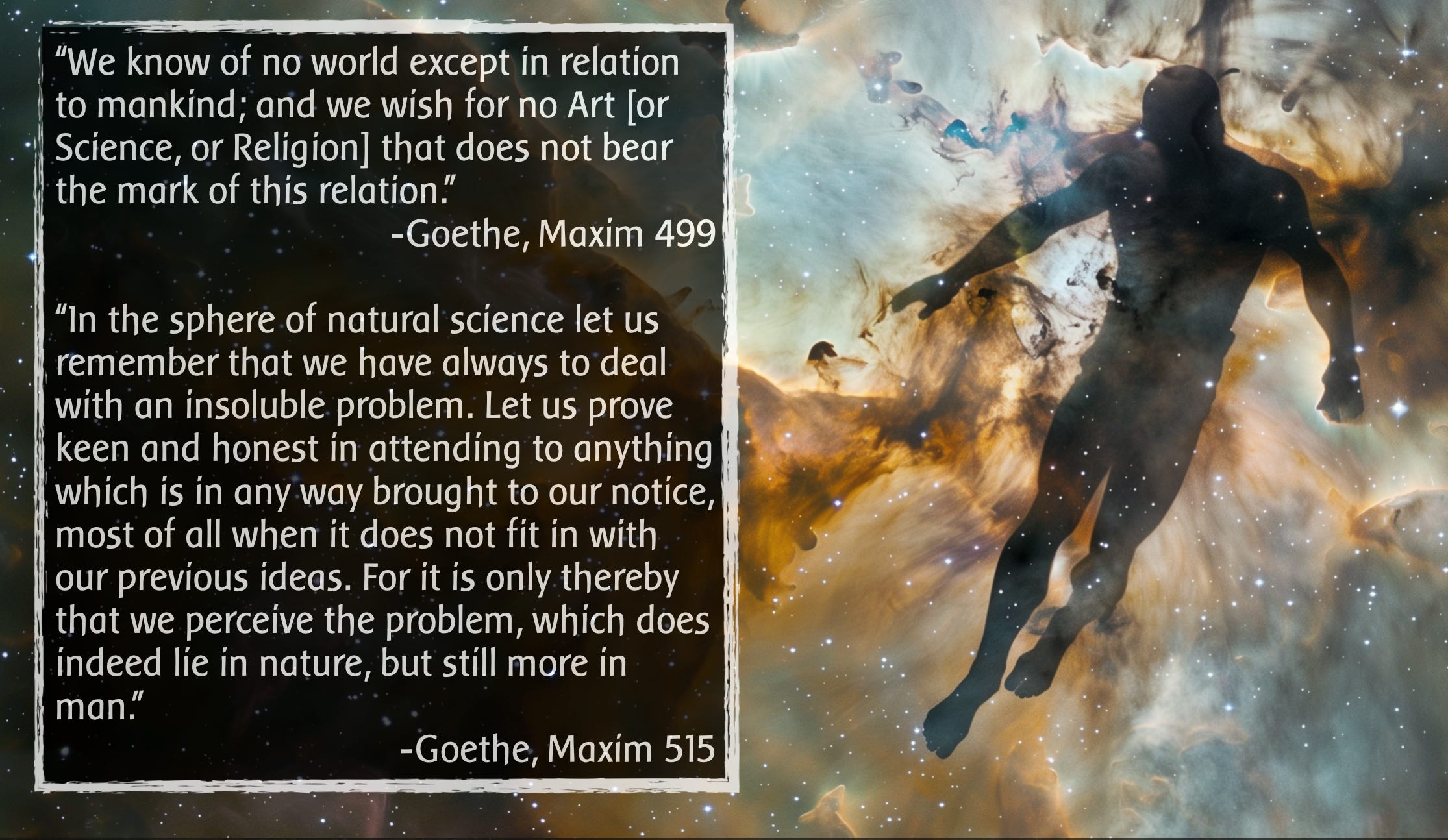
To emphasize the anthropocosmic aspect of this participatory approach to science, let me quote Goethe: “We know of no world except in relation to mankind, to the human being, and we wish for no art, and I add, for no science or religion, that does not bear the mark of this relation.” Goethe also reminds us that “in natural science, we must always deal with an insoluble problem and be keen and honest in attending to anything that challenges our previous ideas. Only by doing so can we perceive the true problem, which lies not just in nature but even more so in ourselves.”
 Footnotes2Plato
What do you think?