
This transcript is an abridged version of Orland and Matt’s conversation. For the full two hours, including dialogue with CIIS students, see the video at the bottom of this post.
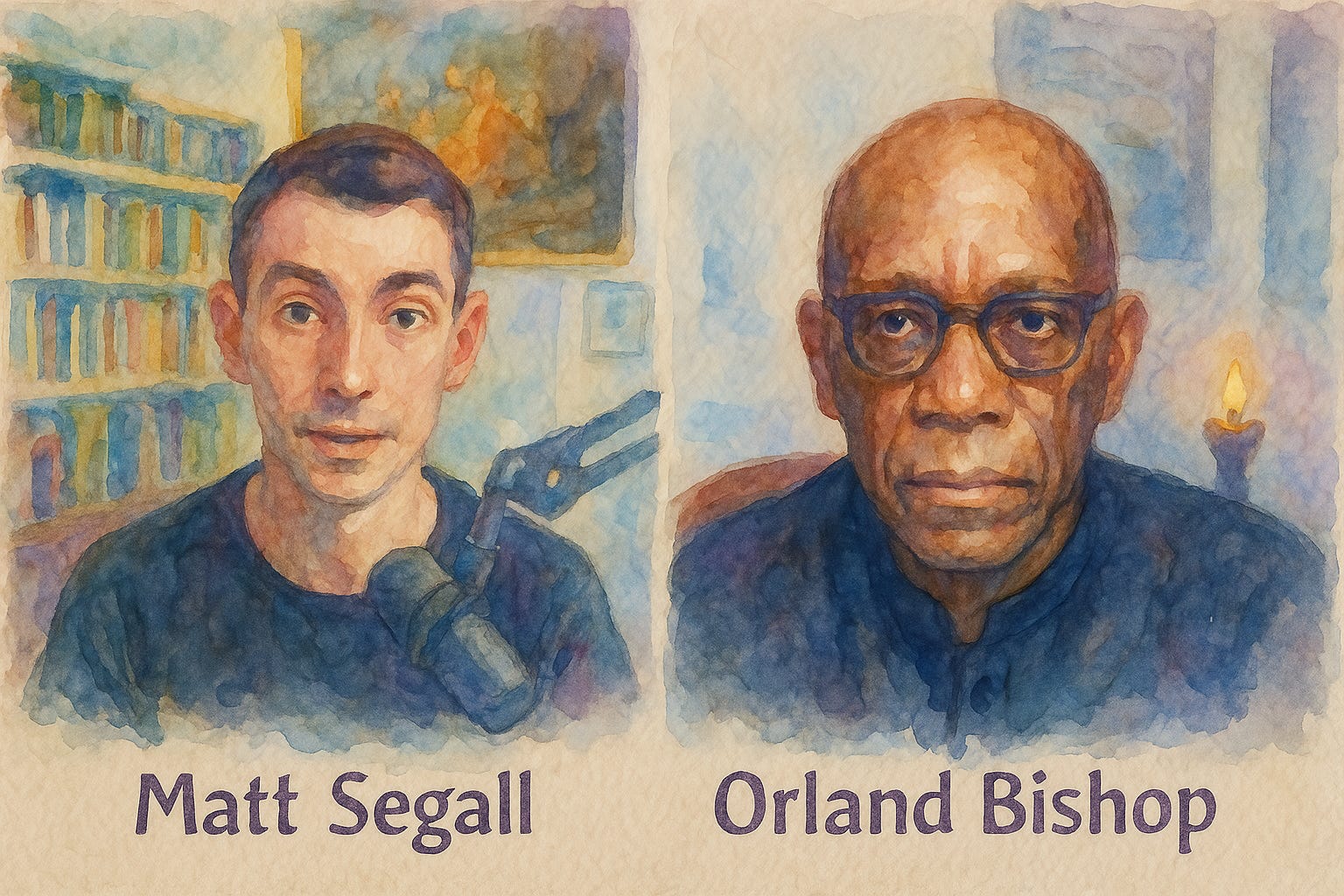
Abridged transcript:
Orland Bishop: Thank you so very much.
Since the inspiration to have this forum and arriving here this evening, so much has unfolded in my own life and work. But this gathering has been building a tremendous amount of inspiration for me, and I’m truly grateful for the invitation to share in this discourse tonight.
To my dear friend Michael—your gift of intention was, for me, the beginning of understanding the deep need to explore the practice we’re holding together: the sacred art of hospitality.
CIIS has been in my life for close to twenty years, through friends who are alumni, and faculty connections as well. So, it’s a meaningful signature that this opportunity to be in dialogue arises through your institution.
Right now, a thunderstorm is passing over where I live in Riverside County, Southern California—in the community of Perris. After many years in Los Angeles, this is the first time I’ve lived outside the city proper, though not outside the elemental forces that draw people here in search of culture and purpose.
This is why I’m here—to be present with what passes through the world from moment to moment, and with the long arc of interest that humanity has carried forward across time.
To choose a theme and choose to be hosts for the creative act—that is something I am deeply grateful for. And I also extend best regards and gratitude to your colleague who couldn’t be here this evening, for making the space for this moment to unfold.
Orland Bishop: So, Michael—sorry, Matt, may we begin?
Matt Segall: Yes, let’s. And funnily enough, my mother also considered naming me Michael, but chose Matthew instead. Maybe you intuited that.
It’s a delight to be here with you in this capacity. I’m up in Oakland, just across the Bay from CIIS. In preparing for this dialogue, I discovered that you were at CIIS back in 2019 to give a talk to the Women’s Spirituality Program during a conference on the nature of money—something I know you’ve reflected on deeply.
Tonight’s title—“Sacred Hospitality and the Dynamics of Initiation: Inspiring Activism Beyond Resentment”—was something we collectively birthed in our planning conversation. I wanted to begin by asking you: what do you mean by initiation?
In your book, The Seventh Shrine: Meditations on the African Spiritual Journey, you write that you’ve come to understand initiation as the soul’s highest prerogative. You connect it with memory and the inheritance of ancestral wisdom, and also with the capacity to imagine the future.
But in our time—on this continent, in this nation, at this historical juncture—it’s hard to even name what time we’re in. Is this modernity? Postmodernity? Hypermodernity?
I think that uncertainty itself reflects a lack of initiation. We don’t know when we are. Many Americans don’t even know where they are, in terms of the history of this land. So, what did initiation mean in earlier times—and what might it mean for us today?
Orland Bishop: Yes, this question of initiation has long been central to my inquiry into the human experience.
Initiation is the most enduring exercise in human social, cultural, and developmental processes. One might say it begins even at conception. The archetypal forces that shape the human form are themselves initiatory—imbuing us with the capacity to receive from the supersensible world and bring that into coherence and, ultimately, into ability—into fulfilled life.
The old phrase “as above, so below” describes the pedagogy of initiation. Something from beyond time—a higher order of reality—seeks to become localized in a receptive intelligence. Nature does this everywhere, giving rise to an ecology in which beings interact and generate a living substance. But the human being is unique.
Our development from conception to birth, and through life’s stages, carries within it a memory—a formative memory that draws human intelligence into becoming. Ancient seers were able to observe this, to see what accompanies a person into existence, and to help that person become more attuned to the forces that shape human life.
Over time, these traditions developed formulas—what we call the mysteries, magic, and eventually, the intellect. The intellect is itself a product of initiation, originally a faculty developed to recognize the supersensible and to bring imagination, inspiration, and intuition into expression.
But as we localized those forces into faculties of cognition, some pathways of initiation were lost. We no longer depend on the higher sources to engage the mysteries. Instead, we developed systems—disciplines—that structured civilization.
Yet the spiritual forces did not cease to stream toward us.
Anyone can re-enter the mysteries. Often, we do so through what we call synchronicity—or what we mistakenly call accident. But the human being is never without this higher calling, this invitation to reunite with the superconscious and to help civilization become a better host for its own source.
That, I would say, is the simple backstory. The complexity is this: the beings interested in our development remain mostly invisible, beyond our lower faculties of perception. We now rely on “knowers”—people with refined disciplines of heart and mind—who support our journey through developmental knowledge, both academic and spiritual, so that we may learn how to apply our creative forces rightly.
Matt Segall: You’ve spoken to the importance of hosting—of hosting ancestral memory, spiritual beings, and higher potentials—and that initiation opens us to this possibility. This connects to the other half of our title: sacred hospitality.
Could you speak to the importance of hospitality in this initiatory process, particularly as it relates to service and activism? In your book, you write that service is the highest initiation of our age. What does it mean to act from a sacred sense of hospitality?
Orland Bishop: Sacred hospitality is not a new practice. It appears in the ancient traditions of many cultures, but it is especially necessary now because of the civilization of the ego.
Our ego-consciousness has pulled away from its original function of co-creation. To return to it requires a discipline—a new ecology of consciousness, one that understands that language, shared understanding, and the very possibility of agreement all live within the ego as a recognition of self and other.
Hospitality is the framework in which two or more individuals can enter a field of mutual cognition—something greater than any one self could perceive alone. That’s how the future is born: through dialogue, through encounters with human and non-human intelligences.
Hospitality invites me to surrender something of my self-interest, so that I may receive something greater. When I only use my faculties for myself, I repeat patterns. And those patterns block the emergence of deeper self-awareness.
True dialogue is not about giving you my understanding. It’s about giving you my trust for understanding. And this trust creates a new field—what I call cognitive feeling—in which your response to my offering becomes part of a shared creative act. That shared creation is what I call truthfulness.
This is not about imposing meaning, but about hosting meaning—inviting it to emerge from between us, not just within us. As Goethe said: what is more precious than gold? Light. And what is more quickening than light? Conversation.
Conversation, hosted at a level of deep trust, can accomplish what has not happened in centuries. It can birth realities that were previously impossible. That’s the power of the Word—the Logos.
Before the world existed, the Word existed. The Word is the coherence-field in which multiple beings can come to mutual understanding. This understanding transcends perception and nurtures a higher cognition—one that elevates the human mind to a plane of intuition, where beings of light can share the radiances that create worlds.
Matt Segall: Orland, you speak from a vision of reality that includes not just our physical forms, but also dimensions of spirit and meaning that are harder to see. At one point in your book, you write that the soul’s task is to evolve the body—and you emphasize how our speech participates in that process. We become what we say.
Most of us are taught that language is merely a tool for communication—I make sounds with my mouth, vibrations travel through the air, maybe now through electronic circuits and radio waves, and they reach your ears as information.
But what you’re describing, in terms of the Word or Logos, is that before we say anything, we’re already immersed in a medium of meaning. Meaning isn’t something we create out of nothing, or out of meaningless matter—meaning made the world. And when we speak, we’re participating in that medium.
Could you speak more to the relationship between the Word as a spiritual reality and our physical, earthly existence? What’s really happening, spiritually, when we engage in conversation that hosts one another—and hosts other-than-human beings, beyond what our physical senses perceive?
Orland Bishop: Yes, Matt—it’s as though the creators of world intelligence knew that we would, in this age, need the Word itself to trace the meaning of our own story. We have become capable of understanding reality only through literal descriptions—language about phenomena.
But we’ve lost the inner cognitive feeling for other states of reality. And yet we can’t be without language for very long. We feel insecure when no one speaks to us.
I’m grateful that there are practices like Vipassana meditation retreats that offer ten days of silence—to help us rediscover other forms of speaking. Because silence is another level of speech. Imagination is another level of speech. Intuition is another level of speech. The question is: who are we in dialogue with?
What is the Word that is streaming through us when we are in the flow of inspiration?
Why do creators do something with inspiration that brings forth new realities in the world? A song, a building, a scientific insight—they all begin with a word. But what’s happening in the body, in the blood, when we’re in silence? When we sleep? Who is speaking to the unconscious then?
This is a fascinating territory, one where most researchers cannot go, because there’s “no one” to talk to—no subject-object relation to measure. But some people have other capacities. They can go into what I call the night forces of human life—the unconscious—and return with creative options.
These are essential skills now, because more and more people are entering states of being where ordinary communication doesn’t work—autism, schizophrenia, dissociation. How do we give meaning in those contexts, where conventional sense-based communication fails?
In ritual contexts in West Africa, Brazil, and other places, we engage mediumship: beings from the other side take hold of the human form and express healing, creative intentions that aren’t accessible through ordinary intelligence.
These are ancient practices—thousands of years old.
In that context, the Word is not just literal. The Word is the will-force of spiritual beings made manifest, crafting perceptible boundaries that help human beings climb out of unconsciousness and into super-conscious creativity.
I’ve experienced this—moving beyond perception to a shared cognitive space, where two or more human beings can agree on something without physical evidence. And that agreement, that trust in shared intuition, becomes real.
That’s the most rewarding part of my work: to cognize realities in sleep, and then offer options to people who seem trapped—those in prison, for example—who can still, through other faculties, achieve greater work than those of us “free” in the world.
Matt Segall: (holding up his cat) This is Philo. He’s decided to join us.
You spoke about how the Word continues even in silence. And earlier, you emphasized trust—that for knowledge to emerge between us, we must trust one another.
But right now, it seems like trust is fraying, especially in societies that consider themselves democracies. People don’t know how to trust, or even that they should trust. And so, perhaps unknowingly, they’re trying to live without initiation.
Could you speak to the consequences of this? What happens to a society that doesn’t value initiation? And what should those committed to social change and activism understand about this situation?
Orland Bishop: Yes… In initiatory systems, particularly those rooted in elemental theory—alchemy, for example—transformation occurs through becoming the other. Earth becomes air, air becomes fire, fire becomes water. These are not just substances but also qualities of divinity, attributes of archetypal beings that shape both ecologies and consciousness.
These elemental beings aren’t only forces of nature—they influence our psychology, our physiology, and our shared mythologies. All of our organs, all of our meridians, express these forces. In Chinese medicine, for instance, the meridian system maps electromagnetic intelligences—chi—that can either be constricted by our habits or expanded by spiritual exercise.
Trust is one such intelligence. Trust is the ability to give our uncertainty a chance to become certainty. It lets us step out of the predictable cycle of repetition and enter time. Trust is what allows us to begin.
It’s the beginning of movement into the unknown.
In many traditional cosmologies, people could name which beings you were invoking by your actions. “As above, so below.” You are a microcosm of the macrocosm. In that view, everything is initiation.
Even modernity is an initiatory process—we just don’t know who is initiating us anymore. We’ve lost sight of the beings behind the forces we’re dealing with. Instead of engaging with those spiritual dynamics, we project our experience onto other people—blame them, isolate them, exile them.
But this is just a shift of projection—from gods to people. And that’s not wrong, necessarily. Human beings do bear responsibility. But the deeper question is: what influences have we become subject to? What forces shape our antagonisms?
Modern therapies now do what the ancient initiatory sciences once did: they help us uncover what causes disturbances in our consciousness. But they’ve inverted the process. Instead of using myth to understand the gods behind our experiences, they use psychology to trace the trauma that occurred when we lacked capacity to overcome something.
We’re just beginning to recognize that trauma is a time being. It doesn’t only live in the body—it lives in a moment when we could not respond adequately. And now we must recover not only from the trauma, but also from the loss of our preparatory rituals—our initiatory readiness.
So now, instead of asking what we should prepare for, we are only responding to what we failed to prepare for. But it’s the same exercise: Can we go into the known and find the unknown? Or go into the unknown and find what is known? Either way, it’s about finding the human being in the process.
This is especially relevant for activism.
I spent many years helping rivals—gang members, often literal enemies—enter dialogue. They thought their shared interest was the annihilation of each other. That was the story they inherited.
But I invited them to imagine the future—20 years ahead. What did they see?
Even if they didn’t yet have the courage to include their enemy in that imagined future, they described the same vision.A community with safety, with possibility, with meaning.
So I told them: if you want to guarantee that your future becomes real, you have to include your enemy in it. When they did, the energy shifted. The future became more practical, more vibrant.
Because here’s the risk: if you imagine a future without your enemy in it, you might be imagining a future that can never happen.
So this is the invitation: can we include our fears in the future? Can we include the unknown, and ask ourselves what capacities we need to cultivate—not just to survive, but to transform?
That’s what sacred activism is. Not just resisting something. But hosting realities that awaken us to our true task: to become the kind of person through whom a different world can emerge.
We are not simply living in the world—we are hosting it. The world is not something given. The world is a shared understanding, a structure of mutual interest.
And if we can perceive new interests in one another, we can host a new world.
Matt Segall: Thank you, Orland.
You’ve just expressed something very difficult and essential—something that, to me, resonates deeply with the meaning of Jesus’ words: “Love your enemies.”
It is also just the law of karma.
As Martin Luther King, Jr. put it: “I cannot be who I am meant to be until you are who you are meant to be—and you cannot be who you are meant to be until I am who I am meant to be.”
So we’re not talking about blame. We’re talking about the shared nature of our becoming.
Can you speak more about the adversary—the role of adversarial powers, human or not—in this process of human evolution? And perhaps share your understanding of the nature of evil, and how those working for change might meet it?
Orland Bishop: Yes… it’s difficult to speak of evil with clarity, because what it was for humanity is not necessarily what it is now.
Historically, evil was a source of inspiration—not in a sentimental sense, but in the deepest, most paradoxical sense. It was a provocation to knowledge.
To know something, I must be separated from it. This is the essence of what we’ve come to call knowledge: a distinction from source, from beginning. In the Gospel of John, “In the beginning was the Word”—this is not the beginning itself, but rather the evidence of beginning. The Word is what allows us to perceive that a beginning has occurred.
But the beginning itself? That is beyond language.
If you were truly in beginning, there would be no need for speech. No need even for a body. We would dissolve ourselves back into the pure presence of origin.
So the condition of knowing that I can begin requires freedom—a kind of inner distinction that allows me to stand apart from source long enough to recognize it again.
And one of the essential freedoms for our time is freedom from resentment.
Resentment says: “I shouldn’t feel persecuted.” But persecution is part of separation. Every intelligence separated from its source feels the wound. Every child pulled from the mother feels it.
These adversarial experiences—the pain, the exile—they do not exist simply to stop us. They exist to provokesomething in us. Evil, in that sense, is not simply the absence of good. It is the pressure that compels the human being to choose beauty, to risk love, to trust again.
In this way, evil is part of the pedagogical drama of becoming.
In the nature of the Logos, we are always standing on both sides of the abyss. We are in the beginning, and we are in the loss—simultaneously.
And we are in dialogue with the forces that allow us to bridge that gap. Until, as you said, all numbers become one.
Today, we think of ten as a greater number than one. But one is still the highest number. Why? Because it contains the maturity of all the steps. It is the return, the gathering in of multiplicity.
So evil, as it has been understood in ancient cosmologies, is not just a force to fear—it’s a condition to understand. In different traditions, it’s categorized in such a way that initiates can learn how to progressthrough it.
Because here is the mystery: when someone has embodied evil—and then someone loves them—their own moral intuition can reawaken. We call this conscience.
Why? Because even evil wants to be known. It is estranged from beginning, and without the human being, it has no way to return.
These are initiatory dramatizations. They’re not abstract ideas. They are real processes by which spiritual forces take on form in human life.
To move from beginning into existence, and then to return through conscious freedom, requires steps. Evolutionary steps. Spiritual steps.
Why do our neurotransmitters allow behaviors we would call “evil”? Because the processes already exist within us, waiting to be transformed—waiting for conscience to awaken.
And still, as humans, we haven’t yet exhausted the possibilities. We haven’t truly encountered the extremity of evil—not in the full sense. We’ve only tasted fragments.
We are still learning from it. Still being initiated by it. Even Scripture, as profound as it is, hasn’t fully penetrated this reality. And yet we are given the task to make sense of it.
And for me, I remain hopeful.
Because the stem cells in our blood are beyond the reach of evil. They are not merely biological—they are spiritual. Our blood is not just inside our bodies. It reaches into beginning. It holds our ancestors, the intelligence of nature, and the creative intention of the cosmos.
But it needs the right Word to organize it.
Evil cannot reach the place where blood begins. Only we can open that door—from the inside. We are the gatekeepers of our humanity. Only we can let in what blocks us. And only we can release it.
So when we face our global crises, our task is to become seers—not just of events, but of the capacities required to meet those events.
We must go into our philosophical traditions, yes—but even more, into our mythological ones.
Because the deeper question is: Who is betting on us to win or lose?What intelligences, what beings, are invested in whether we acquire the knowledge of love? The knowledge of light? The knowledge of life beyond material form?
These are the stakes. And they are the stakes of every war—every struggle—on this Earth. Will we host the light of the divine beings moving through our blood? Or will we deny them?
That is the initiatory choice before us.
Matt Segall: Thank you, Orland.
I’d like to open it up now to others here in the circle—but before I do, I just want to reflect briefly on something you said earlier. In your book, you tell a story about being a boy given the assignment to observe a seed in a jar. Day after day, you watched it—saw how the water evaporated, how the light touched it, how the seed began to grow.
And in that process, you came to understand time—not just as a linear sequence, but as a form of presence, the presence of wholeness. You saw how eternity is always intersecting with time. Always available.
While history may be full of trauma, tragedy, even evil—the eternal is always here. Beginning is always accessible. That gives us the possibility, the trust, that things can change. That the future can be different.
If we decide—together—to make it so.
Orland Bishop: Yes, Matt… The past and the future are both wrapped up in our memory.
And not just our memory, but also our ancestral memory. The physical body carries the imprint of fourteen generations. That’s fourteen personalities in dialogue—inside us—negotiating what our primary substance of genetics might become.
Will I live more like my ancestors? Or is there another future trying to be born through me—one that even they could not foresee?
Modern science—quantum biology, epigenetics—is beginning to glimpse this. The potential for human uniqueness is so profound that one individual could become a species unto themselves. One person, sufficiently developed, could host a new level of discernment on behalf of humanity.
We are more than our inheritance. We are etheric, astral, spiritual beings. And those dimensions operate according to laws distinct from the physical body. They’re not bound by genetics.
So the question becomes: Who am I becoming when I sleep? And when I wake, who returns?
And if it’s not through sleep, what other waking practices can I enter—rituals, meditations, acts of sacred attention—that allow me to dialogue with my ancestors differently? So they may no longer possess me, but inspire me.
If I can host them in a new way, their concepts may not control me—but rather catalyze my freedom.
And if they vacate that inner space—if I release them from the body’s organs and patterns—who or what takes their place?
We must understand our ancestors before we can truly understand the divinities. The divine does not override our inheritance. The divine waits for us to become responsible for it.
The gods don’t intervene in our history—they inspire our capacity to ascend through transformational fields of intelligence. They ask us to take what we’ve corrupted and transmute it—returning it to the spiritual world as new faculties of consciousness.
Only then can that world inhabit us again in a more inspired, more coherent way. And only then can we stop repeating the same patterns.
Consciousness is reality. And unless we truly see the consciousness of past times still operating in our civilization, we haven’t yet engaged the full potential of our intelligence.
We call that intelligence inspiration.
It begins as a feeling—an inner movement. Then it becomes an idea of truth: I am more in my future than I am in my past.
My past, if repeated unconsciously, will corrupt my future. But if I improvise—not to avoid the past, but to take full responsibility for it—then I can enter the new.
Human beings are not enlightened by repetition. We are enlightened by improvisation.
And so I can choose to be new—not out of avoidance, but out of a deeper fidelity to what has happened and what should not continue to happen.
That is the intersection of modernity, indigeneity, and sacred hospitality: to host realities that have not yet entered the world—but must.
Because we are the hosts of what happens next.
Matt Segall: Thank you, again, Orland.

 Footnotes2Plato
What do you think?