A recap of my remarks on Day 2’s Mind-at-Large Conference Plenary Panel (also featuring Ed Kelly and Iain McGilchrist, moderated by Curt Jaimungal).
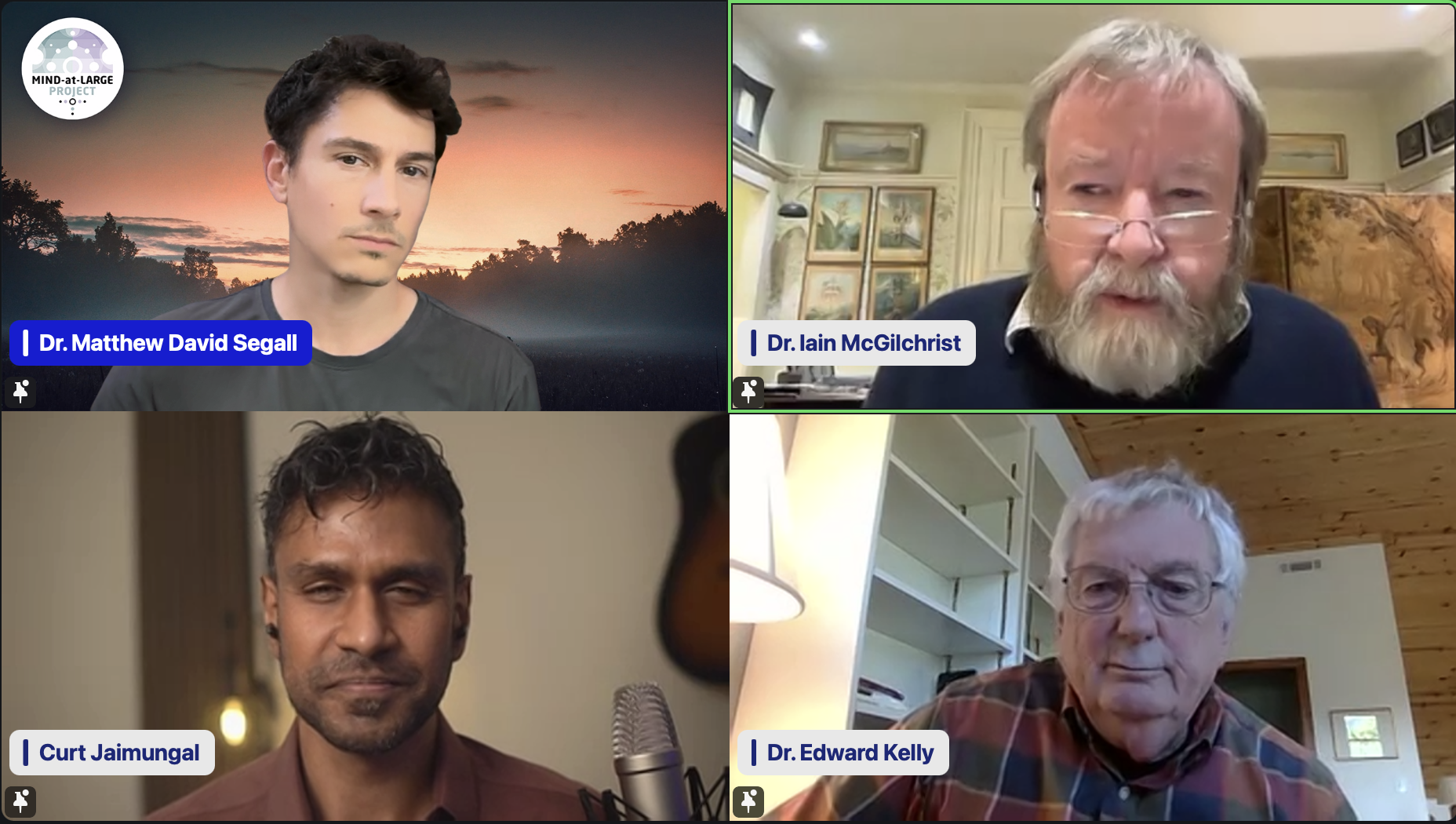
I repeat the questions when relevant so you will know what Curt asked.
1.
Well, I am tempted to take this in a direction that might sound a little idealistic, but when you ask what is real, I want to begin with human personhood as the most basic reality, at least the one most relevant to beings like us who would ask such a question.
I do not think personhood is necessarily common in the universe. On Earth, perhaps there are other animals capable of reflecting on their own existence in some sense, and if that is the case, then I would say they are persons too. It is not that human beings are the only species capable of personal consciousness. But I begin with human personhood not to sound idealistic, only to say that without the disclosure and opening that being a person affords, and without the relationality and shared search for meaning that persons engage in with one another, such a question as “what is real?” does not really arise.
Now, as a metaphysician, given the reality of personhood, I would then ask: what must the universe be like such that persons are possible? And there I would go, like Whitehead, in the direction of experience. Experience, and creative events of experience, are what is fundamentally real. From there, one can build up a picture of a universe in which human persons are possible. To ask what the universe must be like if persons are possible leads naturally, it seems to me, to something like a network or community of creative events, or actual occasions in Whitehead’s terms. That makes a great deal of sense to me.
2.
I think the underlying question here is: if Iain and I both seem to agree that experience, in one way or another, is what is most real, then what is natural science about in that context? Your question was whether science can be understood as advancing closer to an accurate account of what there is.
If you look at the history of what Thomas Kuhn called paradigm shifts, it does not seem there is any straightforward way to judge whether we are getting closer to a mind-independent reality. The nature of a paradigm shift, whether from Ptolemy to Copernicus and then Kepler, Galileo, and Newton, or from classical physics to quantum and relativistic physics, makes it difficult to imagine any simple linear approach to something fixed, because the whole gestalt changes.
There seems to be no access to some mind-independent world by which we might determine whether we are getting closer to it. So rather than thinking of scientific knowledge as trying to represent a mind-independent world, I think that within a panexperiential ontology science becomes more about participation than representation. We could then look at the history of science, and especially the history of astronomy, as in a sense the history of consciousness and its evolution, the changing relationship between the human being and the universe as we observe and experience it.
That history reveals a process of deepening: a deepening of human self-understanding and of our sense of our role in the universe. It is not simply an approach to an objective stock of physical facts. It is also a shift in what we even mean by “physical,” and a recognition that consciousness and cosmos are two phases of the same evolutionary process. So there is no reality simply sitting out there waiting for us to discover it. Reality is this deepening disclosure in which we participate.
3.
Consciousness is a word that, in circles like this, in Mind-at-Large communities open to alternatives to physicalism, more or less becomes indistinguishable from what used to be meant by God. I think that is one reason why people with a more materialist bent are impatient with the “consciousness people.” To them, if consciousness is not just a function of the brain, then talk about consciousness begins to sound like religion. It sounds like God. And that is not surprising.
In a secular context, once people begin to take experience seriously and recognize its irreducibility, and once they come to see, as Ed was saying, that matter itself is one of the most abstract ideas ever imagined by human beings, since no one has ever touched or held “matter” as such, what we actually encounter are qualities: feelings, colors, scents, flavors. No one has ever encountered quality-less extended stuff. Once you come to that realization, it becomes very easy, especially if you have also become alienated from traditional religion, to think that consciousness must be the ground of being.
That is why views like Bernardo Kastrup’s analytic idealism, or positions like Iain’s that treat consciousness and matter as different phases of some underlying process, are so popular. People are hungry for a more coherent worldview that does not require them to deny the irreducibility of their experience.
4.
In the Romantic tradition, imagination stands between abstract concepts and categories on the one hand and more concrete sensations and perceptions on the other. It mediates between them. Rather than thinking of imagination as a fantasy engine in the business of make-believe, it is actually the bridge that brings reality together, that holds the sensory and the intelligible together.
Participation means exactly that sort of betweenness. Instead of a representational understanding of truth, where truth is a mind separate from the world having the right internal picture of an external environment, a participatory framework begins elsewhere. We can still speak of subject and object, mind and body, if we want, but the point is that these are not closed substances. They are relational processes, constantly blending into one another.
I do not, as a self, pre-exist my relations with other selves. Selves are internally related and co-constitutive, just as self and world are internally related. A community of selves, the human species for example, exists in a co-creative relationship with one another and with the world around us. So whatever truth is, it is something enacted or brought forth in that relationship, not some correct internal modeling of an external world.
The representational framework leads to all sorts of epistemological problems, and ultimately to skepticism and solipsism. Science after Descartes has largely been rooted in that representational picture of knowledge. But if you really follow it through philosophically, I think it undermines science. You end up unable to know the outside world. You end up with something like the Bayesian brain hypothesis, according to which all you have are sensory stimuli that the brain as a fantasy engine reconstructs into a model useful for survival, while you remain fundamentally cut off from reality. I do not think there is any basis for science, or ethics, or spirituality, if that is really what is going on.
5.
I think it is definitely true that Whitehead does not spend much time talking explicitly about mystical experience. But he does gesture toward the importance of extraordinary experiences for metaphysics. His theology and his account of the divine are, I think, deeply rooted in the Jamesian tradition of radical empiricism.
Even when Whitehead speaks in abstract terms about the primordial and consequent natures of God, I do not think he is merely positing a logical construct. A close reading supports this. He says the primordial nature of God is actually a fact discovered in experience. It is not like Aristotle reasoning abstractly to a prime mover. For Whitehead, the primordial nature of God is the initial aim that inaugurates each moment of experience and gives us a sense of relevant novelty, so that we may find an intelligent way of responding to the infinite potentiality flowing into us moment by moment.
God is the lure. Whitehead says God is the mirror held up to each creature, reflecting back to it its own greatness, its own potential greatness. Each creature must then decide what to do with that initial aim, because it also has its own subjective aim and is, in Whitehead’s view, self-creating. So God is latent in experience as a primordial lure. Then there is the consequent nature of God, which concerns our hopes and our search for a justification of our own existence, our sense that all this is happening for some reason or purpose.
Mystical experience, I suspect, must have been somewhere at the base of Whitehead’s elaboration of process theology, even if he does not say so directly. He clearly wants his conception of God, though it is also a concept, to be grounded in experience and to have an empirical basis. So there is a fruitful research program into mystical experience that could be developed from Whitehead’s philosophy, even if neither he nor others have yet advanced it very far.
6.
What I am often accused of, and what is not at all how I understand myself, is that metaphysics is somehow competing with science, or that by engaging in metaphysics I am trying to add some secret sauce to the physical world that physics or biology do not need.
I am constantly trying to clarify that metaphysics, in the sense I mean it, which is not just Whitehead’s sense but a broader philosophical sense shared even by many analytic thinkers, is about seeking the most general categories that apply across all the special sciences. What categories apply not only in physics but also in biology, psychology, and sociology? And beyond that, what about mystical experience, aesthetic experience, literature, being in love, engaging in sports, and so on? Human experience takes many forms, and metaphysics is the attempt, foolhardy as it may be, to come up with a scheme of ideas in terms of which all of it can be interpreted. In relation to science, I want to understand the latest advances in the natural sciences as best I can, so that I know what evidence I need to generalize from as a metaphysician. I do not see my work as competing with what physicists are trying to do. I want to learn from physicists. But I am operating at a different level of abstraction as a philosopher. So it is not about adding something extra. It is about trying to understand what is presupposed by all our scientific knowledge of the physical world. And as a philosopher, I would say: consciousness.
The only bad kind of metaphysics is unconscious metaphysics. You can have a metaphysics that I think is wrong and I may disagree with it, but it is worse when you are not even aware that you are presupposing one, because then there is no basis for dialogue. You are just talking past one another. I often feel that when I argue with physicalists who deny that physicalism is a metaphysics and think it simply follows from their understanding of science.
7.
What would I tell Sam Harris if he were here?: I’d say listen to your wife, Annaka Harris, who at least seems very open to panpsychism, if not fully committed to it.
More seriously, I think Sam, like many people in the United States and in the West over the past century, has embraced a certain form of Buddhism that was modernized after the colonial encounter and stripped of much of its cultural, cosmological, ritual, and mythic dimension in order to appear more palatable to a scientific and intellectual audience tired of the dogmas, miracles, and sacramentalism associated with Christianity.
That modernized Buddhist psychology is a valuable path, and I would not want to take it away from anyone. But I think it neglects the extent to which Buddhism overlaps with so-called Western religious traditions more than people often admit. We tend to overplay the differences between East and West. There are differences, of course, but there are also deep resonances.
Sam Harris never misses an opportunity to attack and dismiss Christianity and Islam, and to a somewhat lesser extent Judaism. He often treats monotheism as uniquely foolish. There is a kind of intellectual superiority at work there. Now, there is certainly a form of fundamentalism that he and Dawkins and Dennett were right to criticize, but that kind of fundamentalism is itself a relatively modern phenomenon, a reaction formation.
I think Sam could pay more attention to the thousand-year-old traditions of Sufi mysticism, to apophatic theology in ancient and medieval Christianity, and to Kabbalah. He might then recognize that religion and religious practice, even within Abrahamic monotheism, can be rooted in experience and can be as revelatory of reality as Buddhist meditation.


What do you think?