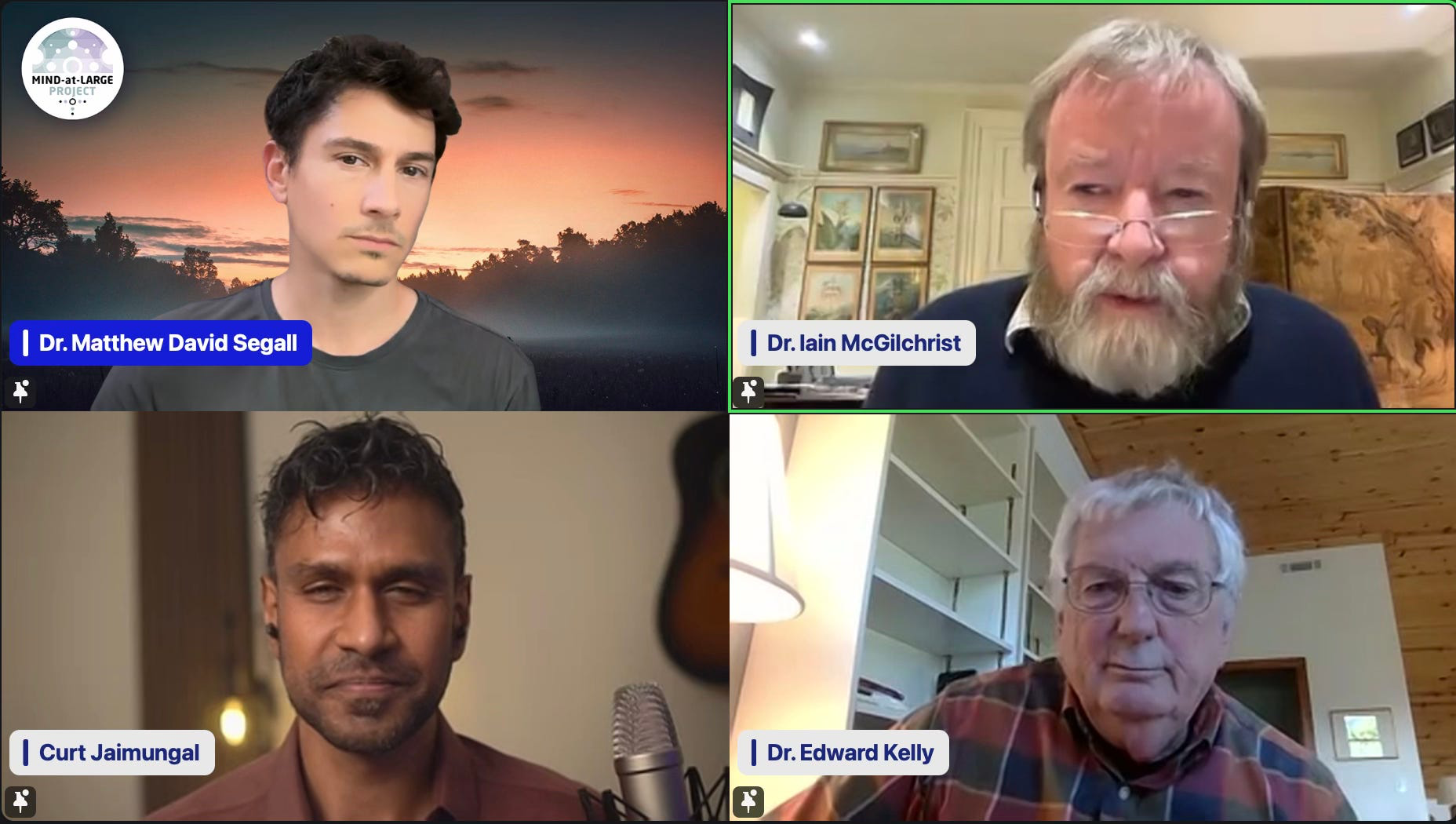
An LLM summary based on the transcript of my panel discussion with Ed Kelly and Iain McGilchrist, moderated by Curt Jaimungal, at last week’s Mind-at-Large conference. Videos of the event will be posted soon!
Curt Jaimungal opened by cutting past preliminaries and asking the most basic metaphysical question possible: “What do you all think exists? Like what is your fundamental ontology?” He directed the question first to Iain McGilchrist, then to Ed Kelly, then to Matt Segall. That set the tone for the entire conversation. The panel was less about defending a single system than about circling a shared intuition from slightly different angles: that experience, relation, meaning, and participation are more fundamental than the materialist picture allows.
McGilchrist answered first, somewhat amused and slightly cornered by the abruptness of the question, calling it “a bit of a googly… at 11 o’clock at night with no prep.” But his answer quickly became quite clear. He rejected the idea that experience is unreal or merely a sign for something else more basic. “It doesn’t make sense to say what we experience has no reality. There’s something else that it is just a kind of code for.” In that respect, he explicitly aligned himself with Whitehead. Reality, for McGilchrist, is not something fixed “out there” waiting to be captured by a detached mind. Rather, “it’s something that comes into being through the process of trying to get to know it.” His first principle, then, was relational: “What is real is never… not relational. So relations are more real than the things that we take to be related. Relations are… the core of everything.” From there he moved to theology, though cautiously. He said he was “not at all averse to calling it God,” while worrying that the word brings “every kind of misconception in its wake.” Still, he affirmed that whatever the “ground of being” is, it is “creative” and “relational,” and that values and purpose belong to reality itself. He said directly that “values pre-exist as a part of the ground of being” and that reality is “directional.”
Because of audio trouble, Ed Kelly temporarily dropped out, and Matt Segall stepped in next. Segall began not with abstract metaphysics but with personhood. He said he was tempted to sound “a little bit idealistic,” but wanted first to affirm “human personhood as the most basic reality that is going to be most relevant to beings like us who would ask such a question.” He did not mean that only humans are persons. If other beings can reflect on their existence, then “they are persons also.” His point was that without the disclosure afforded by personhood, and without the shared search for meaning among persons, the question “what is real?” would not even arise. From there he made a recognizably Whiteheadian move: given the reality of personhood, what must the universe be like for persons to be possible? His answer was that “experience and creative events of experience are what’s fundamentally real,” and that the universe is best thought of as “a network or a community of creative events or actual occasions in Whitehead’s terms.”
When Kelly was finally able to respond, he framed his position biographically, as someone who came to metaphysical revision from the scientific side. He said that, like many scientists, he initially hoped “some little adjustment somewhere in our current scheme of things was going to make everything all right again.” Over time, he had been “slowly disabused of that hope.” Once one gives up physicalism, he argued, “there’s really no safe place to stop short of something amounting to its opposite… some form of idealism or perhaps a dual aspect monism of some sort.” He also took up a familiar objection to idealism, namely that it merely inverts the hard problem by needing to explain matter. He said he no longer found this persuasive, because “all that we really know anything about is experience. That’s all there is as far as we absolutely know. Matter is a concept.” Classical physics, on which physicalism is built, is a conceptual framework elaborated to account for certain regularities in experience. That, he suggested, is what the idealist must explain differently, not magically manufacture matter out of nowhere.
Curt then shifted the discussion toward scientific progress. He asked whether we are on the edge of a new upheaval, comparable to the revolutions of relativity and quantum theory, and whether knowledge simply shifts endlessly or actually progresses. McGilchrist responded by saying he did think there is “a bottom,” perhaps “some sort of gigantic consciousness or intelligence… that is the source of everything.” He said this idea resembles what “most people’s naive ideas about a God” amount to, and that he and Kelly may have come “to very similar places from somewhat different directions.” McGilchrist then became more explicit: “I think that the ground of being is conscious.” He identified himself, with qualifications, as “a panpsychist in the sense that I believe that everything has experience of some kind, some interiority.” He also entertained the label “dual aspect monist,” though only reluctantly. Matter and consciousness are not radically separate substances, but “different appearances, different manifestations, different showings forth of the same thing.” His metaphor was water: it can be fluid or solid, visible or invisible, and still remain water. “I think that I would go with that the stuff of the universe is consciousness.”
Segall took Curt’s question about science in a somewhat different direction. He suggested that once one grants a pan-experiential ontology, science can no longer be thought of primarily as representation of a mind-independent world. Drawing on Thomas Kuhn, he argued that paradigm shifts are not simple linear approximations to a final objective picture. When the whole “Gestalt shifts,” it becomes hard to say science is simply getting closer to a ready-made reality. Instead, science becomes “more about participation than representation.” Astronomy was his privileged example. The history of astronomy is “in a sense the history of consciousness and its evolution,” because it reveals a changing relationship between the human being and the universe. What deepens is not merely our stock of objective facts but our participation in reality and our understanding of our place within it. “There’s no reality out there for us to discover. Reality is this deepening disclosure that we participate in.”
McGilchrist pushed back slightly against any implication that this eliminates truth or progress. He said we do not need to “stand outside” experience to judge whether an account is truer. Within experience itself, theories can exhibit “more or less cohesion” and “more or less complete” responsiveness to the qualities of experience. The materialist-reductionist paradigm, he argued, fails badly in this respect, because it omits too much of what experience includes. So there is progress, not because we are peeking behind the curtain from nowhere, but because some frameworks do greater justice to the fullness of reality than others.
Curt then pressed McGilchrist on a subtle but important linguistic distinction. McGilchrist had said both that the ground of being “is conscious” and that it is the ground of consciousness. Was this careful wording, or a slip? McGilchrist clarified that he did indeed mean the ground of being is conscious and also the ground of consciousness. Since at that level ordinary sequential logic breaks down, he suggested one cannot think simply in terms of one thing causing another in time. Segall then added an interesting sociological gloss. In communities willing to question physicalism, “consciousness more or less becomes indistinguishable from what used to be meant by God.” That, he suggested, is why materialists often grow impatient with such discussions. Once matter is seen as highly abstract and experience as irreducible, idealism becomes very tempting. He noted that “matter itself is, in fact, one of the most abstract ideas ever imagined by human beings. No one’s ever touched it or held it.” What we actually encounter are colors, smells, tastes, feelings, qualities.
Curt next turned to the concept of participation itself, asking whether the panelists meant the same thing by it. McGilchrist began with John Archibald Wheeler’s phrase “participatory universe,” which means there is no “view from nowhere,” no truly detached observer uninvolved in what is observed. Participation thus implies that everything comes from relationship, from “a connection of betweenness.” He stressed that this does not mean reality is “just dreamt up by me.” Rather, there is “something that is not just dreamt up by me, but is accessible to me,” and this interplay is something to celebrate, not regret, because “each of these encounters, each of these betweennesses is giving a new something to the cosmos.” McGilchrist then made a romantic turn through Coleridge, distinguishing “primary imagination” from “secondary imagination.” Primary imagination is the cosmic creativity “bringing everything into being all the time,” while artistic imagination is a reflection or image of that deeper ontological creativity.
Segall then developed participation through the romantic concept of imagination as mediation. Imagination is not “a fantasy engine that’s in the business of make-believe,” but “the bridge that brings reality together, that holds the sensory and the intelligible together.” In a participatory framework, truth is not a separate mind correctly representing an external world. Subject and object can still be spoken of, but they are not “closed substances.” They are “relational processes” that “blend into one another.” The self does not pre-exist its relations with other selves. Selves are “internally related and co-constitutive,” and truth is “something that’s enacted or brought forth in that relationship.” Segall sharply contrasted this with the representational epistemology he associates with post-Cartesian science and contemporary Bayesian brain theories. If the mind is fundamentally cut off from the world and only reconstructs it from sensory input, then “I don’t think there’s any basis for science if that’s what’s really going on. And certainly not for ethics or spirituality or anything else.”
Curt then tried to name a shared enemy. Are they united against physicalism, but also against a kind of idealism that collapses into skepticism or solipsism? Kelly declined to say much here, but McGilchrist and Segall largely agreed. McGilchrist said they were at least “near neighbors.” He explicitly rejected both “pure idealism” and “capitalism… physical realism,” clearly meaning reductive materialism. He returned again to betweenness: reality is neither a self-sufficient external thing nor “some ghastly fantasy.” He made an important distinction between fantasy and imagination. Fantasy is arbitrary invention, whereas imagination is “a disciplined attention to something where something is calling to you and you are answering.” Reality emerges out of this “calling and answering.”
The next major arc concerned mysticism and Whitehead. Curt asked Kelly to repeat a comment he had made elsewhere about Whiteheadians needing to pay more attention, not merely to psi research, but to mysticism. Kelly said Whitehead “violated his own principle about taking all kinds of experiences into account.” In Kelly’s view, Whitehead did not sufficiently reckon with mystical experience, though to be fair the scientific study of mysticism was less developed in his day. Now, however, such study can advance significantly, because we have experimental means of inducing mystical states through psychedelics and meditation, and because spontaneous mystical experiences are also widely documented. Kelly distinguished between “introverted” mystical experiences, in which the world disappears into a concentrated unity, and “extrovertive” ones, in which the whole world remains present but transformed into a different kind of unity. Both, he suggested, should become part of a more systematic scientific inquiry, and this could help further metaphysical investigation.
Curt then posed a sharp Whiteheadian challenge: what exactly is missing from process philosophy if it already comports well with mysticism and psychedelics? Kelly replied cautiously that he was “not sure,” and hoped this was something to explore further, perhaps in collaboration with Segall and Tim Eastman in a future book. Segall then stepped in to defend Whitehead, while partly agreeing with Kelly. He conceded that Whitehead “doesn’t spend much time talking about mystical experience,” but argued that Whitehead does gesture toward the metaphysical importance of extraordinary experience. He interpreted Whitehead’s theology through a Jamesian lens. The primordial nature of God is not a mere logical inference but “a fact that we discover in our experience.” Whitehead’s God is “the initial aim that inaugurates each moment of our experience,” the “lure” toward relevant novelty. Segall quoted Whitehead’s striking phrase that God is “the mirror held up to each creature to reflect back to it its own greatness, its own potential greatness.” The consequent nature of God, meanwhile, concerns our hopes, our search for justification, and the sense that reality is purposive. Segall’s conclusion was that mystical experience was probably implicit in Whitehead’s thinking, even if insufficiently thematized, and that Whitehead’s philosophy could generate a fruitful empirical research program in this area.
A new phase began when Curt asked each thinker how they are often mischaracterized, even by admirers. McGilchrist first complained about simplistic readings of his work on the hemispheres. People say, “the left hemisphere and the right hemisphere are always cooperating,” to which he replied in exasperated fashion: “Well, of course they’re always cooperating. I’m a bloody doctor and a scientist. I know that.” His point is not that the hemispheres are sealed-off agents, but that they nonetheless exhibit discernibly different styles of attending to and disclosing the world. He also complained that some scientists accuse him of “going beyond the data,” as though this were illegitimate. But that, he said, is precisely what real science does: it asks what the facts mean. He then noted that he is often labeled an idealist. In one sense, he is indeed close to the German idealist tradition, especially Schelling. But he is not an idealist in the sense of thinking we merely “construct our reality on our own by reading dials.” He opposes the view that we only know a wall of data with no reality beyond it. Rather, “if there’s something you are experiencing that is the real deal, there is no question about that.”
Kelly’s answer centered on pedagogy and intellectual formation. With Irreducible Mind, he and his coauthors had deliberately written for advanced undergraduates and early graduate students, hoping to reach people before “the hardening of the categories” that occurs in doctoral training. He recounted a review by a postdoc who basically admitted that the book came too late for him. Kelly took this as emblematic: many people become so thoroughly “wedded to the physicalist point of view” that they cannot seriously entertain alternatives.
Segall’s answer focused on metaphysics. He said he is often misread as if metaphysics were competing with science, as though he were trying to pour “some secret sauce” into the physical world. He insisted that metaphysics, as he understands it, is not the addition of occult entities. It is the search for “the most general categories” that apply across not only the sciences, but the full range of human experience: aesthetic, mystical, ethical, social, erotic, athletic. Metaphysics is an attempt, “foolhardy as it may be,” to articulate a scheme of ideas in terms of which all of it can be interpreted. So he wants to learn from physics, biology, and the rest, but he is “operating at a different level of abstraction as a philosopher.” His concern is with what is presupposed by all scientific knowledge. “And as a philosopher, I would say consciousness.” McGilchrist immediately chimed in with a related complaint: many scientists are “terrified of philosophy and imagine that they don’t have a metaphysics,” when in fact they do. Segall added the aphorism that “the only bad kind of metaphysics is an unconscious metaphysics.”
The final substantial theme concerned God, spirituality, and Sam Harris. Curt imagined Harris as a kind of invisible interlocutor, someone not as militantly anti-spiritual as Dawkins, but still skeptical. If Harris says he has meditated, prayed, taken psychedelics, spoken with theologians, and is still unconvinced, what would the panel say to him? Kelly’s answer was surprisingly gentle. He said he had met Harris at Esalen, found him smart and serious, and retained “hope for him that he would come over to something resembling our points of view.” When Curt jokingly pushed him to say more, Kelly could only offer: “Keep trying.” He seemed especially interested in Harris’s psychedelic experiences and how they might yet deepen.
McGilchrist’s answer was more existential. He said uncertainty is “a very respectable position.” In fact, he worries more about those who are certain they are on the path to God than those who are not. Uncertainty “leaves a field open in which something can speak to you, call to you.” God is never likely to arrive “as a great idea.” It must be experienced, though often in subtle, elusive ways. Prayer, he said, is largely listening, but not passively. It is “a kind of reaching out of the soul towards something.” He admitted that language falters here, but insisted there is meaning in the idea of the soul and that “what we’re doing here in this world is growing souls, nourishing souls.” There is no method, no “four-point plan,” no operationalized recipe. He invoked Keats’s phrase “the veil of soul-making” and concluded with a humane encouragement: “The fact that you’re interested is to me the key note that you’re looking for something.”
Segall answered by situating Harris within a broader modern Western religious history. He suggested that Harris, like many Western seekers, has embraced a form of Buddhism that was reshaped after colonial contact to appear more compatible with science and with a self-help conception of psychology. This Buddhism is real and valuable, Segall said, but also truncated. It often strips away cosmology, ritual, myth, and the broader metaphysical and symbolic texture of religious life. By contrast, Harris repeatedly attacks Christianity, Islam, and monotheism in general, often dismissing them as uniquely irrational. Segall argued that this overlooks the depth of traditions like Sufism, Kabbalah, and apophatic Christianity, all of which are rooted in experience and can be “as revelatory of the nature of reality as Buddhist meditation.” The criticism here was not merely theological but temperamental: Harris, in Segall’s view, still carries a certain intellectual superiority toward Abrahamic traditions that prevents him from seeing their experiential and mystical depths.
The conversation ended rather abruptly with time running out. Curt thanked the speakers and audience, and the panelists thanked one another warmly. But by that point the central architecture of the discussion was already visible. McGilchrist emphasized relation, imagination, purpose, and the conscious ground of being. Kelly emphasized the collapse of physicalism under empirical pressure, the primacy of experience, and the importance of integrating mysticism into both science and metaphysics. Segall emphasized personhood, Whiteheadian actual occasions, participation over representation, and the need for metaphysics to articulate the presuppositions of science rather than compete with it.
What united them most strongly was not a rigid shared system but a family resemblance. All three rejected reductive materialism. All three treated experience as irreducible. All three, in different vocabularies, affirmed that reality is relational rather than built from self-enclosed inert substances. All three also resisted a solipsistic or subjectivist idealism. Reality is not merely “dreamt up,” nor is it a dead external mechanism. It comes to presence through relation, imagination, disclosure, and participation. If there was a quiet refrain running beneath the whole panel, it was this: reality is not a finished object waiting to be photographed from nowhere, but a living field of encounter in which mind, world, value, and perhaps even God arise together.


What do you think?