
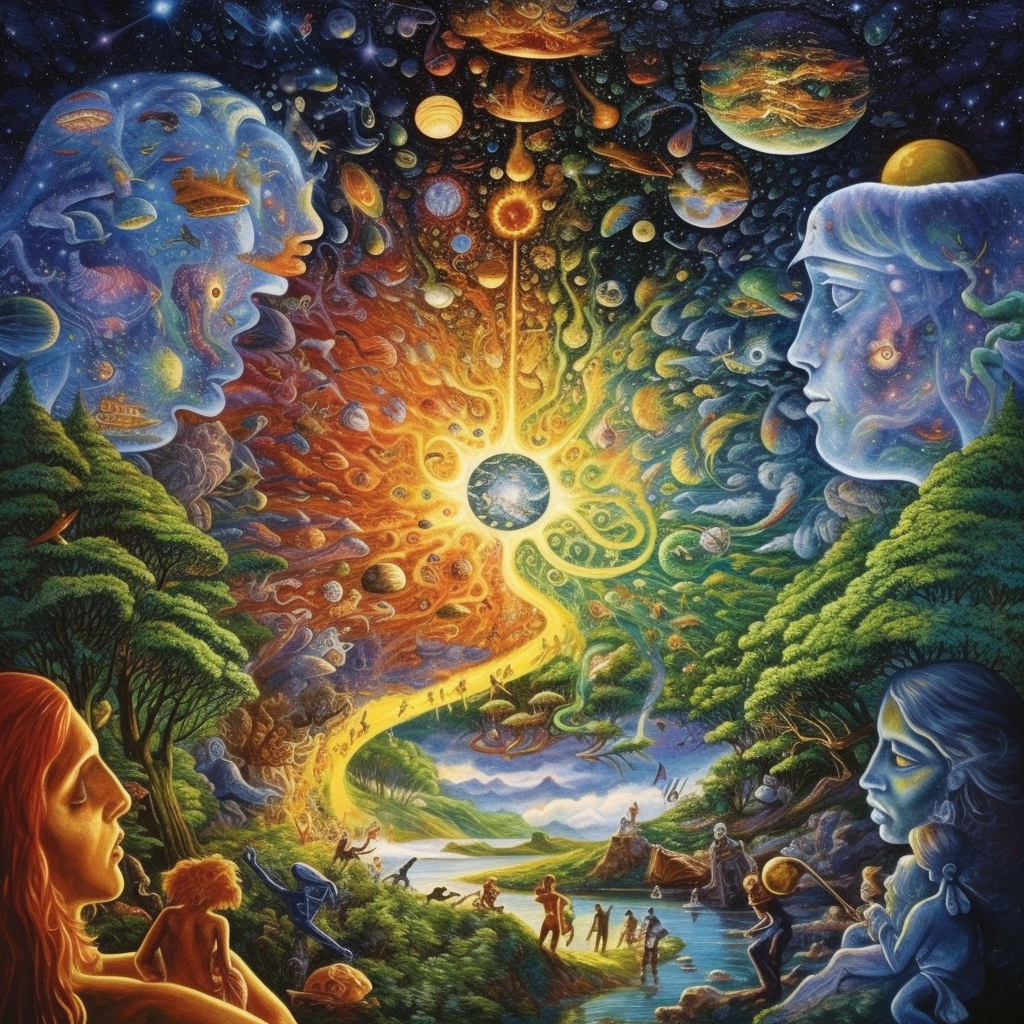
Iain McGilchrist mentions my dialogue with Michael Levin a few weeks ago at the start of this video, before proceeding into an inquiry concerning the whereabouts of ideal form: Where are the forms in the ‘latent space’ of biological possibility? I think everyone in the conversation, including Iain, senses that asking “where”–while essential for noting what’s missing in materialist accounts–is ultimately the wrong sort of question. We need alternative ways of rendering this mystery intelligible.
One alternative is via plasma physicist and process philosopher Tim Eastman’s “logoi framework,” wherein “pre-space potentiae” are understood to grow together with physical actualities. The latter can be effectively mapped using a Boolean dyadic logic of 1s and 0s, while the former cannot. The former, the potentiae, are indecipherable via a dyadic logic, but can be approached via a triadic logic (eg, Peircean semiotics). See my review of Eastman’s recent book for more on this approach.
Scientific materialism has for several centuries gone about trying to explain nature merely in terms of the lawful behavior of already actualized, measurable bits of matter or information. The problem is, in addition to leaving said laws entirely unaccounted for, this explanatory model defines the physical world in such a way that the minds claiming to explain it never could have emerged!
Minds, as we know quite intimately, not only perceive the already actual but conceive alternatives.
Minds harvest possibilities alongside actualities.
Minds partake in a shared realm of ideas.
Minds can selectively ingress new ideas that adapt to unexpected events in the present or upset the settled habits of the past.
Levin’s work is making clear that such minds (of endless forms most beautiful!) are operative at physical scales far beyond just human scientists.


 Footnotes2Plato
What do you think?