
A conversation with Pedro Brea and Karsten Jensen.
LLM generated transcript below.
Matt Segall: Hey, Karsten.
Pedro Brea: Hey!
Karsten Jensen: Hi, Matt! Hi, Pedro! I’m so happy you both agreed to have this conversation with me, and I really look forward to it.
Matt Segall: Likewise. My exposure to Martinus was through you, Karsten, and I really appreciated what you shared, probably a year ago at this point. Pedro, I assume this was your first encounter with Martinus’ work as well, right?
Pedro Brea: Yes, these past few weeks since I connected with Karsten on Substack. I’ve really been enjoying what I’ve read. Karsten has been giving me recommendations, and I’ve been amazed by the affinities between Martinus and Bergson. I’ve been really enjoying what you’ve been giving us.
Matt Segall: I was able to read both his autobiographical account and the piece on “Space, Time, Time, Space, and Eternity.” There’s a lot we could dig into.
Karsten Jensen: This meeting came about because I reacted to your essay about Whitehead’s theology. I thought a good starting point could be for you to briefly outline Whitehead’s idea of the Godhead and the role it plays in his cosmological scheme. Then we could take it from there, because I was baffled by the resonances I saw between Whitehead’s theology and the way Martinus thinks about the Godhead. They are so different in background and epistemic sources, so that was what triggered me to reach out to you.
Matt Segall: I can try to do that briefly. I felt the resonances too. Martinus has these three X’s, this Trinitarian structure, and I think it maps pretty well onto Whitehead. In Whitehead’s so-called process theology, he describes the “groundless ground” as Creativity, and God is the first “creature” of Creativity. Elsewhere he calls God the primordial “accident” of Creativity. God is dipolar for Whitehead: there is a primordial pole, God’s mental pole, in which God envisages Creativity and gives it some form and value—some vector of valuation—whereas Creativity itself is pure possibility, infinite potential. God, in God’s primordial nature, values possibility to tilt it toward a particular end, a particular aesthetic orientation. Then there is God’s consequent nature, the physical pole, which is God’s responsive feeling of the way all creatures respond to the primordial envisagement. The consequent nature is like a cosmic memory that grows with the universe, whereas the primordial pole is unchanging. In this picture, God is subject to Creativity just like every other creature. Every finite creature also has two poles, a physical and a mental pole. The difference between divine concrescence and finite concrescence is the order of the poles: in God the mental (primordial) pole precedes the physical (consequent) pole; in finite occasions, concrescence unfolds physical first and then mental as consequent. So, on the surface, what Martinus describes as X1, X2, X3 seems to align: X1, the uncreated eternal “I,” is akin to Whitehead’s Creativity; the primordial nature of God is akin to X2, the creative power to manifest the definite; and X3, that which is created, is like the consequent nature of God and the physical universe to which God responds. Both converge on a similar Trinitarian picture.
Karsten Jensen: The overall resonance I see between Martinus, Whitehead, and Bergson is that they think in terms of organism rather than mechanism. Martinus, like Whitehead, sees God as an experiential being. God is not just the Creator; God is having an experience. There is an interaction between the One—the Godhead—and all the “sons of God,” all the individual creatures. There is mutual dependence. God is not sovereign above creation but takes part in creation and takes part in the experience of all beings. Our suffering is also suffered by the Godhead. I see the Trinitarian structure and the Christian mythopoetic language in both. But I would add: for Martinus, the ultimate ontological category is the living being. Every living being has a Trinitarian structure: creator, creating, and the manifested organism. You cannot think a being without an organism, and you cannot think a living being without the creative process and the creatorly aspect. He talks about the “I” in a way reminiscent of Fichte: the “I” is universal. It is not what makes us different; it is our access point to the whole cosmos and a shared identity with all beings and with the Godhead. Individuation arises in the creative process, not the “I.” In his autobiographical piece he describes the “golden baptism of fire,” an experience of being without an organism or spatiotemporal structures, immersed in an ocean of golden rays, one with the whole cosmos. That is the point of bifurcation where the One becomes the many and the many becomes the One. Creation is continual, happening all the time. Martinus analyzes the cosmos along two axes, symbolized by the cross: the vertical axis between the unmanifest source and the manifested, which requires intuition; and the horizontal axis, the evolutionary panorama from microcosmos to macrocosmos, which is the field of natural science—molecules to cells to organs to organisms, and upward to planets, solar systems, galaxies, and beyond.
Matt Segall: Lots comes to mind, but I want to give Pedro a chance to connect, perhaps from the Bergsonian point of view or from your own experience of the interface between mysticism, philosophy, and science. How did Martinus’ texts speak to you?
Pedro Brea: I felt a lot of resonance with Bergson, especially in how he treats intuition and mysticism as the pinnacle of moral life in The Two Sources of Morality and Religion. Martinus can sound anthropocentric in seeing humanity as a point of evolution, but I take that to mean that through humanity the vital impetus becomes aware of itself. Bergson contrasts the Hymenoptera (ants, wasps, bees), whose instinct reaches a high point of social cohesion, with human beings, in whom intelligence is at its most fully formed. Instinct is direct contact with life; intelligence manipulates matter skillfully but also threatens social cohesion by intensifying a sense of “I-ness.” Morality thus originates as instinct’s subterranean intervention to defend society against the pressures of intelligence. Then something new happens: instinct refines intelligence into intuition, which puts us in touch with reality like instinct does but now self-consciously. That, for Bergson, is mysticism and the message of universal love, an evolutionary novelty that opens the closed society into an open one. Intelligence relates by analysis—arresting movement into static concepts for manipulation—whereas intuition gives direct contact between the soul and the world.
Matt Segall: The shift from intelligence to intuition—instinct becoming conscious of itself—aligns with the idea that the “I” becomes what makes us the same, not what separates us. Mysticism is full of paradoxes, and that one is significant. Martinus’ analysis of time also reminded me of Bergson: you cannot see time; movement appears in space, but if you get behind spatial movement to a primal movement—creative advance (Whitehead) or duration (Bergson)—you’re already participating in spiritual reality. Phenomenological reflection on perception shows lived time irreducible to material objects. It’s an obvious redirection that can free us from a materialist trap, which often backgrounds the fact that someone is experiencing and measuring. Asking the transcendental question lifts us out of that delusion.
Pedro Brea: The first time I encountered the idea that the “I” is universal rather than individual was in Viveiros de Castro’s Cannibal Metaphysics, via a Lévi-Strauss anecdote: Europeans asked if the natives had a soul, whereas the natives assumed everyone had a soul and asked whether the Europeans’ bodies would rot—whether they were organic. It shows different defaults: for the Europeans the body was given; for the natives the “I” (soul) was universal.
Karsten Jensen: Martinus has something like a cosmic faculty psychology: all phenomena are combinations of six basic energies or faculties—instinct, gravity, feeling, intelligence, intuition, and memory. “Gravity” here isn’t physics’ gravity; it is the dominant energy on the physical plane. All beings have a material organism, but not necessarily a physical one; there are subtler forms. Instinct and intelligence are opposites. Intelligence is not experiential; it is analytical, organizing memories into force fields of recognition. Intuition is an automatic faculty of analysis, but, like Bergson’s “intellectual sympathy,” it requires a harmonization: feeling (sympathy, valuation) and intelligence balance each other. If feeling isn’t harmonized by intelligence, we become partial; if intelligence dominates feeling, we become materialists; if feeling dominates intelligence, we become spiritualists. Balance permits intuition. Bergson and Martinus both use spatial metaphors for intuition: insight from within the object, “sensing from above” versus science’s “sensing from below.” Martinus had early intuitions but took six or seven years to learn to express them analytically; he used imagination to connect higher insight with everyday experience. Whitehead’s The Function of Reason is a defense of speculative reason and methodology, an ascending path toward clarity and consistency, whereas Bergson and Martinus emphasize that intuition can give this instantly, after which one descends into concepts.
Matt Segall: That difference fits: Whitehead comes from James’s radical empiricism and starts from the special sciences—and also arts, aesthetics, religious experience—to generalize categories adequate to everything. The top-down/bottom-up contrast echoes Plotinus’s reading of Plato’s methods of myth and dialectic; both are needed. There’s also terminological slippage around “intelligence”: Plato’s noēsis vs dianoia, Kant’s Vernunft vs Verstand. Bergson’s “intellect” may align more with dianoia/Verstand, while intuition would be noēsis/Vernunft.
Karsten Jensen: For Martinus, “intelligence” is more like a computer—almost a Turing machine, as he outlines in Livets Bog. We mentally sort impressions, stacking memories into ordered fields. That’s Verstand. Vernunft would be akin to intellectualized feeling—reason as harmonized intelligence and feeling—the precursor to intuition. Intelligence can be trained; feeling is deepened through the hard knocks of life—through suffering, which nourishes compassion and our humanity.
Pedro Brea: This connects to Karl Jaspers’ “ethical function of reason.” Reason isn’t merely instrumental analysis; it should sensitize us to others and cultivate compassion. That ties to mysticism’s theme of love. I’m curious how love figures for Whitehead compared to Bergson and Martinus.
Karsten Jensen: For Martinus, intellectualized feeling is another word for love. Illogical sympathies—addictions, partialities—favor some things over others. Universal love is feeling balanced by intelligence so that we acquire an interest in all things without exception. Love is the moral habit required before intuition; intuition is a gift to the one who has cultivated unconditional love for all life. He calls love the basic tone of the universe and wants to redeem evil by placing good and evil within higher aesthetic creational principles: the principle of contrast (light/dark, good/evil) and hunger and satiation. At the core is a primordial desire, determined “from below” by lived experience—its content shaped by what we actually undergo.
Matt Segall: That resonates with Whitehead and Schelling. Schelling says will is primal being, a divine yearning initially dark and unconscious; Whitehead’s primordial nature of God is a similarly unconscious divine Eros. Consciousness arises only in relation to the becoming of creatures. There is a reciprocal dependence of God and world: God needs the world to become conscious, and the world shares in the divine yearning. Steiner also says the first organ of higher cognition—imagination—is like a spiritual touch. Wordsworth writes: “this love, more intellectual, cannot be without imagination, which in truth is but another name for absolute strength and clearest insight, amplitude of mind, and Reason in her most exalted mood.” Reason at its height is imagination: a synthesis of intelligence and feeling.
Karsten Jensen: I saw your conversation with Marc Gafni and Zak Stein about cosmoeroticism, which made me think of Martinus’ sexual principle, another creational principle. All beings are pleasure-seeking in some sense; even unconditional universal love is sexual in Martinus’ understanding. Every experience is a fertilization, followed by a gestation and then expression impregnated with the receiver’s character.
Matt Segall: Let me share one of Martinus’ images that captures the sexual and organic nature. It looks like a zygote, a fertilized egg—Martinus’ Eternal World Picture—with six colors representing the six energies.
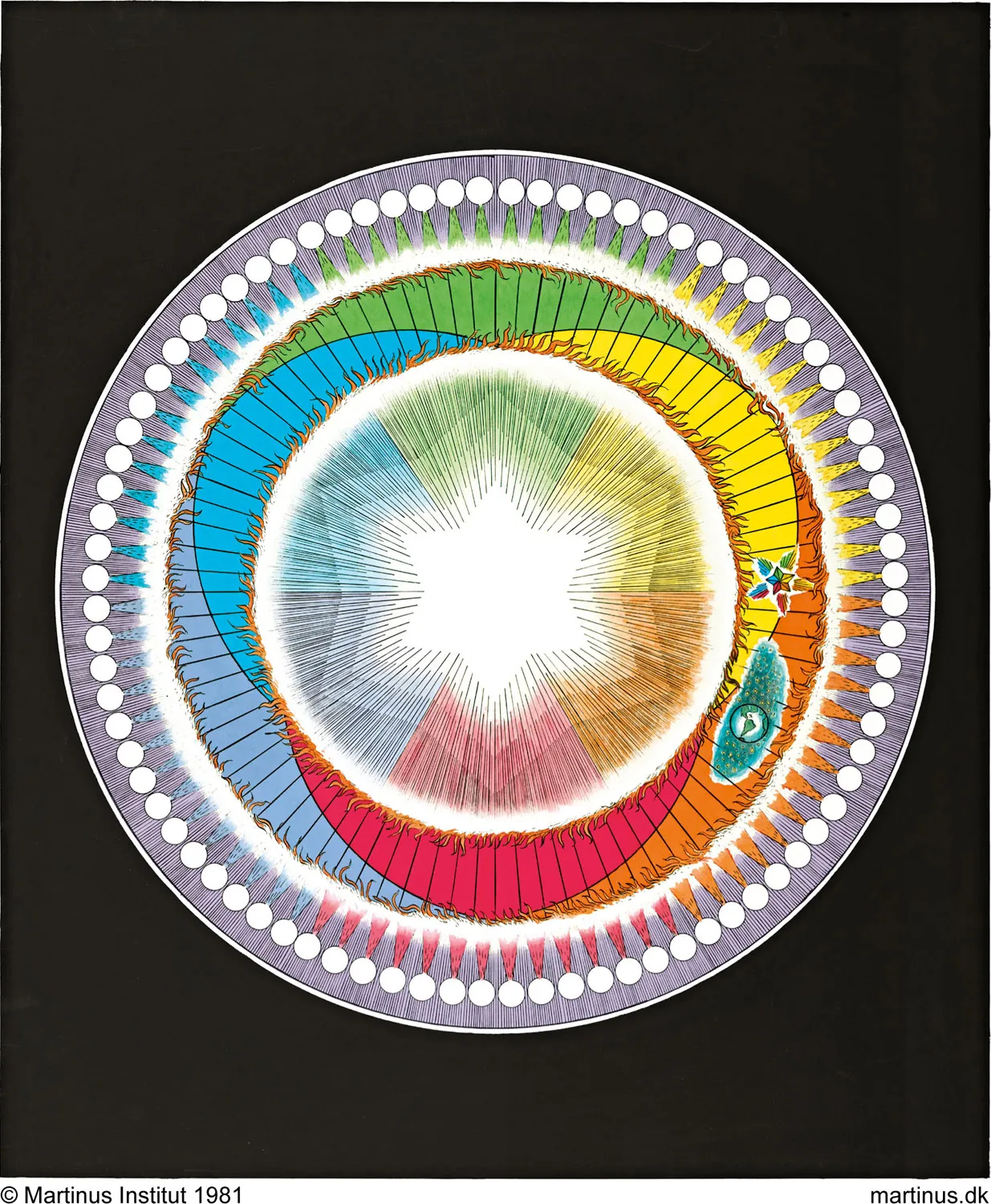
Karsten Jensen: Yes, the Earth is in the animal phase (orange) moving toward feeling. He says that in about 3,000 years, the majority of humanity will move into Christ consciousness, where compassion dominates. This is his main symbol. He had his decisive experience in 1921, made many sketches he later rejected, and only after six years did this symbol “fall into place.” He described feeling the blessing of the spiritual world afterward; from then until his death in 1981 he received much support. In the symbol, the white background is the I (X1), and the violet periphery is the faculty of creation and experience (X2). Together they constitute superconsciousness—not content of experience. The six colors are the changing manifest world (X3). Some see determinism in the cyclical structure, but process philosophy’s concern for novelty can help: like daily or annual cycles, there is repetition but no two days are alike. The cosmic “day” culminates in darkness in the animal kingdom and in noon at the peak of intuition; experience requires returning to “night” again and again.
Pedro Brea: When Martinus says “energies,” does he mean it like Orthodox theology’s divine energies—emanations of the essence we can contact—versus scientific energy? How does he distinguish them?
Karsten Jensen: For Martinus, energy is movement or vibration. Different energies are different frequencies, some too subtle to measure. The frequency spectrum extends infinitely upward; physical measurement has limits, but intuition can reach further. I’ve studied Martinus for 34 years, lecturing and writing for the last 20. In the culture around Martinus, things easily turn into a collective monologue—as can happen around Steiner. Martinus says the proof of his intuitive insight is in his cosmology, but that must be critically examined. I like Whitehead’s Function of Reason criteria: clarity of propositional content, internal and external consistency, whether it yields a genuine cosmological scheme, and so on. I want Martinus in the public conversation, subjected to scrutiny, not believed uncritically.
Matt Segall: I know that dynamic with Steiner. One question I wanted to raise is the tension between scholarship and mystical insight—or clairvoyant deliverances. Martinus reportedly spent three years not reading to keep revelations pure, but he still imbibed cultural assumptions. Can we ever be sure such insights aren’t culturally clothed? We need a foot in both domains: the critical scholarly orientation and openness to mystical insight. If we’re only analytic, we end up like Nagel’s “What is it like to be a bat?”—declaring we cannot know. But we are animals; through imaginative sympathy we can feel into other experience, even if our concepts later impose limits. If we abandon critical distance, we drift into delusion. Whitehead said his philosophy of organism aimed to save Bergson from the charge of anti-intellectualism—rightly or wrongly applied.
Pedro Brea: That’s why Bergson is a master to me. Matter and Memory affirms the reality of spirit and matter. While he has been accused of anti-intellectualism, he wasn’t against intellect; he argued that intellect is not our highest contact with reality. He respected science, was well-versed in physics, neuroscience, and mathematics, wrote a book on relativity to dialogue with Einstein, and reportedly solved a problem of Pascal’s at seventeen. He took both science and spiritual life seriously, refusing to reduce one to the other. He criticizes both idealism and materialism. I wish he had written more on theology, but he tried not to overstep empirical experience; his high profile may have constrained speculation. He stayed faithful to a kind of radical empiricism.
Karsten Jensen: Martinus certainly wasn’t anti-intellectual. He insisted on the need for natural science, though it yields relative knowledge—“the scent of the ocean.” He saw philosophy as the beginning of a true spiritual science—Geistwissenschaft—and advocated speculative reason. He would likely welcome Whitehead’s ascending path; we need both descending and ascending. He never wanted blind belief and invited critical scrutiny, confident his work would stand the test of time—but we shouldn’t take his word for it.
Matt Segall: Thank you both. This has enriched not only my understanding of Martinus but, dare I say, the truth. One closing thought: Martinus situates himself not as a second coming of Christ but as a vessel of the Holy Spirit.
Karsten Jensen: He would say he is not the spokesman; his cosmology—the ideas—are the spokesman, the Holy Ghost.
Matt Segall: Right—he offers a kind of holy knowledge that others can come to know, not relying on him as the authority, but knowing for themselves.
Pedro Brea: I’ll add one last point. Simone Weil’s decreation captures the role of love in mysticism: through unconditional love for whatever happens and for the world, the ego diminishes to allow union with the divine. I see that in Bergson and in Martinus. Is there a similar focus in Whitehead, a unified view of mysticism among the three?
Matt Segall: Whitehead’s metaphysics is conducive to interpreting mystical experience, and he references it, though he doesn’t dwell on his own. He says the primordial nature of God is ingredient in each moment as an initial aim. If we get our mistaken identity out of the way—ceasing to think of ourselves as skin-encapsulated egos—we can feel this guiding lure. At the end of Process and Reality he writes that the kingdom of heaven is with us now and the day of judgment is today. The divine is as present now as it will ever be, offering a persuasive aesthetic lure unique to each of us and to each moment, waiting for our attention.
Matt Segall: It’s been lovely to spend this Friday with you two. Let’s keep the conversation going. I’m happy to read more Martinus and continue exploring together.
Pedro Brea: Thank you.
Karsten Jensen: Thanks, Pedro. Glad you were here.
Matt Segall: Talk to you soon. Bye.

 Footnotes2Plato
What do you think?