

Recapping my time in the twilight zone between physics and psi in Charlottesville, Virginia two weeks ago.
I left the DOPS Psi Theory Meeting feeling like I’d been sitting around a camp fire telling ghost stories at the edge of a new continent. In fact, we spent the week together in the Marriott Hotel’s appropriately named Louis and Clark room. It was an adventure in transdisciplinarity: participating were physicists like Bernard Carr, Tim Eastman, Ruth Kastner, Federico Faggin, and Michael Epperson, all pushing beyond four-dimensional spacetime, mapping hyperspaces, transactional potentiae, and other higher dimensional structures; psi researchers like Ed Kelly, Bob Rosenberg, Paul Marshall, Emily Williams Kelly, and Michael Nahm cataloging and assessing anomalous phenomena including precognition, telekinesis, synchronicity, and mystical states that stubbornly refuse to fit inside a physicalist ontology; and philosophers like Sharon Hewitt Rawlette and myself, searching for theoretical integration and cosmological coherence. Between our respective disciplinary ridges ran a river I was asked to represent: process philosophy in the lineage of Schelling and Whitehead, both of whom insisted that possibility and value are just as real as the measurable facts of nature. I already shared my contribution to the meeting a few weeks ago:
Schelling’s Panentheism and Psi
Below is my attempt to expand my notes on the other presentations into a kind of field report. It is analytic where needed, personal where it helps, and hopeful about an emerging post-physicalist cosmology. I hope that my characterizations of the various contributors to this dialogue are not caricatures. I must take preemptive responsibility for any errors in the presentation of their ideas!
Framing the Meeting
Ed Kelly set our compass. DOPS has always wagered that if you follow the best evidence (eg, lab results, case studies, first-person reports) without flinching, you reach a horizon where physics, phenomenology, and metaphysics begin to speak to one another without stalling out. If I had to sum up our time up with a cliché, I’d say the vibe wasn’t “anything goes” but more like “let the best of each cross-pollinate.” Ed tended the methodological ecology of our co-inquiry with great care. No single discipline or species of knowledge (equations, experiments, or experiences) was allowed to monocrop the field of discussion.
Ed asked us to take seriously one core proposition:
Following F. Myers and W. James, the mind is filtered rather than fabricated by the brain.
He quoted Frederic Myers:
“That which lies at the root of each of us lies at the root of the Cosmos too. Our struggle is the struggle of the Universe itself; and the very Godhead finds fulfilment through our upward-striving souls.”
Two Roads Out of Physicalism (That Might Meet)
By week’s end two broad programs, both non-reductive, came into focus as serious contenders.
Road 1: Possibilist/process frameworks (pre-metrical, pre-spacetime).
Here, the fundamental stuff isn’t point masses but potentiae or real possibilities. In Whitehead’s terms: subjective aims achieving aesthetic satisfaction rather than dead corpuscles going bump in the night. These possibilities are best understood in terms of the relations-of-relations of category theory rather than the static containers of set theory. Spacetime doesn’t vanish from view, but it does become even more relativized: spatiotemporal relations are what realized possibilities look like when they’re geometrized from some actual standpoint. This road explains why the measurement of facts in quantum theory feels like a creative act and why the future stays genuinely open.
Road 2: Hyperspatial frameworks (metric extensions of spacetime).
Here, we expand the stage by adding dimensions or levels until phenomena like memory, telepathy, and precognition become geometrically natural. Bernard Carr thinks of perception as a four-dimensional causal chain, arguing that a fifth dimension buys us all the room we need for mind, and perhaps spirit, too. This road meets the physicist’s appetite for lawful structure while giving consciousness breathing room beyond the skull.
From my Schelling–Whitehead perch, these are not rival approaches so much as two newly developing organs in the same emerging consciousness. To borrow Whitehead’s distinction in Process and Reality, the possibilist side tracks the genetic (logical, value-laden) order of becoming; the hyperspatial side tracks the coordinate (metrical) order through which becomings cohere in an extensive continuum. These two roads may just be a binocular vision of the same new world.
Speaker by Speaker (stitched from my notes)
Ed Kelly
Ed’s big tent approach isn’t just manners, it’s method. If psi data are real (some experimental findings are maddeningly robust), then our metaphysics and scientific theories must grow to meet them. If physics is yielding pre-space potentiae and higher-dimensional timelike curves, then our philosophy of mind cannot remain narrowly physicalist. Ed’s gift is to keep the conversation wide enough for the anomalies and yet disciplined enough for the skeptics. In this sense the meeting’s ethos embodied the panpsychist thesis that fact and value always travel together.
Tim Eastman
Tim distilled his book Untying the Gordian Knot into a generous, crystalline account of the Logoi framework. The move is simple and radical: treat “laws” as relational constraints on possibility rather than iron edicts hovering over matter. Give potentiaeontological standing—non-Boolean, non-spatiotemporal—and let category-theoretic structure do the bookkeeping for triadic, context-laden relations. On this view, the Principle of Least Action isn’t a deterministic search over a fixed phase space but an aesthetic genesis of relations of relations in pre-space. Aesthetic harmonization replaces brute minimization.
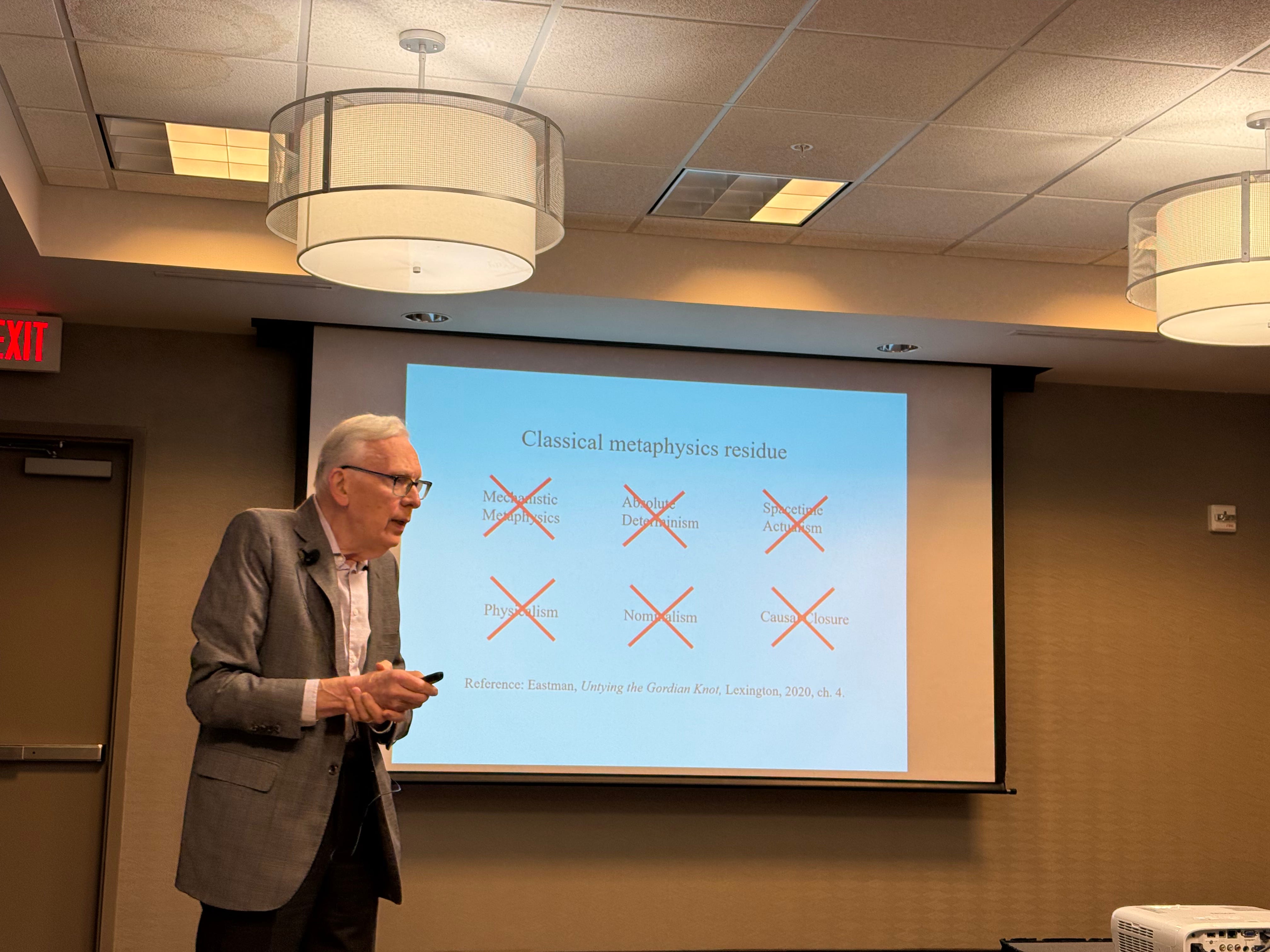
This converges with Whitehead’s prioritization of the genetic order over the coordinateorder. Schelling’s striving potencies also hum in the background. Tim is cautious about using Platonic language, but the family resemblance is unmistakable: possibilities aren’t ephemera; they’re the growing grain of the real.
My contribution at this stage is to argue that the Forms are axiologically self-organizing: possibilities aren’t equi-valent. They house a responsive gradation of worth; a lure toward intensity, harmony, and beauty is at play in virtuality from the get go. I believe it is possible to show how evolutionary panentheism plugs straight into physics without asking physics to stop being physics.
Ruth Kastner
Ruth extended her Possibilist Transactional Interpretation: quantum events are born in a pre-spatiotemporal handshake between “offer” and “confirmation” waves; measurement isn’t passive reading but fact-making; the Born rule is earned, not assumed. It’s a Yang-Yin critique with a technical twist: if you only model Yang (ie, actuals, metrics, boundaries), you manufacture the “measurement problem” by design. Add Yin (ie, ontologically real possibilities) and what was a paradox in the physicalist paradigm transmutes into a process of creative actualization.
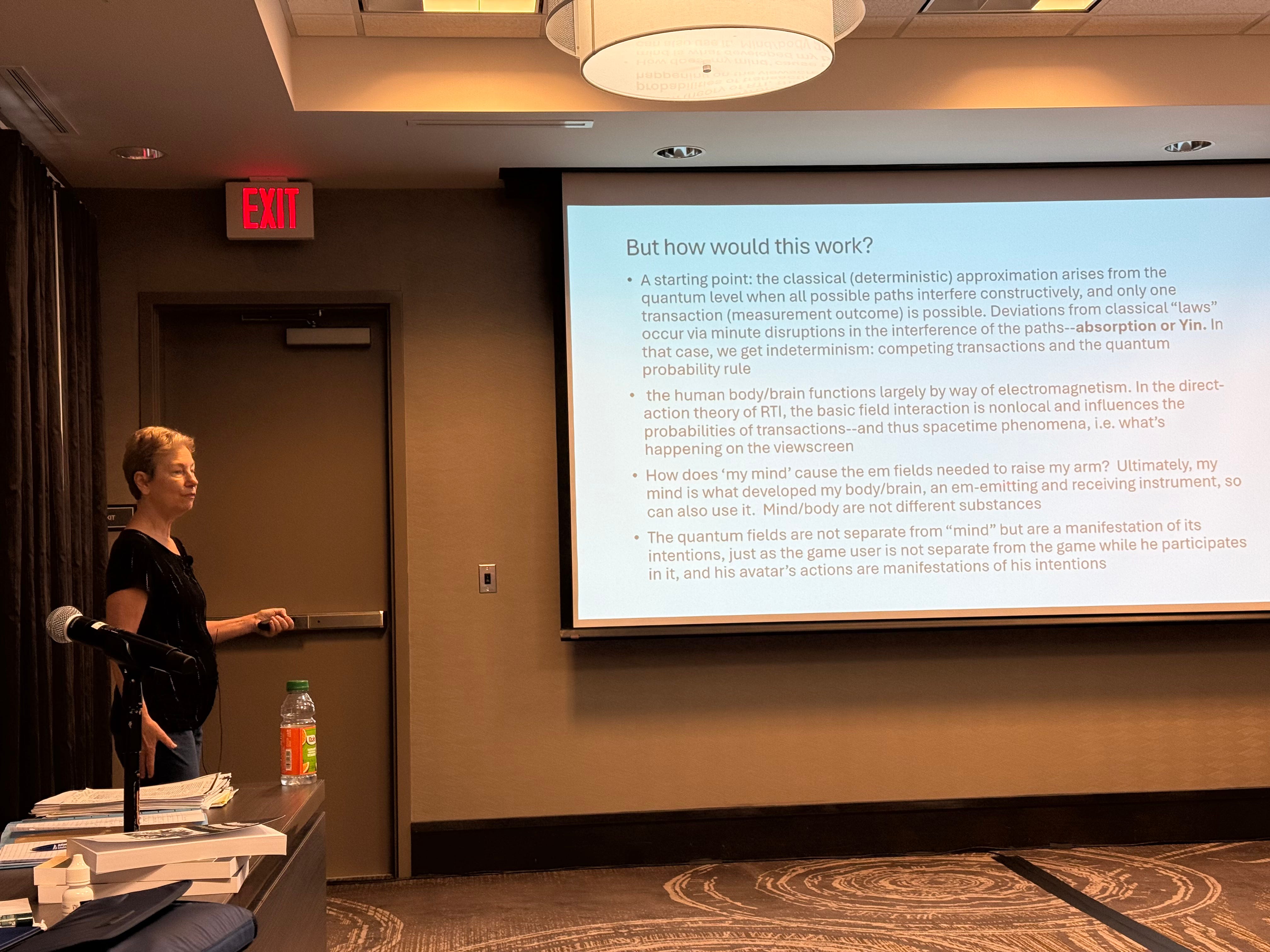
For the Whiteheadian, this is a kismet match: res potentiae function like eternal objects while the completed transaction functions like concrescence. I’d again want to emphasize here that not all routes from possibility to fact are equally valuable. The cosmos is not only learning, it is loving, lured by richer intensities of experience. Ruth’s framework offers the physics and Whitehead metaphysics supplies the natural axiology.
Mike Epperson
Mike framed his talk with a methodological reminder: beyond deduction and induction lies abduction (ie, disciplined, speculative inference). This is the right posture when your theory must stretch to meet stubborn facts. In classical physics, he noted, we start with objects and relate them with propositions. In quantum physics, that order flips: propositional relations are the objects, such that relations-of-relations become fundamental. Measurement, accordingly, is not a mere readout but a propositional internal relation between an actual initial state and an actual outcome state. When an outcome is registered, it satisfies the familiar laws of thought (ie, identity, non-contradiction, excluded middle). But prior to that satisfaction lives a non-Boolean, contextual domain that refuses to bow to classical logic.
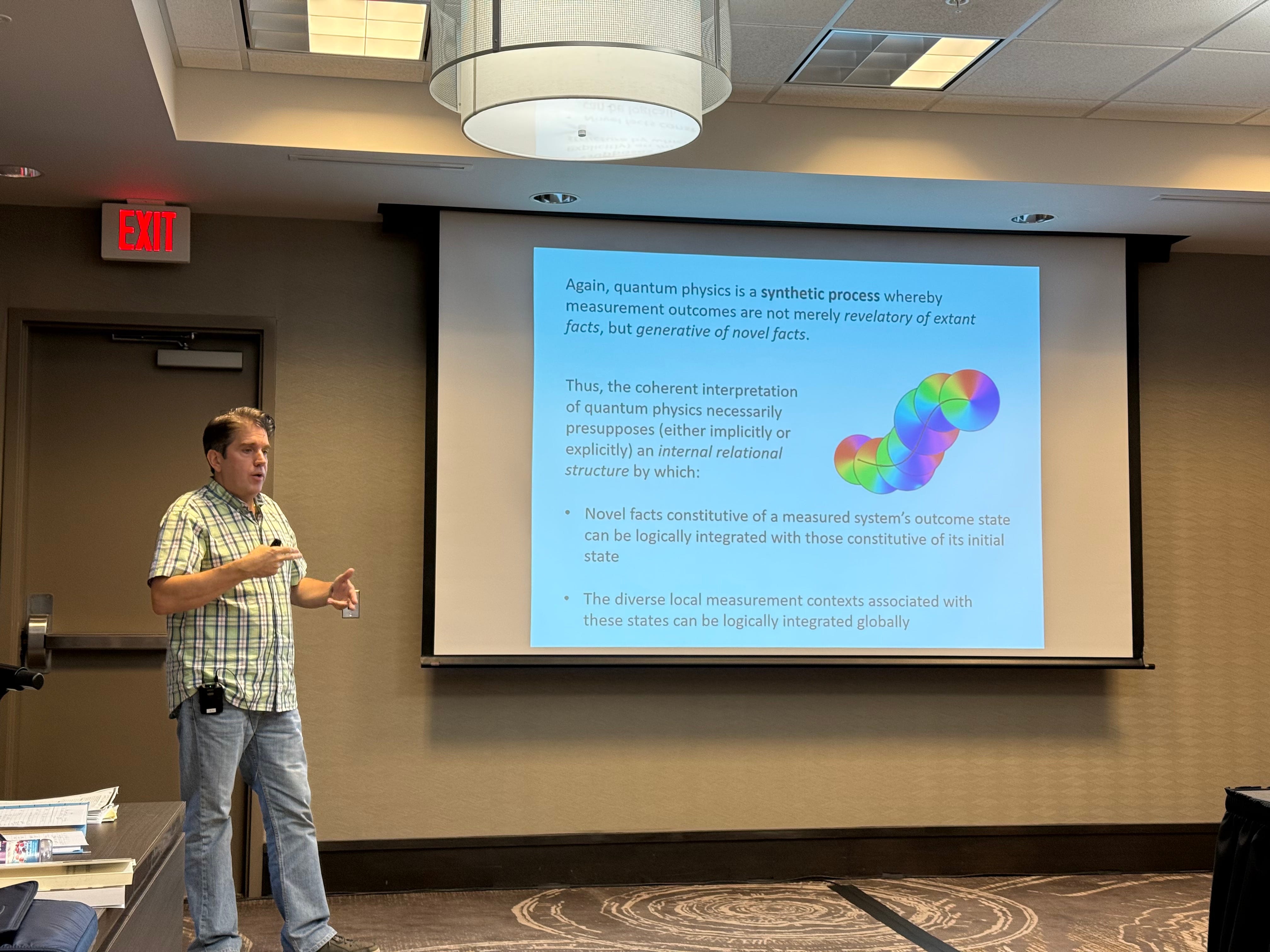
Ruth pushed him (helpfully) by asking how do we get from probabilities to facts? (i.e., where’s the “Yin,” the process that confirms the offer wave and transmutes potential into actual?) Mike’s answer lives partly in the mathematics: his and Zafiris’ category-/sheaf-theoretic reformulation shows how quantum propositions are locally Boolean within experimental contexts, while globally they glue together only as a presheaf of contexts where no single global Boolean algebra exists. On this view, “an object” just is a stable pattern of morphisms across contexts. Classical-looking facts are what certain relational structures look like after a measurement internal relation collapses. Ruth’s challenge stands (and keeps the project honest): the collapse needs a physical story, not just a logical diagram. My notes captured but did not resolve this tension.
Federico Faggin
Faggin joined us on Zoom from Italy. He spoke with the authority of someone who invented the microprocessor. He knows its metaphysical limits from the inside. His core claim was rather straightforward: consciousness is not mathematics, is not symbol or code, but ontology, the very condition that makes knowing possible. “You cannot explain the creator with the created,” as he put it. Experience is first-person and private. We can gesture with public symbols, but the symbols are never equivalent to the knower or to the known. Physics, as currently practiced, has defined only the shell (ie, Shannon information, quantities and probabilistic signals), while meaning is what actually matters in a life. Information is communication. Meaning is communion.
From there he leaned into his “irreducible” thesis. The no-cloning theorem marks a principled boundary: a quantum state can’t be fully copied, mirroring the privacy of qualia. Only a sliver of the state can be objectified without destroying it. He suggested we read a quantum state as the qualia of the field in that state, and pressed the point that quantum physics represents the mind of the universe while space-time is symbolic, a downstream codification. Meaning precedes metrics.
Two contrasts brought the picture into focus. First, wholeness: the hydrogen atom is more than proton+electron; a quantum system is not additive. A computer, by contrast, is no more than the sum of its transistors: syntax all the way down. Second, collapse: at the local level we register outcomes, but the wavefunction of the One (ie, the total universe) never collapses. Here Faggin lands almost in Whitehead’s lap: the One as the divine everlasting concrescence within which finite occasions pulse and decide.
Paul Marshall
Paul titled his talk “Experience is Everything, Everything is Experience,” placing Leibniz and Whitehead on different sides of the same campfire. His pivot point was precognition. If, as Whitehead holds, the future is genuinely open, then “true” precognition (direct, non-inferential knowledge of what will occur) seems ruled out; hence Paul sides with a modified Leibnizian approach, reading each monad as spatiotemporally complete, so that future events are, in some sense, already enfolded within each experient. Paul, like other psi researchers, stressed that many precognitive experiences are non-inferential, and that remote viewing experiments outperform chance while not being perfect, evidence that for some seems to strain a purely open-future process model and motivates the monadological alternative.
But the Leibniz move comes with new headaches: if monads are windowless, how do “more active” monads affect “more passive” ones (ie, how do “minds” affect “material” bodies), as Paul suggested? Pre-established harmony buys coordination at the cost of forbidding real affection: monads end up logically connected, but actually isolated, incapable of relationship. This is where my Whiteheadian nerve starts twitching: everyday life and ordinary experience among others is nothing if not a nexus of spontaneous mutual influence: speech acts that change minds, touch that soothes or threatens, the common commerce of call and response among freely relating co-creators.
On my reading, Whitehead has a way of accounting for the available evidence of precognition in terms of feelings of the future. Whitehead’s actual occasions don’t only inherit an objective past; they also have anticipatory feelings and become superjects, achievements that pass onward into the transcendent future to become data for others. This superjective vector can be understood as the communication of future possibilities to present actualities, but this is not backwards time travel but a function of the ontological dipolarity between actuality and possibility.
Paul fortified his stance with further time-theory considerations. Following H. Wildon Carr, he noted that relativity can be read as a late-modern nudge toward an idealist monadology, with Minkowski spacetime tempting us to see all events laid out in advance. But he also called Minkowski’s absolute spacetime an abstraction, not a literal picture of reality, thus leaving open whether principle/theory elegance is enough without a constructive story of how beings live in time. The process move is to anchor “all-at-once” symmetries in the coordinate order, while letting the genetic order of becoming (where value-laden possibilities sort themselves) remain open. That keeps room for psi’s anticipatory edge while also preserving the reality of novel emergence.
To sum up, from Paul’s point of view as I understand it, if some precognition is genuinely non-inferential and about what will occur, we need an ontology where future facts can already be “there.” Hence he posits a spatiotemporally complete subject (a re-tuned monad) that can, in principle, access later segments of itself.
From my process-relational point of view, we need a metaphysics that preserves real interaction: words that persuade, bodies that bruise or heal, practices that change us, etc. I think Whitehead’s scheme lets us keep these hard core common sense features of experience while still leaving plenty of room for comparatively uncommon psi phenomena. I just can’t shake the sense that Leibniz’s pre-established harmony costs too much; Whitehead’s prehensions fit the bill.
The phrase “true precognition” may itself may be equivocal, assuming a determinist temporal ontology it still needs to prove. A Whiteheadian can accommodate non-inferential anticipations by treating them as prehensions of potentiae (or of value-graded possibilities in the primordial envisagement), not of already fixed future facts. In a creative cosmos, there are no such things as “future facts.” This possibilist rendering of precognitive remote viewing, etc., still fits the better-than-chance profile Paul and Ed cited, but without flattening time into a block. Indeed, the better-than-chance results are precisely the sort of partial anticipatory grasp a process account expects.
Bernard Carr
I’ve enjoyed getting to know Bernard (he was also at the plasma conference I attended last week in Exeter). We’ve had several in-depth chats about Whitehead’s alternative rendering of relativity theory. Like Whitehead, Bernard attended Trinity College, Cambridge.
Bernard’s wager is that consciousness and psi require an extended arena: we must go beyond 4-D spacetime into a hyperspatial framework where mind has more room to move. He linked this explicitly to the specious present—the lived “now” that has duration—but also said that within this window there is no distinction between past, present, and future. I asked him about this seeming contradiction (ie, how can the specious present exemplify real duration if it is also time symmetrical?). More on that below. He mused about an association with hyperspatial closed timelike curves to model an experiential simultaneity that might allow for precognition. He emphasized that physics as it stands contains no passage: the Einsteinian block has all events “there” at once, so a final theory that accommodates mind must speak directly to passage and to the temporal structure of the specious present. He also noted that the specious present likely scales with the system (shorter for rapid systems, longer for larger wholes), and he tied puzzles of personal identity to the scope of this living interval. In discussion, we pressed a key distinction: perhaps within the specious present there is no separation of past–present–future, yet a distinction remains, preserving time’s asymmetry by echoing Whitehead’s insistence that “there is no nature at an instant.”
On the model side, Bernard sketched a 5-D (and beyond) picture where perception becomes a 4-D causal chain: perceptual object and perceiving brain are two ends of a network of signaling worldlines, and memory is access along segments of spacetime connected to that nexus. This “mental space” can be communal (telepathy) and, as in clairvoyance, may even contain the physical, thus suggesting that physical space is a slice of a richer manifold with qualitative as well as metrical structure. Psi, if real, should therefore force a deeper physics. As Bernard put it, “in quantum theory space is fuzzy, in relativity time is funny,” and below the Planck scale neither is fundamental. So why not treat mind and spirit as domains in (or aspects of) a higher-D whole? Tim Eastman asked whether Bernard’s extra dimensions need be metrical: might some mental/spiritual dimensions be non-metrical (ie, topological or projective)? That open question is precisely where Bernard’s hyperspatial geometry can meet phenomenology and process/possibilist metaphysics without either side being overly domesticated by the other.
We need to discuss the details in more depth, but where I may diverge from Bernard is over the symmetry of the specious present. He treats the lived interval as symmetric (no internal past–present–future distinction), then seeks a hyper-dimensional physics that honors this simultaneity. James and Whitehead, by contrast, treat the specious present as asymmetric: a thickness of experience with retentions and protentions (to use Husserl’s language), oriented by inheritance from the past and aim toward the future (objective physical feelings and superjective anticipatory feelings, in Whitehead’s terms).
Michael Nahm
Michael is a psi researcher who has developed an account of anomalous phenomena in terms of what he calls an “arcane nexus.” But his main aim at our meeting was to focus on contemporary philosophy of biology in an attempt to revitalize vitalism. Vitalism is here not as a spooky “life force,” but the claim that living beings require distinct principles of functioning and modes of causality irreducible to the laws governing inorganic processes. He traced the lineage back to Aristotle’s entelechy (internal purposiveness) and forward through neo-vitalism, which drops talk of a substance-like “vital force” while insisting that explanation must include form, function, and aim. Vitalism, in this clarified sense, need not be dualist: it simply says life and consciousness are cannot be fully understood as products of mechanistic classical physics. Nahm recovered Gottfried Treviranus (the coiner of the term “biology”) for whom the essence of life is self-activity maintaining equilibrium under perturbation, an immanent purpose continuous with a nature understood as a giant interconnected organism (thus resonating with Schelling’s Weltseele). In this sense, even “inorganic” processes carry finality in germ, with interiority pervading nature, becoming active selfhood in organisms.
From there, Michael discussed Hans Driesch, who helped introduce the concept of “system” into developmental biology and argued (after his regulation experiments) that organisms show hierarchical organization, unconscious self-regulation, and “labile equilibrium,” such that wholes determine parts and organic processes resist purely mathematical modeling. Consciousness is the most developed aspect of life and is more obviously irreducible to physics and chemistry. Michael then turned Eduard von Hartmann’s philosophy of the unconscious. Von Hartmann posited an “Absolute Unconscious,” or intelligent, world-grounding will as a synthesis of Schelling, Schopenhauer, and Hegel.
Of course, twentieth-century biological authorities like Ernst Mayr declared vitalism “totally refuted,” and were keen to dismiss “acquired characteristics” because they still “smelt” of it. Michael made the case that “organicism” and “vitalism” should be distinguished, given that the early 20th century organicists never missed a chance to throw vitalism under the bus in an effort to appear more scientific. To my mind, this division can feel like the narcissism of small differences. Michael also revisited Ludwig von Bertalanffy, who emphasized that life realizes its own Urphänomen, irreducible to physics. Bertalanffy originally sought what he called a “methodological vitalism” (explanatory principles without metaphysical baggage) and popularized “equifinality” (inherited from Driesch), but later distanced himself entirely from vitalist ideas.
Michael closed by pointing toward the promising development of an Extended Evolutionary Synthesis (EES), including the work of biologists like Jablonka and Lamb, West-Eberhard, Shapiro, and Noble emphasizing epigenetic inheritance, developmental plasticity, niche construction, active adaptation, and even genome rewriting. EES reveals a world of purposive evolution and layered causation with no privileged level. He also highlighted Michael Levin’s heritable bioelectric fields guiding morphogenesis and entertained the idea that biological “memory” is not only in the brain or in the genome. All of this tilts biology toward field-like conception of order and away from mastery by supposedly information containing genetic molecules. I’ve recently spent some time at conferences with the biologists extending evolutionary theory in exciting new directions:
Romanticizing Evolution: Whitehead’s Organic Realism and the Return of Romantic Science
More controversially, Michael voiced some sympathy for intelligent design (ID) arguments about the origin of life (eg, Stephen Meyer, Perry Marshall), claiming abiogenesis is intractable on purely chemical grounds and so demands an “intelligent” explanation. I immediately voiced caution about this move, since the ID theorists assume a mechanistic conception of physical and biological phenomena, taking us back to the Paley-paradigm that Darwin was assuming (despite other indications that Darwin was moving beyond mechanism) but adding the need for a deus ex machina. If Michael wants a fair hearing within the halls of science for neo-vitalism, suggesting sympathy for ID theorists is obviously not going to help. I also felt his stance on ID is ironic given his skepticism toward Rudolf Steiner’s scientific bona fides.
Sharon Hewitt Rawlette
Sharon’s centerpiece is GEIsT—the Globally Efficacious Intentions thesis—which starts from a deceptively simple but subversive claim: some experiences are worth having, and that worth is not epiphenomenal but in fact helps bring them about. In GEIsT, mind is not a late side-effect of matter but the whole point of existence. She frames this as a live answer to the standard puzzle of mental causation: if value is real, how could it ever do anything? Her proposal is that there’s a direct linkage between the felt quality of an experience and its coming-to-be: “it is good” is not decorative commentary but real causality. Philosophically, that can be cashed out in two ways: either intention/free will is fundamental, or there are objective values with causal properties that shape will and intention. GEIsT is officially agnostic between them, but Rawlette personally leans toward the latter. In either case, intention is the operational interface by which value enters the world.
From GEIsT’s angle, psi becomes a kind of end-first or final causation: consciousness starts with the goal and lets the means fall out along the path of least resistance permitted by physical constraints. That elegantly explains both why psi phenomena often present as usefully inaccurate (they nudge choice without needing a perfectly veridical picture) and why lab results are capricious (multiple, sometimes competing, intentions are in play). In Rawlette’s phrasing, mind “adds the smallest amount of additional order” needed to realize the aim, which is why the same intention can manifest as a hunch, a dream image, a timely phone call, or (if ordinary channels are blocked) as PK. GEIsT thus predicts psi’s instrumental opportunism: it recruits whatever channels are easiest: human bodies, shared attention, even electronics as our “extended body.”
She buttresses this picture with two physics-adjacent considerations about macroscopic indeterminacy. First, in chaotic systems tiny uncertainties rapidly proliferate. She offered a billiard-ball parable, where prediction becomes impossible past a handful of collisions without including the gravitational pull of the people standing around the table. Second, she points out that establishing complete determinism would require infinite informational density, which finite regions of space cannot contain due to holographic constraints. Put together: micro-indeterminacies are not too small to matter in the meso-world; thus the future universe is in principle not derivable from the current one. This leaves real slack for value-guided selection among nearby futures, especially in systems (like brains) that can amplify small fluctuations. GEIsT then adds an ethically colored rider: nonlocal psi effects often correlate with intense, blocked emotion. Why? Because the aim seeks another route when ordinary expression is constrained.
Sharon’s theory aims to be predictive as well as unifying. It forecasts that when ordinary bodily pathways for intention are compromised, psi recruits alternative routes: first telepathic coupling with caregivers (acting through another organized body), and, when even that isn’t available, greater incidence of PK. It also anticipates clusters of telepathic communication where conventional interaction is difficult (eg, in some autistic communities). And because the easiest means shift with our tools, GEIsT expects technology to function as a psi amplifier: e.g., more “telepathy-through-smartphone” synchronicities as our devices become integrated extensions of the body. These are not just just-so stories; Rawlette treats them as test points for the framework.
Where I think my process and evolutionary panentheist lens dovetails with her view is in the way Whitehead lets us say both: the universe includes an objective field of value—a divine envisagement of possibilities—and each finite occasion decides how to actualize in response. That makes room for GEIsT’s value-to-intention link while securing plural agency and agonism of aims (your intentions mingling with mine, all flowing through real physical constraints). It also clarifies why psi is mostly subliminal: on a process account, the prehensive causal efficacy of physical feelings is always at work at the edge of awareness, with the body acting as a complex amplifier that normally realizes intention through ordinary channels. Psi shows up when the system leverages less usual couplings (including nonlocal ones) to satisfy the lure.
If minds share a world, intentions interfere and accumulate; the realized outcome is whatever the value-weighted network of striving possibles can most easily bring about under local physical conditions. At the cosmological register Rawlette flags, moving from mechanism to meaning is not sentimentality but explanatory progress. It ties why anything like our world exists to why it is good that it does, thus bringing fact and value back into coherent relation.
Bob Rosenberg
Bob zeroed in on precognition, emphasizing that “true” precognition, or non-inferential knowledge of what will in fact occur in the future, must be taken metaphysically seriously. This opened up a bit of an epistemic rift in the group. Out of this rift poured a series of difficult questions. These questions include: does the knower contact future facts, or merely rely on present cues to infer statistically probable future facts?; or is there direct acquaintance with future possible events through what Whitehead called anticipatory or superjective feelings? Bob walked the room through the empirical trail from precognitive remote perception at PEAR (Jahn & Dunne), to work on presentiment by Radin and Bem (and the kerfuffle when a major paper was headed for the New York Times), to Stefan Ossowiecki’s striking cases of clairvoyant retrocognition,.
Bob’s account of true precognition clarifies the target phenomena and helps us tune theories to evidence. If true precognition exists, we need either (a) a process-relational story in which quantum transactions allow for pre-spatiotemporal, as yet unactualized feelings of potent possibilities (ie, Ruth Kastner’s Possibilist interpretation or Mike Epperson’s topological account), (b) a hyperspatial account where access to future segments is geometrically natural (ie, Bernard Carr’s fifth-dimension timelike curves), or (c) a quantum panpsychist account like Federico Faggin’s). Tim Eastman’s reimagination of physical laws as constraints on possibility suggests the world is already rigged for meaningful anticipation without violating the irreversible flow of causality: the cosmos leaves just enough slack for value-laden selection among nearby but not yet determined futures.
David Presti
David began with the Indra’s net motif that keeps reappearing across traditions and research programs, a reminder that relations are not an add-on but the very weft and weave of reality. From there he unfolded his own genealogy in the biophysical sciences. David’s Caltech mentor Max Delbrück, influenced by Bohr’s extension of complementarity to the living world (ie, probe too hard and you kill what you’re trying to understand), helped shape Schrödinger’s What Is Life? Delbrück’s blunt suggestion that new laws of physics may be required to explain life’s order rhymes with Whitehead’s suggestion in 1925 that the next great advance in physics would likely come through biology.
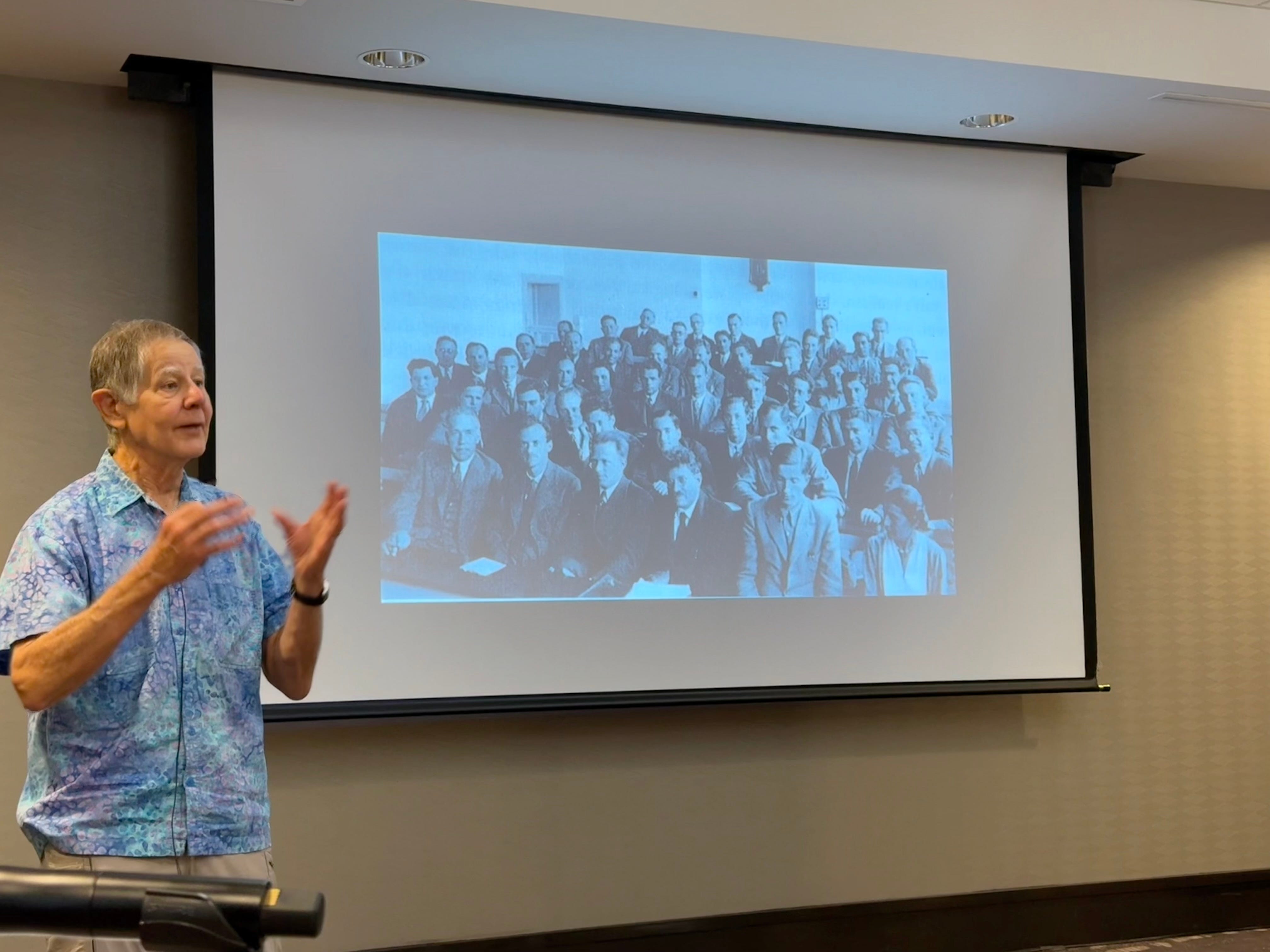
David then situated the roots of psychedelic science in a longer intellectual arc: Benjamin Blood and William James’s “wild facts” (and the later’s nitrous-aided understanding of Hegel), Humphry Davy on N₂O, and Stan Grof’s notion of psychedelics as “non-specific amplifiers.” David emphasized that psychedelics are pharmaka, both poison and cure. He also sketched the Esalen-era bridgework that helped clear space for the modern clinical renaissance (including that ‘90s convening with the government drug czar that eventually fed into the Hopkins program). He pointed to David Luke’s work at the psi/psychedelics interface for ways toward deeper synthesis.
I was glad to see David reference the way Western science rode to epistemic dominance on colonial power and an ontologically faux fact/value split that many cultures would find unintelligible (he cited Nathan Sivin on how grotesque “value-free truth” would seem in classical Chinese terms). And he called out the implicit metaphysics of today’s biomedical lab protocols: clinical psychedelic research often pretends neutrality while being nose-deep in physicalist presuppositions. Materialism and brain-to-mind reductionism is not metaphysically neutral. It is speculative philosophy just like the varieties of idealisms and panpsychisms. The question is not which is less metaphysical, but which better integrates our empirical experience of the facts (in W. James’ radical sense) with our intellectual expectations of coherence and consistency?
…
In the end, the metaphysical and cosmological stakes of psi research are simple to state and difficult to ignore: the available data disclose the fact that mind belongs to and is basic throughout the universe. What we call precognition, telepathy, synchronicity, and the rest are not glitches in a clockwork but boundary-case expressions of a relational, value-laden cosmos. They press physics to recognize possibility and passage as real, nudge biology to accept aim and interiority, and invite us to treat “laws” as evolving constraints within an open creative advance. Read this way, psi is neither superstition nor miracle but an empirical whisper that the many become one and are increased by one, that the specious present has directional depth, and that facts follow values at every scale. A post-physicalist science worthy of these data doesn’t need to abandon precise measurement and rigorous logical formulation. Such a science will widen its method, making it binocular if not triadic, possibilist and hyperspatial, and hospitable to experience so that our theories can finally speak the same language as our lives.
 Footnotes2Plato
What do you think?