I went to my first Phish concert on Saturday night at Dick’s in Denver. I came in peace, was torn to pieces and made whole again once or twice, and by the end concresced into someone new. I also did some anthroposophical research.

I should explain. I don’t mean any ordinary sort of research, the sort which separates science from art and art from nature, as if nous, techne, and physis were ever found apart. I did not go for science but to join a close friend for her tenth show this year because Phish is Phish. And because I had somehow reached forty without ever seeing them. And because I happened to be in Denver when they were playing Dick’s Sporting Goods Park. And because there comes a time when a philosopher has to put down the scholarly footnotes and join the Dionysian dance.
There were also drugs. One drop of C₂₀H₂₅N₃O shortly before the show, reportedly descended through some pharmacological apostolic succession from the original Grateful Dead supply. I don’t share this confessionally nor evangelically. Make your own judgments. But if what follows is to count as experimental metaphysics, then the experimental conditions should be disclosed.
I did not go to Dick’s simply to “have an experience.” I don’t stop being a philosopher just because I get high dancing. I carried my philosophical inquiries with me into the show in the hopes that the event would help frame new questions about consciousness that the modern fragmentation of academic knowledge has made it nearly impossible to ask. How might the perspectives of science, aesthetics, and religious studies be reintegrated?
Phish performed the dissolution of the Cartesian bifurcation that turns nature into an external mechanism and consciousness into a private interior theater. If Phish shows are real, the split between cogitation and crag cannot be. I’ve spent many years thinking with Whitehead, Schelling, Steiner, Goethe, Jung, psychedelics, quantum physics, evolutionary biology, religious ritual, and occasionally Jesus Christ and Mary Magdalene. I’ve argued that philosophical thinking itself can become an alchemical operation, a transmutation of self and world through which the separation between cosmology and autobiography melts into a single coin.
At Dick’s, under falling glow sticks, I became one thought of many in a much wider, wiser brain.
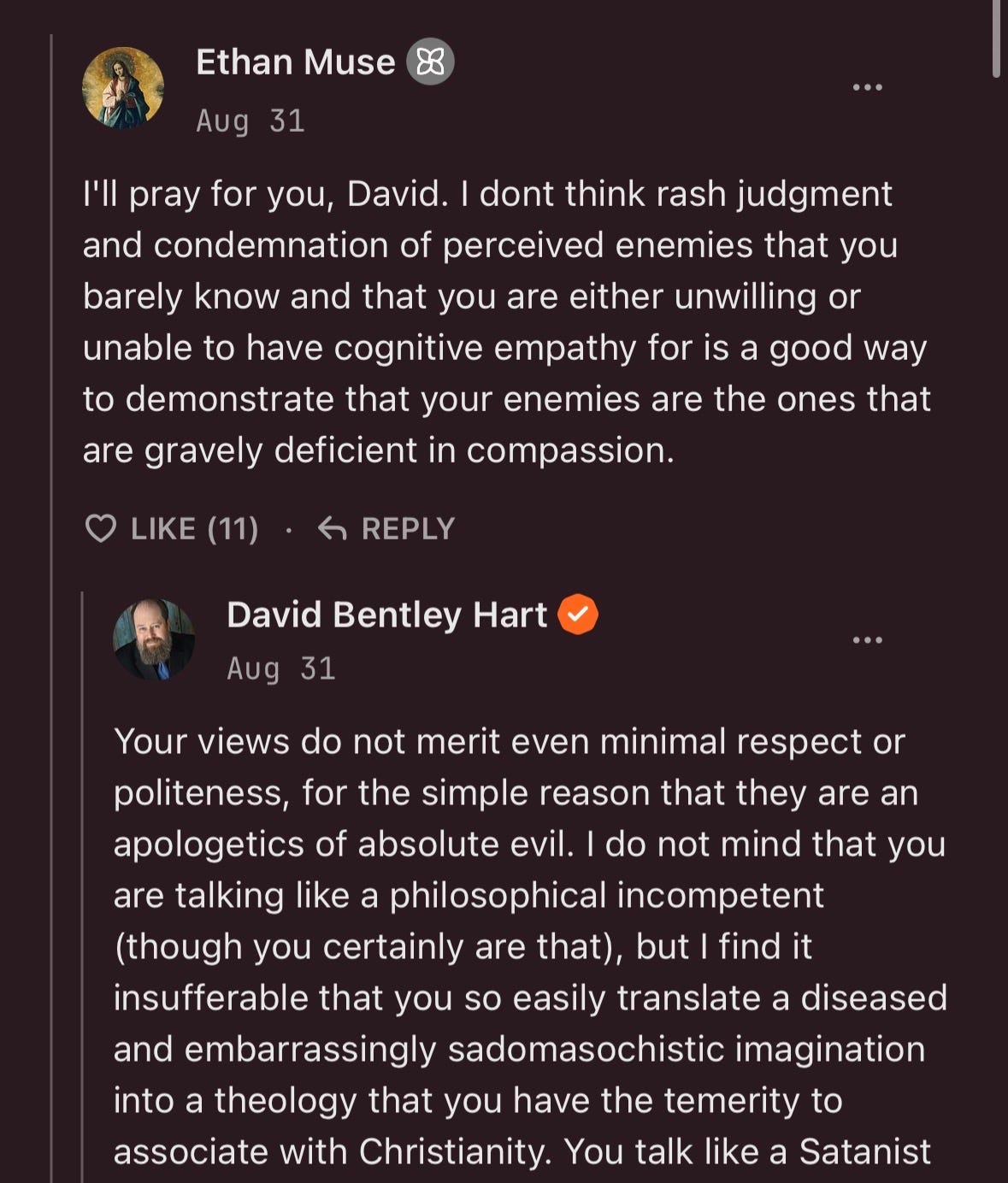
Earlier that day I had been thinking about another famous episode of collective consciousness: the miracle of the sun at Fatima, recently dragged back into philosophical discussion by debates over Joe Schmid’s conversion to Catholicism, Ethan Muse’s apologetics, and David Bentley Hart’s fiery THC-fueled ripostes.
On the ride home after the show, I saw Philip Goff’s deliberately excessive suggestion that something like a “telepathic mass hallucination” might be more plausible than all the theological pleading required to interpret Fatima as straightforward confirmation of Roman Catholicism (as Muse and Schmid appear to).
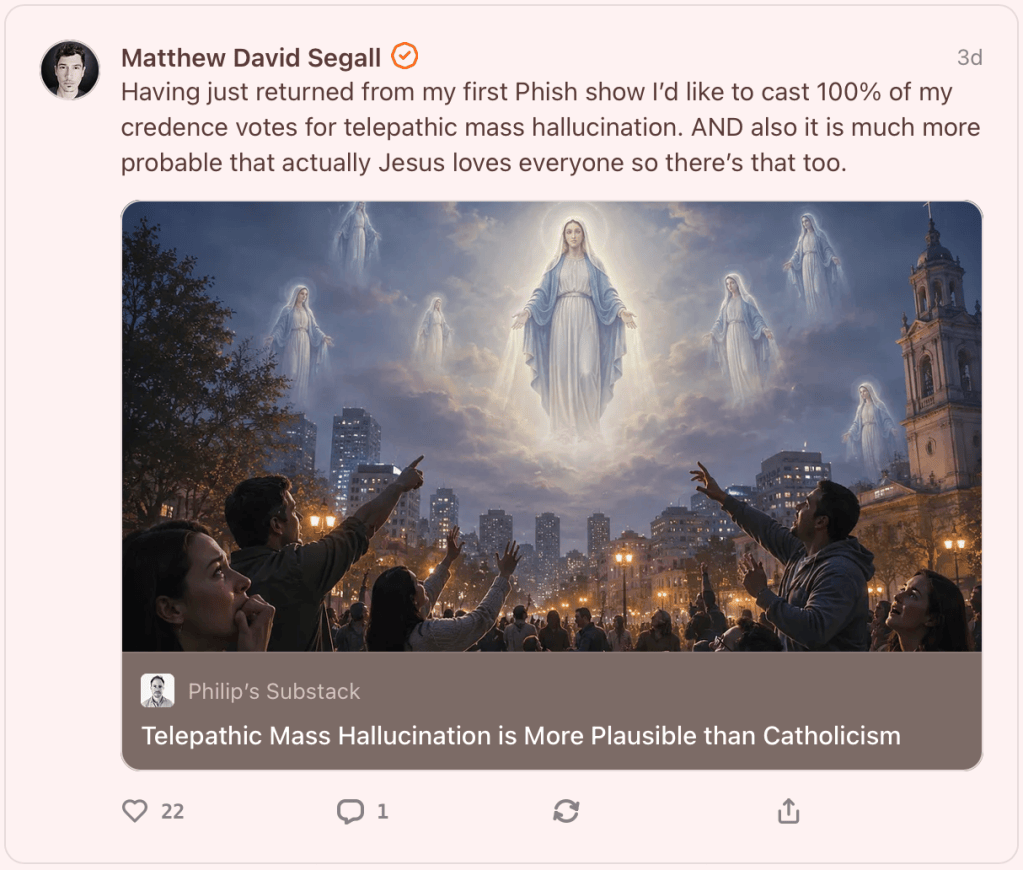
Goff is making an important point about metaphysical inferences. Something genuinely strange happened at Fatima to thousands of people. Does that mean Mother Mary descended from heaven to bless them? Maybe! Does it prove God punishes unrepentant gay sex with eternal conscious torment? I agree with Goff that any reasonable person ought to doubt it.
What if what Fatima discloses is both more mundane and more marvelous at once? What if the event reveals something about the mind-world relation that our old categories remain too crude to classify?
I am, of course, rather temperamentally generous toward high weirdness. Panexperientialism? Obviously true. Spiritual beings? I have met several. Telepathy? A common occurrence. My speculative hospitality expands surprisingly far before it runs aground on the absurd proposition that Infinite Love operates an infinitely funded Department of Damnation. My objection is not just moral, it is metaphysical. Evil is not coeval with creation, but a confused conception of Creativity. For if evil were eternal, if some creatures were permanently refused the possibility of transformation, then discord would long ago have taken the reins of the world and driven the whole to nought. If there existed a single place in this cosmos where divine creativity simply stops, the hole would quickly widen and swallow everything. If divine existence means anything, it means Creative Love knows no bounds.
Phish turned this theology into a phenomenology. We got to the field early enough to secure a spot near the stage on Trey Anastasio’s side. It helps to be close so you can see the musicians listening to one another. I witnessed musical agency migrate among them, out to the crowd, and back again. With every spontaneous crescendo, hundreds of hands sprayed glow sticks into the air. It felt neurological.
From above the bowl looked like the surface of a giant cortex, glow sticks erupting like neurotransmitters spitting themselves onto neighboring synapses. I’m not positive neurons know they are participating in a nervous system. But we did. The whole was at crucial moments throughout the night becoming partially conscious of itself.
Where was the consciousness that housed such moments? Folded inside the curves and chemicals of my brain? Certainly it would be interesting to know what sorts of electrochemical changes were occurring inside my skull. But there’s no way my brain can contain what happened last night.
At some point the music began to play the musicians. Trey would respond to Fishman, who was riffing on Gordon, who followed Page’s unexpected key, who was led off script by Kuroda’s improvised lighting. Fishman would then chime in again to change the rhythmic meaning of everything that came before. The crowd leapt and launched more glow sticks. The band felt the crowd reacting. I reacted to their reaction. Memory altered expectation. Expectation altered perception. Sound and light and chemistry shaped each other in turn. Causal influence ran in every direction.
Whatever the event we call our own consciousness is, we cannot hope to reconstruct it by isolating our nervous system and sense organs from the relational networks in which they are embedded. A subject does not first exist and then encounter an objective world. The subject emerges from the world. Before the clear and distinct display of immediately present colors and tones there is the deeper sway of causal efficacy, our inheritance of the melodies of an already active reality. Our conscious experience is not an interior representation concocted by an isolated observer. It is the flowering bud in which the past is felt by a new present.
The show was an improvised communion, showing us how the world does not appear to a subject but becomes subject, how a pattern can emerge from an interaction to then reorganize the agents who initiated it. The many become one, and the newly achieved one is archived, becoming a datum for others. Creativity, it seems, belongs neither to isolated individuals nor to undifferentiated collectives. It accomplishes its playful work in relational processes through which differentiated agents become mutually constitutive without ceasing to be themselves.
I have to dwell on Kuroda’s lighting rig for a moment.
What an extraordinary assemblage of machines. Motorized trusses contract toward the band, descend, tilt, rotate, and open outward to the audience. LEDs spin on wheels within wheels. Kuroda moves machine to move light to move hearts and minds. The lights are not set on a track synchronized in advance to a known sequence. He plays the rig responsively, translating the musical journey into an illuminated geometry of expansion, enclosure, harmony, and dissonance. Sometimes the apparatus contracted tightly around one or more of the musicians, bathing them in Leonine centrality. Then the electronic architecture swung open to spill the dawn of day out across the sea of faces. Figure became field. Centrality was contextualized.
Kuroda once described Phish’s improv in a way that I can’t help but hear as an inadvertent advertisement for process aesthetics:
“They jam into beautiful, and then they jam into evil, and they jam into pretty again, and they jam into ugly again.”
Whitehead does not grant evil independent metaphysical substantiality. But nor does he damn it to hell. Evil is creativity in conflict with itself. It arises when positive intensities become mutually obstructive, when differences fail to compose themselves into richer contrasts. The result is destructive, and should not be sentimentalized. There is no secret beauty in cruelty. The atrocities of history cannot be written off as temporal dissonances awaiting eternal resolution. But without the risk of discord and destruction, we would not exist as expressions of a genuinely creative cosmos.
Even the most perfect artistic achievement becomes sterile through repetition. The holiest harmonies can harden. But there are perfections beyond perfections, harmonies of harmonies. Discord need not destroy but may function to break “the tameness of outworn perfection,” as Whitehead puts it. Imperfection striving toward wilder beauty is often preferable to lesser perfections grown stale.
Again, Phish performed it. Sometimes they jam into ugly. The sounds and lights become abrasive, awkward, ominous, uncertain. The path grows dim. Then a new order precipitates out of the uncertainty. It doesn’t make the ugliness seem good but transforms it into material for a form unplannable in advance.
And here aesthetic phenomenology turns back into theology. Eternal damnation is metaphysically absurd because it makes discord seem permanent. Hell is made into a note God cannot resolve. A creature is made forever unavailable for further relation, a fragment of the real is cast out of the creative advance.
But Christ is love, and so descends to harrow hell as a light entering every abandoned region so that nothing may be left outside the reach of divine concern. Enter Lucifer and Ahriman, the anthroposophical adversaries, whose polarity was made strikingly evident to me by the spectacle. Ahriman is fixity, abstraction, calculation, machinery and technical control. Lucifer is levity, intoxication, imagination, beauty, and boundary dissolving spiritualization.
Ahriman was evident in the steel trusses, the electric power, the motors, the digital control systems and speaker arrays. The rig was a cathedral of calculation. But Lucifer turned the lights liquid, making the rig appear to float and breathe, to loosen time. Technical constraint provides the condition for imaginative freedom, just as imaginal excess and the risk of discord prevents technicity from decaying into lifeless repetition. Forces that might otherwise obstruct one another are composed into heightened contrasts.
Dick’s stadium became an alchemical athanor. The vessel melted steel, silicon, electrons and photons, subwoofers, smoke and sweat, LSD, friendship, history, and vast amounts of glowing plastic. I was not just observing the transmutation but was one of its reagents. Dissolve and reform.
There was also a two-minute stretch near the end of the second set when I remembered Monday was just 24-hours away. I remembered my email inbox and the many administrative meetings on my calendar this week. My cosmic sensorium dimmed and all that remained visible was my next writing deadline. The anxiety passed quickly and the show crescendoed, but the after-show brought the inevitable come down.
We exited the stadium to a cacophony of clanking tanks and popping balloons. Dudes prowled around with five balloons swollen in each hand to sell dissociation to exhausted concertgoers for 20 a pop. The scene went from Dionysian to dystopian fast, as police moved through aggressively to clear the shakedown from the parking lot.
I made it back to my hotel by about 2am and finally fell asleep for a few hours. Alchemy is exhausting.
The lineage from the Acid Tests through the Grateful Dead to Phish constitutes a peculiar experimental tributary in the evolution of modern Western consciousness. I wouldn’t want to overly romanticize it. The story includes addiction, escapism, the clawing grip of commodification, over-indulgence, and a great deal of naïveté. But it has accomplished something invaluable. Modern Western consciousness achieved extraordinary power by means of differentiation: of mind from nature, subject from object, individual from community, reason from myth… The problem is not the differentiation, but reifying it into separation. Rock music might initially look like a caricature of the sovereign Western male ego. One man in the spotlight holding an electrically amplified guitar in front of tens of thousands. Phish shows undo the sovereignty. The jam dismembers the rock God. Nietzsche’s Dionysus appears as the force that fractures the individuation principle. But Dionysus is not just dismembered, he is remembered, torn apart, metamorphosed, and reconstituted.
The point isn’t to murder the ego but to remind it of its birthplace, that it was never separately created, that individuation is participation, and that losing oneself is becoming more deeply oneself.
Lying in my hotel bed last night, it occurred to me that fundamentalist forms of Christianity need Phish. And that Phish needs Jesus.
Patriarchal Christianity has become anti-Dionysian when it should be Dionysus-plus. Rigid hierarchies must be disrupted, eros unleashed, bodies and minds merged beyond all purity codes. If I may humbly say so, Christians need to remember the meaning of Christ’s incarnation. God became earthly. Spirit entered matter. Christ is not simply a dying and rising God. Dionysus already accomplishes the feat. Christ is also the love that frees us from fear of death, so that we might open our hearts to the Divine Body of which we are co-creative members.
The Mystery of Golgotha announces, no longer in merely mythic ritual but in spiritual form, that fear of death need not be the organizing principle of consciousness. The passage into death is not the end if relationship runs deeper than self-preservation. Christ doesn’t just put the dismembered self back together but invites it to inhabit another kind of body. We become members of one another, intensified in our personhood rather than diminished by our participation in others.
Immortality is not endless repetition of the same. Resurrection is not recurrence. It is freedom from organizing our existence around the terror of ceasing to be. It is freedom from the satanic belief in eternal hellfire.
What happens when we jam into evil? Must discord be denied or can it be transformed?
Consciousness can be intensified in horrible ways. Crowds can become mobs. Charisma can become coercion. Technology can produce collective convenience or industrial slaughter. Altered states can heal, illuminate, inflate, fragment, seduce, terrify. The softening of ego boundaries can issue in compassion or in the inability to remember where one’s responsibilities begin.
This is why religion can never simply be replaced by neuroscience or aesthetics. Religion asks what consciousness is for.
Science investigates the conditions under which consciousness occurs. Art experiments with what consciousness can become. Religion asks what forms of becoming are worthy of us. Philosophy asks how they all belong to one world. Consciousness is made intelligible only when these three modes of inquiry correct and complete one another. Science without art mistakes abstraction for actuality. Art without religion becomes intoxication without orientation. Religion without science and art becomes blind to everyday miracles and reduces morality to fear. Held in solution, they disclose that consciousness is not a skull computer but a creative portal linking self to world through God, and God to world through self.
My point is not that Phish proves panexperientialism, but that extraordinary experiences can disclose solutions our inherited concepts conceal.
So we jam into beautiful. We jam into evil. We jam into ugly, terror, exhaustion, transcendence, Monday morning, and wherever love leads us next.


What do you think?