I was back in Aspen, CO this past weekend for the second annual Frontiers of Knowledge event at Wheeler Opera House. I presented alongside David Peña-Guzman (who you’ll hear in the last few minutes asking me a question about artificial intelligence). All the talks should be available in the coming weeks on the Frontiers of Knowledge YouTube page.
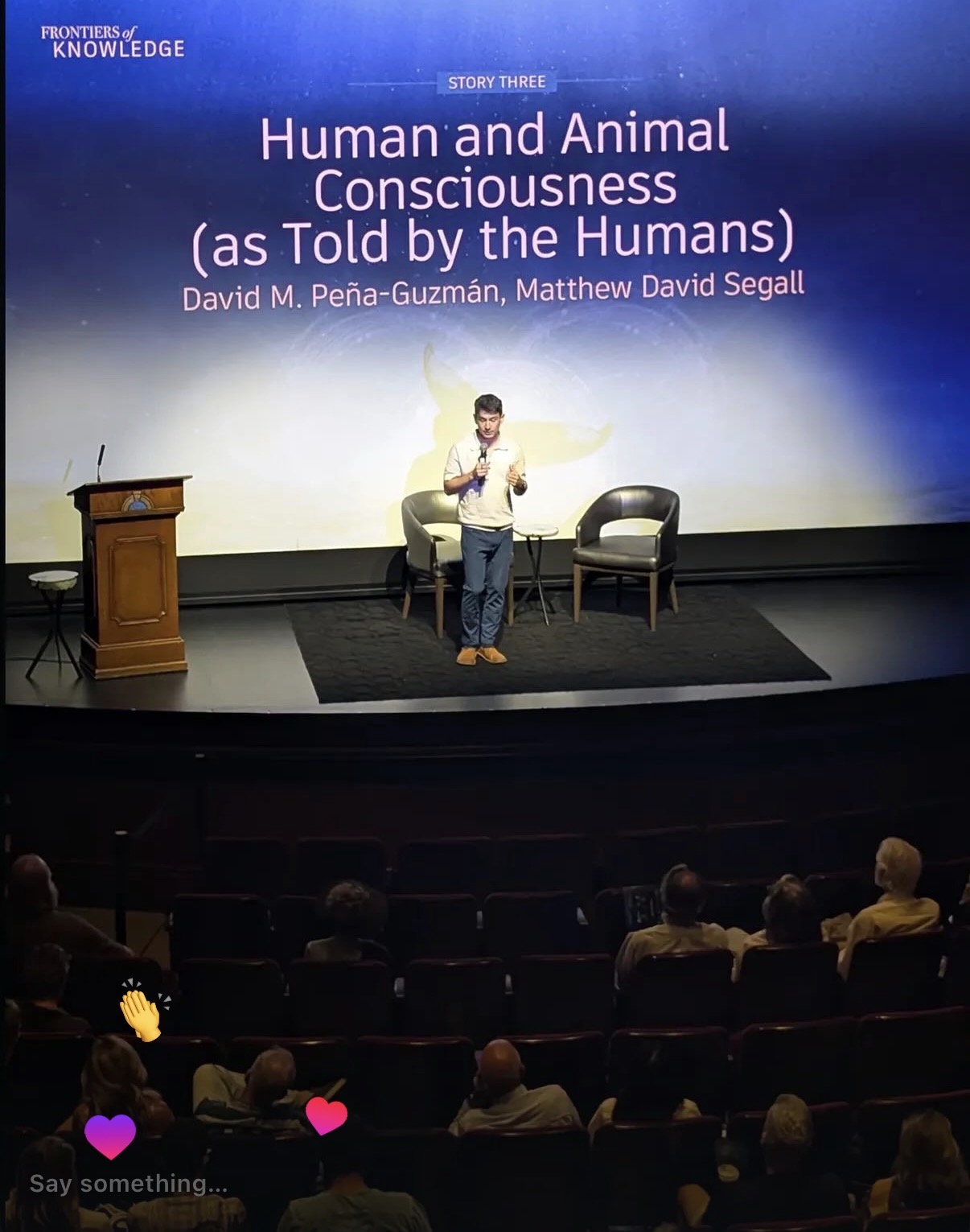
My name’s Matt Segall. Hello, everyone. It’s great to be here with you again. I don’t know if anyone was here last year, but thanks for coming back.
My talk from last year’s Frontiers of Knowledge event:
Matter, Life, and Mind: Love as a Cosmological Power
I’m a philosopher, and in the wake of what David shared about animal consciousness—and the invitation to reimagine who and what animals are, and by proxy who and what we are—I’m going to give a little historical overview of the shifting worldviews that have gotten us to this point.
I’m going to begin by talking a little bit about what’s called animism. Chantal Forbes earlier invited us to inhabit this cosmovision of our ancestors, predominantly hunter-foraging peoples who were attuned to the natural world in a relational way. I’ll speak more about that in a moment.
Then I’ll talk about two philosophers and two scientists: Plato and Descartes are the philosophers, who tend to get a bad rap in these sorts of conversations; and then Darwin and James Lovelock are the two scientists who help us reimagine the human being and our relationship to the Earth and the community of life that we share this planet with.
And then I’ll talk a little bit about what the human is and what our responsibility might be—all in under fifteen minutes.
So, we’re here in Aspen, and I love this place. I grew up coming here in the summers as a child, and the aspen tree is one of my favorite features of this landscape.
The thing about the aspen tree is that it really blurs the boundary between the individual and the community, because above ground you see all these seemingly individual trees, while below ground they’re all connected and are, in fact, one organism—a clonal colony.
And so I invite us to consider the ways in which that’s true of us as well. This doesn’t mean we aren’t individuals. It means that to be an individual is to be a node in a network of relationships.
Maybe there are some Life of Brian, Monty Python fans here. Repeat after me: “We are all individuals!”
It doesn’t sound like you’re very convinced.
So the point of stepping into a relational worldview is not that we’re not individuals. It’s that to be an individual is something we learn how to do together. First and foremost, by being raised by loving parents and loving communities, we are invited into what we call individuality, which is not something separate from the world but a way of being in relationship to the world—and of achieving, through mutual recognition, a kind of collective freedom as human beings and as living organisms.
I think this has a lot to do with animism, which is a relational way of knowing, but also a relational way of being.
At the human level, one way of understanding what this relational worldview would be like is to consider the ways in which, when we relate to another human being, we’re always relating to a “you-plus-me.” I don’t relate directly to you; I relate to how you and I emerge into a new type of being together—a third thing, actually.
Similarly, when you relate to me, you relate to “me-plus-you.” But this isn’t simply additive. It’s cumulative. In every relationship with another human being—or, indeed, you can expand this to any other being, or a mountain, or a river—we’re becoming something new together, moment by moment.
And that’s kind of what evolution is, writ large. Evolution is always coevolution.
So even though these animist worldviews emerged long ago, many tens of thousands of years ago, I think there’s already something evolutionary about them in the sense that Darwin would rediscover. In many ways, this is a story of how, while we’re advancing in some ways, we’re also forgetting things we already knew and then rediscovering them in a new context.
Animism, as Chantal was also pointing out, is the default worldview for 95 percent of our species’ history. It’s not the anomaly. The anomaly is the modern mechanistic view of nature as a machine and the human being as some sort of anomalous creature that was parachuted in from another dimension, as if we don’t belong in this world.
And so we’re really just trying to go back to what was normal for our species for most of our history.
In addition to the aspen tree, I want to arrive in this place by remembering the Goethe Bicentennial Convocation in 1949, which helped put Aspen on the map as a place where people were exploring the connection between body, mind, and spirit.
Goethe is really an astonishing figure—not only a poet, playwright, and statesman, but also a scientist who recognized this relationality and the way in which the human mind is not an anomaly in nature, but a way in which nature comes to know itself.
Goethe was alive in the late eighteenth and early nineteenth centuries, watching this new methodology of natural science begin to develop all sorts of instruments for measuring the sky, and microscopes for observing the microscopic world. He was all in favor of that, but he was also worried that these instruments and technologies were throwing us out of proportion.
He thought that the healthy human being, and our suite of senses, was actually the most perfect instrument for the observation of nature.
So an attunement of our senses—which evolved to keep us in touch, in a kind of resonance, with the natural world—is actually not simply a source of illusion. There’s plenty of research showing that, yes, we can be deceived by our senses. That goes all the way back to Plato and Descartes. But there’s also a way in which the senses reveal something that gets distorted when we use high-tech instrumentation.
Not that we shouldn’t consider what is revealed by advanced technologies and instruments, but we shouldn’t forget what our bodies—what embodied presence—reveal to us about the natural world.
Another thing I’ll say about animism is that, as animists, we don’t relate to a mountain, say, as just a source of silver ore. This theater itself was built during the silver boom here in Aspen. And there have now been a few hundred years not just of non-animist but of profoundly anti-animist modes of relationship to the natural world, where we relate to something like a mountain as just a dead stockpile of resources that we should extract, rather than as a living presence of some sort.
What we might mean by “life” in a way that could include even mountains is something I hope to unpack as I move forward here.
So I want to talk about Plato.
Sometimes, in histories of environmental thought and environmental ethics, or attempts to overcome dualism, Plato is maybe public enemy number two, if Descartes is public enemy number one.
People will say, “Well, Plato was the originator of this dualism between mind and body.” And there’s some of that in Plato, no doubt about it. But Plato was also, I think, a profoundly relational thinker.
In one of his dialogues, the Timaeus, Socrates enters into dialogue with the astronomer Timaeus about the origins of the universe and, eventually, the origins of the human being. The story is in some ways a kind of developmental journey, almost like an embryogenesis, in which the entire universe is imagined as a living organism.
For Plato, in a way inheriting this default cosmovision of Indigenous cultures around the planet, the universe is a living organism.
But he’s also trying to understand how intelligence comes into relationship with what we would now call matter.
Plato’s concept of matter was a little stranger than, say, the Cartesian understanding of matter as simply dead stuff. For Plato, intelligence was this active principle trying to bring goodness and beauty into the world, and materiality was something akin to a vibratory space of possibilities that was ready to receive the activity of this cosmic mind or intellect.
But what Plato realized is that for intellect and materiality to touch each other, there needs to be a mediating presence, which he called soul—or the anima mundi, the world-soul.
And this was the universe imagined as a living organism: the meeting place of these ideas coming from the intellect and the receptivity and generativity of materiality, which can receive those ideas and give them a place to become, as it were.
So the idea of soul or life, for Plato, is what overcomes the dualism between, you could say, mind on one side and matter on the other. It’s life that allows these two principles to meet.
We can understand this idea of the cosmic organism, the cosmic animal, as the meeting place of ideas and intelligence, on the one hand, and materiality on the other.
Plato also, I think, helps us understand intelligence in a way that’s still relevant for us today in the age of AI.
He would say that it was human beings observing the motions of the heavens—the wandering planets going through their orbits, sometimes going retrograde, and then the fixed stars—who encountered the rhythms and harmonies that taught us mathematics. Plato says the heavens taught us how to count, how to keep time, and taught us geometry.
So rather than saying, “The human being is so smart, and our brains produce this knowledge,” Plato was saying, no, we learned it in relationship with the sky, with the nonhuman world.
Intelligence, in that sense, is not just a human possession that we created ex nihilo, pulling ourselves up by our bootstraps out of a universe that was somehow not intelligent before we got here.
Intelligence is there already for Plato, just like life is there already.
For most of the ancient world and the medieval world, up until around 1600 or so, this idea of the world soul was in some sense taken for granted.
But gradually there was building an understanding of the human being as something separate from this world.
There were a lot of religious wars going on in the seventeenth century, and René Descartes began to search for a universal language that he thought could help resolve some of these disputes about religious issues that nobody really had evidence to settle one way or another.
He thought that mathematics, measurement, science, and scientific method could unify Europe. While religion was dividing us, maybe science could unify us.
I say that to help redeem Descartes a little bit.
We all know the terrible things he would say about animals when they were being dissected: that when you think they’re screaming in pain, it’s actually just the squeaking of gears. He would teach this because he had a conception of the world that was indeed divided in two.
Everything extended in three-dimensional space is made of matter. It’s mechanistic, and the human mind can understand it completely in a mechanistic way by modeling it with geometry and mechanics.
And on the other side was the human soul, which didn’t come out of nature. It was, as I said earlier, sort of parachuted in from heaven, designed by God and given these innate ideas by which we could understand this mechanistic universe.
And this is the basic image of the human being and nature that we’ve inherited over the last few hundred years in the modern Western world.
It’s a tremendous shift away from nearly everything prior to this modern period. If you look at cultures the world over, the human being took life for granted. Of course the whole universe is alive. Everything that moves was, for most of humanity’s history, considered to be alive, ensouled, and in some sort of resonant response to our own intentions. We could relate to the nonhuman world as another form of soul.
It was death, for most of human history, that was the abiding mystery and somehow needed to be explained—which is where a lot of religions, rituals, and burial rites come forth.
If the universe is predominantly alive, and we see human beings and animals die and their bodies decay, where does the soul go?
So we come up with all of these stories about how life continues, because we couldn’t really fathom how it could just end.
In the modern period, death becomes the pervasive rule. The whole universe is imagined to be dead, and now life is a mystery.
And so we have all of these scientific challenges: Where did life come from? How did life emerge? Where did consciousness come from? How could consciousness possibly come out of matter?
These remain active research areas. But if we don’t accept Cartesian dualism, then I think a lot of these challenges get totally refigured.
In the mid-nineteenth century, of course, we have Charles Darwin and Alfred Russel Wallace, among many others, beginning to work out this understanding of an evolutionary process in which the human being is, in fact, an animal that has emerged out of a process billions of years in the making.
And our ancestors include not just our parents, grandparents, and their parents, and so on, but extend all the way back to the first cells that emerged out of the chemical and geological processes that Dr. Bruce Damer, the astrobiologist, taught us about last year, if you were here.
Darwin allows us to understand a continuous process of evolution.
The human being is not an anomaly in nature anymore. The human mind is not an anomaly in nature anymore. As David was just sharing with us, we are continuous with the animal kingdom.
Darwin’s book The Descent of Man—the descent of the human, we might say—puts us back into nature.
But Darwin was still accepting a more or less Newtonian picture of the physical world. The Earth is a kind of rock, and then life somehow emerges on it. Darwin didn’t pretend to know exactly how. He talked about a “warm little pond” where the right chemistry might have gotten together for this to occur, but he didn’t speculate extensively about the origin of life.
So the Earth is a rock, and life is something else that’s happening on the rock.
Darwin gets us really far in helping us understand ourselves as part of this universe and part of this Earth, but there’s still this mechanistic background that he was assuming.
And he had every reason to, because we didn’t yet have quantum physics, relativity physics, complex-systems science, and so on, all of which began to erode this mechanistic view of the natural world.
The final scientist I’ll mention here is James Lovelock, who was asked by NASA in the 1960s if he could help them figure out a good test for discovering life on another planet—on Mars.
They wanted to know: “Okay, you’re a chemist. What do we look for in the soil of Mars to be sure that life exists, or used to exist, on this planet?”
And he thought about it. He started studying spectral analyses of the Martian atmosphere and said, “You don’t need to go to Mars. There’s no life there.”
How did he know that?
The atmosphere of Mars was close to chemical equilibrium. If life were present on a significant scale, the metabolic activities of living organisms would disturb that equilibrium.
And in thinking about Mars and the Martian atmosphere, Lovelock then turned back around and looked at the Earth.
He realized: there’s life on Earth. And if I were on Mars looking at Earth, I would notice this in the disequilibrium of our atmosphere.
He began to think more about this and realized that life isn’t just adapting to live on a rock that’s fundamentally dead. Actually, life is creating the environmental conditions for its own further flourishing, so that the entire planet can be understood as a living system engaged in the activity of producing and maintaining a more hospitable environment for life.
The organism is not separate from the environment on this planet. Living organisms have been creating and transforming their own environment, regulating the atmosphere and participating intimately in geological and geochemical processes.
So Earth is a living planet down to its very geology.
There’s no longer simply a mechanistic background of dead matter. Lovelock is helping us understand life as a planetary phenomenon.
And I think, if we put on our speculative, imaginative philosophers’ hats—and I hereby identify all of you as philosophers here today, so you can do this with me—maybe Plato was right, and the whole universe is a living organism.
Maybe every living planet is a living cell within that larger organism, and every organism on the Earth is itself a cell within that larger organism.
Remember what I said about individuality and community, individuality and relationality: there’s a blurry line between these two. We are all cells within a larger body.
So the takeaway here, I think, is that as human beings, one thing that makes us unique—and gives us a unique responsibility on this planet—is that our idea of nature affects nature.
Our idea of what the Earth is affects the Earth, because we have tremendous power.
We’re living in the so-called Anthropocene, where the human being—or at least a portion of human society engaged in industrial activity—has become equivalent in geological force to something like an asteroid impact or a super volcano eruption.
We are changing the geochemistry of the planet. We are helping initiate the sixth great mass extinction in the history of this planet.
And so we have a tremendous responsibility to get this right: to imagine the Earth and the whole cosmos in a way that, first of all, lets us feel like we’re at home here, and then lets us stop fouling our own home and destroying the conditions not only for our own survival, but for all the other species with whom we share this planet.
…
I think I agree deeply with SCARLETT that intelligence is relational. I gave this example from Plato—and in another dialogue, the Laws, he talks about the stars, the sky, the heavens teaching human beings mathematics.
And if you look at the evolution of our species and our coevolution with our technologies, in some sense human intelligence has always been artificial, in the sense that it has required these external artifacts to augment our own cognition.
So we’ve been in a coevolution with technology from the very beginning.
People make a big deal about the fact that we’ve been carrying around smartphones in our pockets, almost like they’re appendages of our bodies. We’re on the verge of actually putting these things into our bodies.
But if you go back to the Paleolithic and think about something like the harnessing of fire, which allowed us to cook food, that made food much easier to chew. That allowed our jaw muscles to shrink and created more room for our brains to grow. So already this new technology was changing us at a physiological level.
I loved what Chantal was saying about tracking animals—looking at footprints and the different ways the landscape is affected by the movement of animals—as perhaps the first form of reading and writing: recognizing traces of what has occurred in the landscape.
But as we actually develop what we would usually think of as writing systems—the alphabet and other character-based systems—our whole cognitive apparatus and sensorium are being changed.
David Abram has written a great book about this, The Spell of the Sensuous, about how learning the alphabet is, in a way, de-animating our sensory attunement to the living world so that we can then reanimate these little squiggles on the page. They’re visual symbols for sounds that then become conveyors of profound ideas. But there’s something lost in learning to become literate.
And so we’ve been on this trajectory toward what we now call artificial intelligence for a long time. Our intelligence has always been artificial.
I think keeping that in mind—that, yes, this is a new technology, but it’s also part of a very ancient coevolutionary trajectory—might help us chart a path forward.
 Footnotes2Plato
What do you think?