This past Sunday, my partner Rosie and I attended a service at a conservative evangelical congregation just outside Asheville. We went at the invitation of friends who had recently converted to Christianity. We knew the church leaned conservative, but we weren’t quite expecting the degree of biblical fundamentalism and religious exclusivism we encountered.
The experience left us disappointed but also genuinely puzzled.
The congregation was full of young people, from toddlers to teenagers, their parents, and relatively few older people (as someone used to generally whiteheaded Episcopal and process-oriented congregations, this was notable). The joyful energy was palpable in the room. During the opening songs, dozens raised their hands above their heads in praise. The young women singing on stage, one wearing a gold-lettered Christ is Kingsweatshirt, were enraptured in heartfelt devotion. I have no reason to doubt that something spiritually meaningful is happening in these people’s lives. They have found a sanctuary, a life-enhancing rhythm of worship, and a sense of transcendent purpose that by all appearances animates their relationships with one another.
And yet, the theology through which this devotion was being framed seemed to me profoundly at odds with the spirit of Christ as I have come to know and love Him.
The worship songs repeatedly emphasized that Christ is King, that He alone is worthy, that He alone can save us. The language felt almost insecure in its repetitive insistence upon His absolutely sovereign supremacy. Christ’s greatness seemed to require not just the marginalization but the demonization of other wisdom traditions and spiritual paths.
Before Holy Communion was offered, the Eucharist was described as a weapon in spiritual warfare against Satan. I found this metaphor repugnant. My understanding of the Eucharist is centered on participation in the body of Christ, on the way the divine enters into our embodied coexistence to call us into deeper communion with one another. To treat this sacred meal as a weapon inverts its meaning.
The pastor’s sermon focused on Paul’s first letter to the Corinthians, particularly his criticism of the Corinthian community’s tendency to become attached to particular preachers and spiritual authorities. The pastor repeatedly warned against following charismatic personalities or so-called gurus rather than Christ Himself.
As Rosie pointed out, he seemed entirely ignorant of the Vedic meaning of the Sanskrit term he had appropriated. But in today’s spiritual marketplace full of charlatans, it’s hard to deny that there’s something to his warning. Still, I found his reasoning rather silly. Counseling the congregation not to take his word for anything, the pastor kept insisting that they should simply “look at the facts.” By facts, he meant the words of the Bible.
Biblical inerrancy seems specifically designed to annoy people who enjoy reading. I admit I cannot grasp how any halfway educated person could come to believe that the Bible is simply a collection of uninterpreted facts. Some kind of early childhood trauma, maybe? OK, I confess to being a bit judgmental here… But c’mon, the Bible is a set of historically assembled texts written, edited, translated, canonized, and interpreted by many generations of human beings. Treating these texts as though they somehow speak for themselves or transparently convey propositional facts obscures the unavoidable and indispensable role of human hermeneutics in establishing their authority and their meaning.
A few offhand political remarks furthered my sense of dissonance. The pastor expressed anxiety about the results of the November 3 midterm elections and, at another point, implied that gay and lesbian people are confused about sexuality. These were not the central subjects of the sermon, but precisely because of the way they were passed off as casual remarks, they revealed something about the cultural assumptions taken for granted within this congregation.
Rosie and I were left trying to understand how such genuine religious devotion could coexist with what seemed to us a constricted, patriarchal, and politically reactionary interpretation of Christianity.
I do not want to dismiss the congregation or pretend to know the hearts of its members. I recognize something of my own devotion in theirs. That is part of why the experience was so unsettling for me.
I have spent much of my adult life trying to understand what happened to me when Christ unexpectedly poured into my soul more than twenty years ago. I am devoted to Christ, though my understanding of His cosmic power differs dramatically from the forms of Christianity that have become culturally dominant in the United States.
The question I left the service with was not simply whether these evangelical Christians have misunderstood Christ. I left reflecting with great urgency upon how Christianity became what it is today. What happened to the original spiritual impulse that emerged among the followers of Jesus? And what might it mean to become faithful to Christ in a way that allows Christianity to move beyond its inherited religious, political, and cultural boundaries?
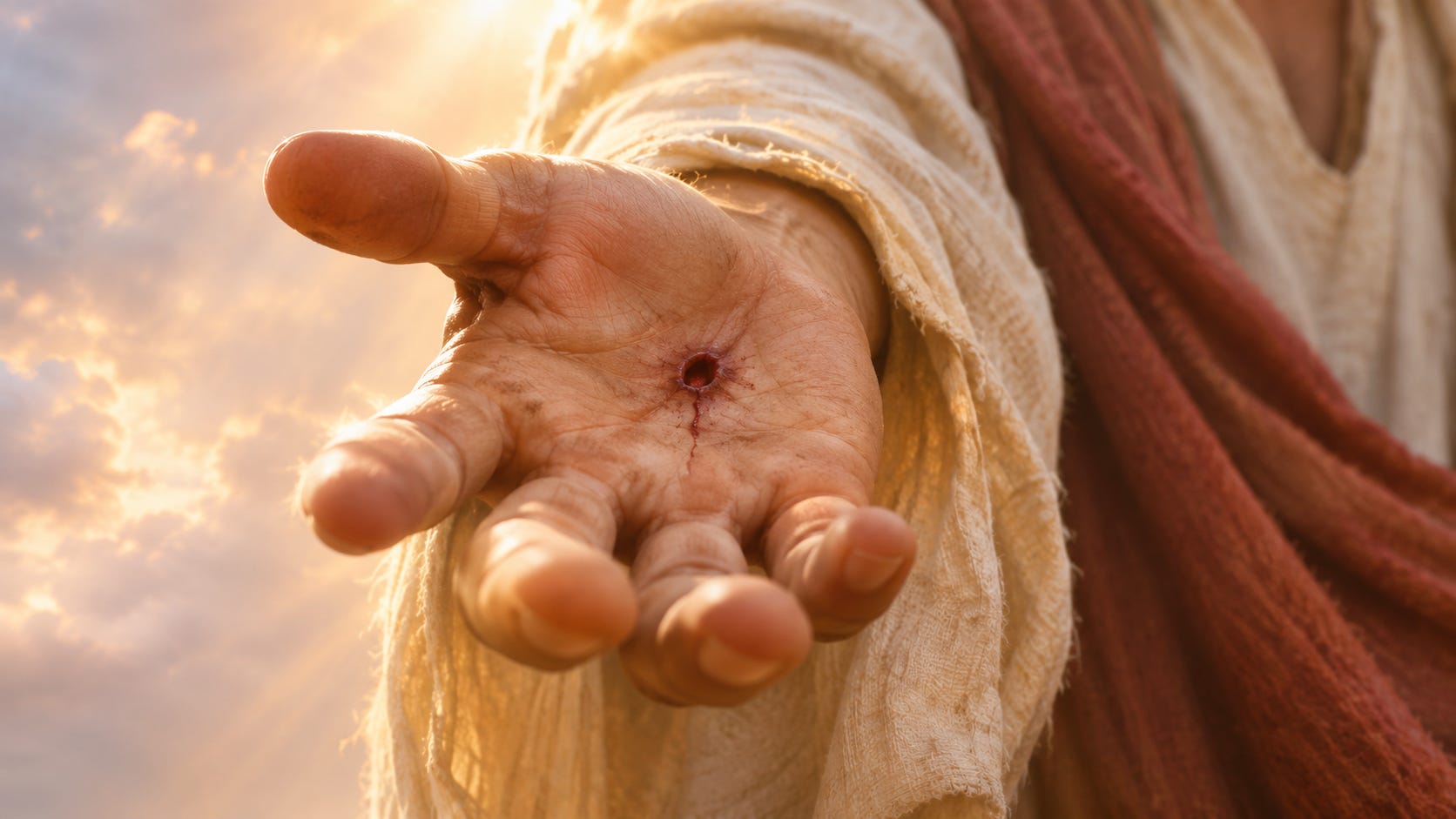
There are three aspects of the Christ event that seem especially relevant to countering what I witnessed this past Sunday: the Incarnation itself, the divine Word becoming flesh; Mary Magdalene’s encounter with the risen Christ; and the Eucharistic sharing of bread and wine.
Each has given me a way of understanding the unique significance of Christ that differs from the jarring martial language of religious supremacy. The Incarnation reveals a God who became kin with creation. Mary’s encounter after the Resurrection reveals a Christ who cannot be possessed. The Eucharist invites us into a communion that continually challenges us to expand the boundaries of our individual and collective identities.
Christ’s mission is not to establish a religious empire, but to transform our participation in the divine life already at work within this world.
Chosen
My reaction to Sunday’s service only makes sense in the context of my own spiritual journey. I grew up with an evangelical Christian mother and an agnostic Jewish father. My mother’s faith was heartfelt, but impossible for me to make sense of. Christianity was present but not a deeply structured part of our family life. I rarely attended church with her. By about twelve or thirteen years old, I had begun to reject religion altogether.
Influenced by my rather superficial adolescent readings of the rather superficial atheist materialism of scientists like Stephen Hawking and Richard Dawkins, I converted to their scientistic religion. I thought religious people were gullible, that science had effectively disproven God, and that the history of religion amounted to no more than humanity’s long struggle to overcome superstition and the fear of cultural difference.
As you might imagine, I was a rather obnoxiously overconfident teenage atheist. Fortunately, my intellectual horizons soon began to expand. Through encounters with Nietzsche, Jung, Alan Watts, and various traditions of Asian philosophy and spiritual practice, I began to recognize that the history and psychology of religion were far more complicated than scientific materialism had led me to believe.
By seventeen, I had taken up Buddhist meditation. The teachings on emptiness, impermanence, and nonattachment profoundly shaped my understanding of consciousness. By nineteen, I was meditating daily and proudly identifying as a Buddhist. I was increasingly inclined to see the ordinary world of human relationships, desires, and conflicts as a kind of illusion from which spiritual awakening would liberate me. I was also growing mildly depressed and experiencing an increasing sense of derealization and depersonalization. I was trying to relieve myself of the burden of an ego that hadn’t even fully matured yet.
Then something entirely unexpected occurred. During my first experience with psilocybin mushrooms, while sitting alone at my desk intending to journal about what I assumed would be an experience of Sunyata, I came face to Face with what I immediately recognized as the Christ being.
This was not an experience I would ever have consciously sought. I was not contemplating conversion. Indeed, at the time, despite my opening to Eastern spiritualities, I continued to regard Christianity as peculiarly irrational.
As I explained in a talk in Chiang Mai this past summer, Between the Cross and the Bodhi Tree, I did not choose Christianity. I was interrupted by Christ while trying to become a Buddhist.
The infinite intimacy of the encounter overwhelmed everything I thought I knew about myself and the world. I felt the face of Christ immediately behind my own, as though the depths of my soul had suddenly become transparent to a Self who knew me more intimately than I knew myself. There was an extraordinary warmth and love, but also an urgent insistence that I wake up.
What was I being urged to awaken to? Not to the superiority of Christianity as a religious institution. Not to the necessity of converting other people to a particular doctrine. Not to the wickedness of secularism, Buddhism, Islam, or any other spiritual path.
I was shown the living presence of Christ in every human being. The Christ I encountered was not simply a supernatural authority standing above the world, demanding submission. The Christ I came to know and love that night is involved in the depths of earthly existence, suffering and rejoicing with us, calling to be recognized in every face we meet.
I share more about this experience in Facing the Face Within: Christopoetics in an Unfinished World in Process, where I reflect upon Christ as the face behind every face.
The significance of this encounter continues to unfold for me, and to unfold me. I do not regard Christ as merely an archetype of the human psyche, though Jung’s language remains helpful. I understand Christ as a real spiritual being whose activity cannot be reduced to psychological projection or cultural construction.
The spiritual being I met that night was not the property of any religious institution. After this experience, I immersed myself in Western esoteric and mystical traditions, especially Rudolf Steiner’s anthroposophy and Christian Hermeticism. I discovered dimensions of Christianity largely absent from the fundamentalist Protestantism I had rejected in adolescence. I found the cosmic significance of the Incarnation, its importance for the evolution of consciousness and the transformation of the Earth, the possibility of theosis or human divinization, and the profound continuities between Christian theopoetics, participatory Platonism, and the contemplative traditions of Asia. Perhaps in Christ’s kenotic love I had experienced Sunyata, after all?
Steiner helped me understand Christ’s incarnation as a pivotal event not only in human religious history but in the spiritual evolution of the planet itself. The Incarnation was not simply a rescue mission for fallen human souls, designed to evacuate a faithful few from a doomed material world. It accomplishes an onto-epistemic and axiological transformation in the relationship between spirit and matter, heaven and Earth, God and humanity.
I have also continued to find indispensable spiritual guidance in the Buddha. As I wrote many years ago in Religious Dialogue as Soul-Making, my position is one of pluralistic religious realism. I take Buddha and Christ to be real spiritual beings who can enter into communication with human consciousness independently of the cultural and religious institutions that have formed around them.
I do not mean to say those traditions are irrelevant. They preserve invaluable practices, symbols, scriptures, and communal forms through which spiritual realities become accessible to human beings. But they are not the owners of those realities, which they all too often distort and deform.
Buddha and Christ are not competitors in a marketplace of spiritual weapons, each offering a proprietary product to help potential customers beat one another to salvation. Their teachings are distinct, and sometimes genuinely contrasting. Buddhism’s invitation to release attachment and Christianity’s passionate embrace of historical existence pull my soul in different directions. But I have come to experience this tension as generative. And in the spirit of creative interpretation, deep religious pluralism, and ongoing revelation, I have come to see, for example, the Mahayana development of the Bodhisattva’s vow as an instance of the incarnational impulse transforming Buddhism from within.
The Buddha invited me to unclench my fist. Christ then took my open hand.
I remain a Christian at heart and a Buddhist in mind, with Whitehead’s cosmology helping me hold these impulses together without prematurely collapsing their differences. Despite two decades of spiritual deepening, I still have not found a church community where I feel entirely at home.
The Church
Last year, I attended the Divine Liturgy of St. Basil the Great at Holy Trinity Cathedral in San Francisco, an Orthodox church. I wrote about the experience in Participating in the Liturgy at Holy Trinity Cathedral.
The church was similarly filled with families and children. There were chants, incense, icons, candles, bows, and prayers. The rhythm of concealment and revelation enacted by the opening and closing of the Royal Doors and curtain of the iconostasis nearly dropped me into an altered state. Here was an ancient form of worship that did not pretend divine truth could be reduced to a collection of factual propositions. Mystery was not an embarrassment to be overcome by explanation and Biblical fact-checking. The focus was ritual participation.
I was deeply moved by this form of Christianity, and yet I could not ignore the patriarchal structures and hierarchical authority that have become so deeply embedded in the Orthodox tradition, as in many other churches. My attraction to its sacramental imagination did not erase my reservations about the cultural assumptions that surrounded it.
I have felt similar tensions within Catholicism, Anglicanism, and even within anthroposophical communities that might otherwise seem closer to my own philosophical orientation. Again and again, I find myself attracted to the depth of the Christian tradition while resisting the tendency of institutions to identify their inherited formulations with the limits of divine revelation.
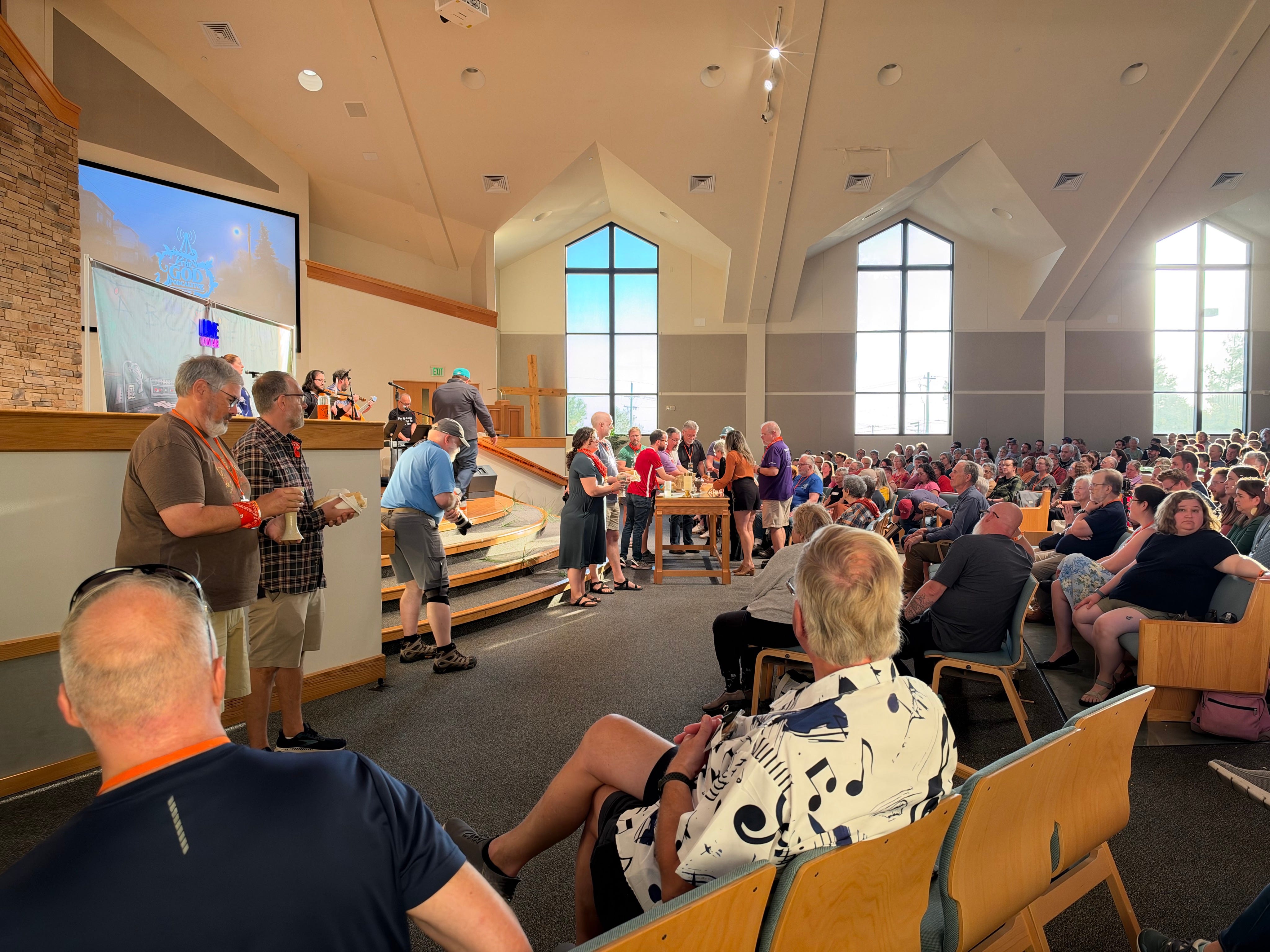
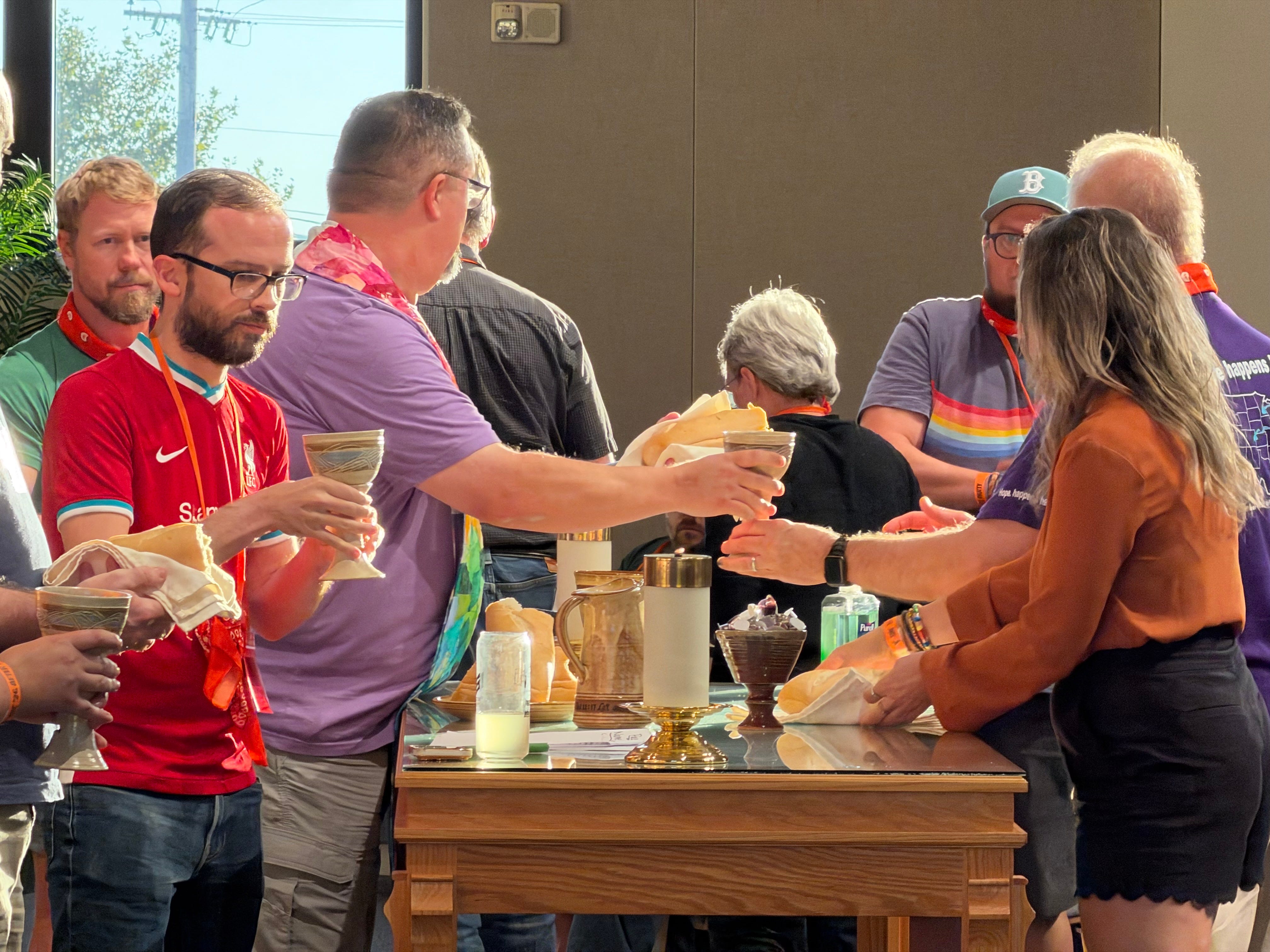
Several weeks before our church visit last Sunday, I was in Kansas City for Tripp Fullerand friends’ Theology Beer Camp, where I participated in panel discussions about process theology, the evolution of God, and the meaning crisis. Many of those gathered were exvangelicals or post-evangelicals who had grown up within conservative Christianity and subsequently undergone profound and painful processes of theological deconstruction. For many, the religious world of their childhood had become intellectually or morally untenable, yet they had not lost their love for Christ or their desire for Christian community. The last day of Beer Camp included one of the most moving communion rituals I’ve yet experienced.
But what struck me was how deeply some still remained attached to an image of an all-powerful God who could intervene from above and make everything okay. Even after rejecting fundamentalism, the longing for a cosmic authority who remained fully in control was difficult to relinquish. Though I’d never had such a belief, even in childhood, I can see how there may be a tremendous comfort in believing that someone is in charge, that any and all suffering has a predetermined purpose, and that history is ultimately governed by an omnipotent micromanaging intelligence.
Process theology seems to me to invite a more spiritually mature relationship to divine power. God is not an omnipotent dictator orchestrating the world’s tragedies according to some hidden plan. God is intimately involved in the creative advance of the universe, a creature of creativity suffering and rejoicing with the rest of us, luring us toward possibilities that cannot be realized without our participation.
We are called to become God’s head, heart, and hands. Taking that calling seriously means we cannot assume that God can or will intervene to repair whatever we fail to care for.
I left Theology Beer Camp feeling hopeful about the possibility of new forms of Christian community emerging among people who had survived the collapse of their inherited faith without abandoning their spiritual longing.
As I argued in The Word in Every Tongue, religion needs spirituality, and spirituality needs religion. Personal revelation risks becoming narcissistic or fragmentary without the discipline and accountability of communal life. But communal religion becomes spiritually suffocating when its institutionalization attempts to control the divine mystery it is supposed to serve.
The task, so far as I can tell, is to cultivate forms of religious life that can sustain genuine devotion without enclosing the infinite within a rigid doctrinal system.
History
The Christianity we met on Sunday is the product of a long and complicated history. My first direct experience of a conservative evangelical service sent me back to the books to recall that history. It is worth reminding ourselves that the earliest followers of Jesus were Jews living under Roman imperial occupation. Jesus announced the coming of the kingdom of God. His teachings and actions challenged established hierarchies of religious purity, wealth, and political power. He ate with people considered sinners, including sex workers, healed the sick, and instructed His followers to hate their families and love their enemies.
He also spoke the language of Jewish apocalyptic expectation and announced a decisive confrontation with the forces of evil. It would distort history to portray Him as some kind of modern liberal progressive. But the form of power revealed in His ministry was radically different from the imperial sovereignty exercised by Rome.
The earliest Christian communities struggled to interpret the significance of His historical crucifixion and the spiritual experiences of resurrection that followed it. Paul understood Christ as inaugurating a new creation and overcoming the powers of sin and death. The Gospel of John identified Christ with the eternal Logos become flesh, the divine Word through which all things came into being. Already within the New Testament, there is a remarkable plurality of images at play: Christ as the new Adam, the sacrificial lamb, the divine wisdom, the cosmic Logos, the suffering servant, the risen Lord, the head of a mystical body.
These images do not easily add up to a single coherent theology. Christian thinkers have spent two thousand years struggling to understand how to integrate them. Early theologians like Irenaeus understood Christ’s mission as a recapitulation of human and cosmic history, restoring and transforming what had gone astray. Origen entertained an expansive vision of cosmic restoration in which even the most alienated beings, including Satan, would ultimately be saved. Athanasius and the Greek fathers emphasized the Incarnation as the means by which humanity could participate in divine life. Later thinkers developed other accounts. Protestant reformers and their successors increasingly emphasized justification, substitution, and Christ’s saving work in relation to sin and divine judgment.
Quite obviously, there is no single, uninterrupted Christian interpretation of what Jesus’ mission means.
The institutional history of Christianity might be even more complicated. In 313 CE, Constantine and Licinius established toleration for Christianity within the Roman Empire. Constantine subsequently patronized the Church and convened the Council of Nicaea in 325, helping to establish the conditions under which Christian theological disputes became matters of imperial significance. Under Theodosius I, Nicene Christianity received official imperial support beginning in 380.
Christianity did not simply convert Rome. Rome also transformed Christianity. In my essay Carl Schmitt’s Political Theology: A Process Theological Intervention, I drew upon Whitehead’s observation that when the Western world adopted Christianity, Caesar conquered, and his lawyers edited Scripture. Whitehead’s point is that the Church increasingly modeled its conception of divine authority upon the image of an imperial ruler.
The God revealed in Jesus’ self-giving love was repeatedly reimagined as a cosmic sovereign whose authority resembled that of an earthly monarch, except with unlimited power. Christ thus became idolatrously conflated with the supreme instance of political sovereignty.
This is, in my opinion, the fundamental confusion that continues to haunt Christian theology. Over the following centuries, ecclesiastical institutions consolidated their authority, and Christian doctrine became increasingly tied to political identity. Yet mystical and alternative traditions continued to emerge, challenging the identification of divine truth with official hierarchical religious structures.
The Protestant Reformation in the sixteenth century disrupted the authority of the Roman Catholic hierarchy, but it also intensified the problem of religious certainty. The institutional Church could no longer serve as the final authority in interpreting revelation, so literalist readings of Scripture increasingly assumed that role.
The result was not a single purified Christianity but a proliferation of competing interpretations, denominations, and reform movements. In America, the Great Awakenings of the eighteenth and nineteenth centuries transformed Protestant Christianity through an emphasis on personal conversion, emotional worship, revival preaching, and the experience of being “born again.” This history is continuous with the fervent and righteous energy of the congregation we visited.
The more specific phenomenon of American fundamentalism emerged in the late nineteenth and early twentieth centuries as a reaction against Darwinian evolution, historical-critical scholarship, comparative religion, and liberal Protestant theology. The publication of The Fundamentals between 1910 and 1915 and the Fundamentalist–Modernist controversies of the 1920s crystallized a movement dedicated to defending Christianity against what it perceived as the corrosive forces of modernity.
So it turns out that fundamentalism, while presenting itself as the preservation of timeless biblical truth, is itself a distinctly modern reaction formation. Its obsession with factual certainty developed in response to the epistemological authority of modern science. In attempting to defend the Bible against scientific criticism, fundamentalists increasingly adopted the assumption that religious truth must take the form of empirically demonstrable propositions. The Bible became, in effect, a rival scientific textbook.
Thus modern Christianity has saddled us with bad religion and bad science.
But the Christ event is not reducible to the historical accuracy of a collection of ancient documents. Scriptural traditions are indispensable witnesses to the event, yet its spiritual truth cannot be exhausted by questions of factual correspondence.
Which brings us back to the pastor’s admonition that we should look at the facts rather than believe him.
Twin idolatries
Do you see how the scientific materialism I embraced as a teenager and the biblical fundamentalism I encountered on Sunday are mirror images of one another? Both exemplify what I would call non-participatory literalism.
Scientific materialism tends to imagine that the world consists of a mind-independent collection of dead stuff whose reality can be completely described in the abstract language of scientific theory. Meaning, purpose, value, and spiritual experience become secondary projections of human subjectivity onto an intrinsically pointless mechanical universe.
Biblical fundamentalism, meanwhile, tends to treat revelation as a collection of authoritative propositions whose meanings can be established independently of the historical, cultural, and spiritual processes through which the texts arose and continue to be interpreted.
In one case, mathematized matter is treated as the only legitimate reality. In the other, one narrow interpretation of a select set of Scriptures becomes the final and unquestionable authority. Both positions replace the living reality of the world-process with an abstract representation of it.
Owen Barfield’s account of the evolution of consciousness addresses precisely this predicament. Barfield recognized that modernity had brought about a profound transformation in humanity’s relationship to both nature and language. The participatory experience of an ensouled cosmos had largely given way to a subject-object dualism in which the world appeared as a collection of objects to a profoundly alienated subject.
Our task is not to regress into an earlier, undifferentiated form of unconscious immersion in oceanic feeling. It is to develop a new, consciously achieved participation in reality. Barfield called it final participation.
Science, rightly practiced, can contribute to this achievement. So can scriptural interpretation. But both become spiritually deadening when their desiccated conceptual representations are mistaken for reality itself.
To affirm that Scripture is inspired need not mean that every historical or cosmological assertion made by its authors is infallible. Nor does acknowledging the human formation of the biblical canon entail that its texts are spiritually worthless. The New Testament did not descend from heaven as a completed book. The collection of twenty-seven writings now familiar to most Christians emerged through centuries of communal use, controversy, interpretation, and ecclesiastical decision-making. Athanasius’s Easter letter of 367 provides the earliest surviving list corresponding precisely to the modern New Testament canon.
Other early Christian writings, including the Gospels of Thomas, Mary, and Judas, preserve important evidence of the diversity of Christian theological imagination in the first centuries. Their dates, literary genres, and historical reliability differ, and not every text should be granted the same evidentiary weight. But I see no reason to assume that the formation of the canon brought divine revelation itself to an end.
I affirm ongoing revelation, not necessarily in the sense that any newly channeled text is gospel truth, but in the deeper sense that the relationship between God and the evolving cosmos remains open to novel symbolic expression.
The Logos is not an already bound book. The Logos is the living creative intelligence through whom the world becomes intelligible, and who continues to disclose new possibilities through the evolving experiences of creatures.
The terrible irony of biblical literalism is that its attempt to guarantee the authority of revelation ends up imprisoning the transcultural divine Word within a finite collection of culturally relative human words.
There is a legitimate concern behind the evangelical defense of scriptural authority: without standards of discernment, religious experience can become arbitrary, self-serving, or delusional. I share that concern, and do not mean to dismiss the traditions that have formed around sacred texts, which provide indispensable disciplines of interpretation.
The alternative to fundamentalism is not relativism. It is a more demanding practice of discernment that takes historical scholarship, philosophical reason, spiritual experience, and communal accountability seriously, without pretending that any one of these exhausts the divine mystery.
The problem with fundamentalism is not that it takes Christianity too seriously. It is that it doesn’t take the freedom of its Spirit seriously enough. It too readily mistakes the parochial representations of scriptures written thousands of years ago by a still tribal mentality for the saving vision toward which those representations were striving, fallibly, to point.
Incarnation: Christ is kin
Of all the aspects of Sunday’s worship, the repeated insistence that Christ is King has continued to echo in my soul.
I understand why this language is important to Christians. The earliest followers of Jesus already referred to Him as Lord, and the New Testament includes potent images of Christ’s cosmic status.
But I wonder what sort of sovereignty is being proclaimed. If Christ’s kingship is imagined as the supremacy of one ruler over all others, then I worry we fall right into the imperial theology that Whitehead criticized.
If, however, divine kingship is interpreted through the self-emptying of Christ, the meaning changes entirely. Philippians 2 portrays Christ as relinquishing divine privilege, taking the form of a servant, and accepting a humiliating death nailed to a tree.
This is kenosis, divine self-emptying. It is the opposite of the ordinary human desire to accumulate power, command obedience, and establish superiority. Christ does not become great by distancing Himself from the lowly. Christ reveals divine greatness precisely through intimacy with the vulnerable, the suffering, the ordinary, even the criminal.
Christ is kin
Christ is our relative, our companion, our fellow sufferer, the divine presence that enters into the bleeding flesh of the world and discovers Its solidarity with every creature.
This is not meant to deny Christ’s unique significance. On the contrary, I understand the Christ event as a singular turning point in the spiritual history of the Earth. But Christ’s uniqueness does not consist in being merely the highest being in a hierarchy of competing spiritual authorities. Christ’s uniqueness is revealed through His radical distribution of divinity, through God’s descent into the conditions of earthly existence, and the simultaneous elevation of that mortal existence into fullness of participation in divine life.
The highest becomes intimate with the lowest. The divine does not simply demand that matter ascend toward spirit. Spirit descends into matter, transforming the meaning and dignity of embodiment.
A God who becomes flesh cannot coherently be understood as fundamentally disdainful of earthly existence. If the Incarnation is primarily interpreted as a temporary divine visitation designed to save a small number of human souls from eternal damnation, then earthly life remains essentially a form of exile. Its value is instrumental, a testing ground through which the faithful must pass before escaping into heaven.
But if the Incarnation represents the deepening of divine participation in earthly existence, the significance of divine embodiment is not to undertake a rescue mission. The Earth is not merely the location of humanity’s fall but the site of God’s continuing creative work. The divine does not enter the world reluctantly, as though matter were an unfortunate prison from which souls must eventually be liberated. The Word becomes flesh because flesh itself is capable of becoming the bearer of divine life.
This is the sense in which I understand the Christian promise of resurrection. It is not simply the survival of an immaterial soul after the death of the body. Nor is it the restoration of a previously existing state of innocence. It is the transformation of bodily existence, the disclosure of spiritual possibilities that could not become actual apart from the conditions of earthly life.
The Christian tradition has long preserved this insight in its doctrines of incarnation, resurrection, and theosis. But these doctrines have often been overshadowed in popular Protestant theology by an account of salvation centered on individual forgiveness, divine judgment, and the fate of the soul after death.
The question becomes one of belief, whether we have accepted Jesus as our personal savior, rather than whether we are learning to participate in the cosmic transformation that His incarnation inaugurates.
I do not mean to trivialize the significance of personal salvation. Sin, guilt, forgiveness, and moral regeneration are real and powerful aspects of spiritual life. But I resist reducing the entire significance of the Christ event to a transaction in which Jesus pays a debt that human beings owe to an offended jealous divine sovereign.
My understanding of this mystery has been shaped by Steiner’s spiritual science, Teilhard de Chardin’s evolutionary cosmology, the Christian mystical tradition, and above all Whitehead’s process-relational metaphysics.
Whitehead’s God does not stand apart from the universe as an unmoved ruler but partakes in its evolutionary process as the most moved lurer. God participates intimately in every occasion of experience, offering possibilities for creative realization and receiving into the divine life every achievement of value.
God’s relation to the world is not one of unilateral domination but reciprocal feeling.
In Revitalizing Christianity, I explore how a renewed Christian imagination might recover the cosmic and evolutionary significance of Christ, moving beyond the opposition between modern scientific disenchantment and inherited theological dogmatism.
Christ reveals the divine intimacy at the core of our coexistence. In Him, the relation between God and creation becomes newly manifest, and perhaps newly possible, as a relation of kinship.
Christ is not simply a supernatural individual occupying the highest position in the spiritual hierarchy, nor merely a historical teacher whose memory is preserved by a religious institution. Christ is a cosmic being whose incarnation discloses the possibility of divine life becoming increasingly manifest throughout the whole community of earthly creatures.
The significance of Christ Jesus is not diminished by this universality. On the contrary, the singularity of His mission is revealed precisely through its capacity to become universally transformative.
The divine Logos was not inactive in the world before Jesus’ birth. Nor did God’s creative activity suddenly become confined to the cultural and ecclesiastical structures that developed around various competing Christian movements.
I do not need to deny the wisdom of Buddha in order to affirm Christ. Nor must I deny the revelatory power of Indigenous spiritual traditions, Islamic mysticism, Jewish Kabbalah, or the philosophical insights of Plato and the great sages of Asia.
The spiritual worlds disclosed through these traditions are not necessarily interchangeable, and I do not claim that their teachings can all be harmonized into one systematic worldview or perennial philosophy. Their differences remain real and irreducible.
But if Christ truly embodies the divine Logos, then the activity of Christ cannot be confined to those who consciously recognize Him under that name.
Indeed, any religious tradition claiming exclusive ownership of this universal spiritual reality has already misunderstood what is essential to it.
A king rules over subjects. Kingship is a hierarchy of command, with the supreme ruler standing above those who must obey.
Kinship, by contrast, implies a relation entirely unlike domination. It involves inheritance, mutual vulnerability, dependence, care, and the recognition that one’s own life is inseparable from the lives of others.
The Incarnation reveals a God who does not govern the world from above but becomes related to us from within.
Christ is not less than king. Christ overturns our understanding of kingship by becoming kin. One radical implication of this transformation is that our kinship with Christ cannot be separated from our kinship with one another.
If Christ is present in the least among us, then to reject the stranger is to reject the divine presence one claims to worship.
Mary Magdalene
Another aspect of Sunday’s service troubled me, though it was less explicitly stated than the sermon’s theology.
The visible structure of church authority was entirely male.
The church’s publicly listed elders are men, and the theological atmosphere seemed to reflect a familiar evangelical pattern in which male authority, doctrinal certainty, and spiritual leadership reinforce one another.
I do not deny the profound contributions of men to the history of Christianity or mean to suggest that masculinity itself is somehow spiritually problematic. But the marginalization of women in Christian institutional leadership is one of the great tragedies of the tradition’s history.
The earliest Christian movements were sustained by women. Paul’s letters mention women such as Phoebe, Prisca, and Junia. And there is perhaps no figure more important to the origins of Christianity than Mary Magdalene. According to John’s Gospel, Mary was the first to encounter the risen Christ and was commissioned to announce the resurrection to the disciples. Christian tradition does honor her as the apostle to the apostles.
Consider the implications. The central event upon which Christianity rests, the resurrection of Christ, is first proclaimed by a woman. Yet the subsequent institutional development of Christianity would increasingly exclude women from the offices of teaching, sacramental leadership, and ecclesiastical authority.
I often wonder how differently Christianity might have developed had Mary Magdalene’s apostolic significance remained central to the organization of the Church. The Gospel of Mary, though not part of the canonical New Testament, preserves an alternative early Christian imaginary in which Mary possesses spiritual insight that the male disciples struggle to understand and respect. Whether or not the text tells us anything historically reliable about Mary’s relationship with Jesus, it is a valuable witness to the contestation of spiritual authority in early Christianity.
But it is not merely Mary’s importance as an apostolic witness that interests me. It is the character of her encounter with the risen Christ. In John’s Gospel, Mary comes to the tomb while it is still dark, grieving, searching for the body of her beloved teacher. At first she does not recognize the risen Christ standing before her, mistaking Him for the gardener.
Then Jesus speaks her name.
Mary.
She recognizes Him and responds with joy.
But as she reaches toward Him, Christ says: Do not cling to me.
In his recent essay What Has the Erotic to Do with God?, Mark Vernon offers a beautiful interpretation of this moment. Mary’s desire is not being condemned. Her love is precisely what has brought her to the garden, and it is through the intimacy of being addressed by name that she recognizes the risen Christ. But the resurrection discloses a new form of relationship, one that cannot be understood as merely the restoration of the familiar relationship that existed before the crucifixion.
Vernon suggests that Mary is being invited into a new kind of desire, one that will not cling to Christ as an object of possession but will draw her more deeply into the divine love in which Christ Himself participates. She is being invited into a transformation of eros.
The beloved is not to be possessed, but neither is love to be abandoned. Rather, love is fulfilled through a deepening participation in the life of the beloved, a communion that transforms both self-understanding and the relationship to the world.
The resurrection opens their relationship, whatever its nature may have been before Christ’s death and rebirth, beyond the limits of possession. There is an important lesson for Christianity in this.
If Mary Magdalene herself cannot possess the risen Christ, how much less can any ecclesiastical institution claim exclusive ownership of His Name or likeness?
If Christ is risen, then His spiritual activity cannot be confined to a body of doctrines, a religious denomination, or a particular interpretation of Scripture. Certainly, He cannot belong to any nation.
Indeed, the temptation to possess Christ, to identify His living reality with the boundaries of one’s own religious community, may be among the most persistent obstacles to genuine Christian discipleship.
This does not imply that Christ is an amorphous universal essence, equally present in every religious idea or practice. His encounter with Mary is profoundly particular. She knows Christ because He calls her by name.
Concrete universality does not dissolve the particular. It becomes manifest through intimate and concrete relationships. But the encounter also transforms the meaning of that particularity. Mary is not asked to forget the Jesus she knew. She is invited to recognize that the reality disclosed through their relationship exceeds every previous form of understanding. The revelation is continuous with what came before, but it is also genuinely new.
This is how I understand the relationship between Christ and Christianity. The historical Christian traditions preserve indispensable memories, practices, symbols, and interpretations of the Christ event. Without these, my own spiritual journey would have been immeasurably impoverished.
But fidelity to Christ cannot mean simply clinging to inherited formulations or institutions. If Christ is a living spiritual being, and if revelation continues through the creative advance of the worldly Word, then Christianity must remain capable of being transformed by encounters it cannot predict or control.
This includes encounters with other religious traditions. My own relationship to Buddha is not an embarrassing obstacle to my devotion to Christ. It is one of the ways that devotion continues to develop. Buddha and Christ are not simply two different names for the same spiritual being. Maintaining their distinctiveness is important. Their teachings and examples emerge from different historical and cosmological contexts, and their spiritual impulses cannot be collapsed into a single doctrine without loss. But precisely because they are distinct, their encounter can be creative.
The Christ I met at nineteen did not demand that I renounce the Buddha. Instead, He invited a transformed understanding of what I was seeking through Buddhism in the first place.
Genuine religious dialogue involves something analogous to Mary’s experience in the garden. We must love our traditions deeply enough to recognize the spiritual realities that have become manifest through them, while remaining willing to release our attempts to possess those realities.
In Christianity Beyond Itself and Christ After Christianity, I have explored the possibility that Christianity’s future depends upon its willingness to undergo this kind of transformation.
The alternative to traditional orthodoxy need not be the abandonment of Christ. It may instead be a deeper fidelity to Christ that requires Christianity to relinquish its historical claims to cultural supremacy so as to rediscover itself as a living participant in the spiritual evolution of humanity and the Earth.
We are called not to abandon the beloved, but to love without clinging. Not to dissolve our religious identities into a vague universalism, but to allow our particular commitments to become more transparent to the universal spiritual reality that continually exceeds them.
The risen Christ is not a possession. He is an invitation.
The Eucharist
The most hurtful moment of Sunday’s service for me was the description of Holy Communion as a weapon in spiritual warfare against Satan.
I understand that Christianity has always contained an apocalyptic dimension, and that the New Testament speaks of demonic powers, spiritual conflict, and the struggle between Christ and the forces of evil.
But the Eucharist discloses something fundamentally different about the nature of Christ’s mission. In 1 Corinthians 10, Paul asks whether the cup and bread are not a participation in the blood and body of Christ. He then concludes that, because there is one bread, we who are many are one body.
The Greek term koinonia suggests communion, participation, sharing, and fellowship. This is not just an assertion about how Christians happen to hold similar beliefs. It is a claim about the transformation of their mode of existence. Through participation in Christ, the many become one body.
Of course, Paul himself does not draw the fully pluralistic implications that I am inclined to find in this image. In the same chapter, he explicitly warns against participation in pagan sacrificial rites, associating them with demonic powers. Early Christianity was not without boundaries, and it would be misleading to pretend that the Eucharist originally functioned as an indiscriminate celebration of religious diversity.
Yet even within Paul’s own account, there is a profound tension between the exclusive claims of religious identity and the participatory logic of the sacrament itself. In the following chapter of 1 Corinthians, Paul becomes indignant because some members of the congregation are eating and drinking while others, presumably poorer members, go hungry. The social inequalities of the surrounding world are being reproduced within the sacred meal. For Paul, this contradicts the Christic meaning of the Eucharistic gathering. The community cannot claim to participate in Christ’s body while failing to recognize and care for its own members. The sacrament is not a magic trick that operates independently of the quality of our relationships. Its meaning and efficacy are inseparable from the ethical and communal transformation that it enacts.
The body of Christ is not merely the historical body of Jesus, nor simply the consecrated bread and wine, nor even only the institutional Church. It is a living communion in which the divine life becomes present through a transformation of our relationships. The many become one, but their differences are not abolished.
The Eucharistic imagination resonates profoundly with Whitehead’s process-relational metaphysics. For Whitehead, every actual occasion of experience arises through the integration of a multiplicity of relations. Actualities, including human soul-streams, are not isolated substances that subsequently enter into external relationships. We are constituted through our participation in one another, and in a world that we inherit, transform, and contribute to.
The many become one, and are increased by one. Every moment of becoming is, in this sense, an act of communion. The world enters into the constitution of each new actuality, which in turn contributes its own achievement to the ongoing life of the cosmos.
The Eucharist can be understood as a sacramental intensification of this universal process, a ritual invitation to become consciously aware of the divine intimacy already operative within creation. Bread and wine, the fruits of the Earth and of human labor, become the media through which divine life is received.
This is not an escape from matter into spirit but the transfiguration of matter through spirit, and the disclosure of the spirituality of materiality.
I think again of the Orthodox liturgy I attended last year, and the way that its sensory richness invited participation in a mystery exceeding conceptual explanation.
And I think again of the evangelical congregation we visited on Sunday, where the emotional intensity of the worship likewise seemed capable of gathering individuals into something greater than themselves.
Despite the profound differences between these liturgical forms, both disclose the importance of embodied participation.
Religion cannot be reduced to propositions about God. It requires practices through which human beings become capable of feeling, perceiving, and responding to divine love.
The Eucharist understood as a weapon is the Eucharist disfigured. Communion is not combat. Instead of emphasizing incorporation into a body that heals division, the weaponized ritual becomes a means of strengthening the boundary between protected insiders and threatening outsiders.
I suppose the language of spiritual warfare can be understood as a metaphor for confronting cruelty, hatred, resentment, and the destructive forces that threaten human flourishing. But I worry about the habits of perception encouraged when a congregation is repeatedly invited to imagine itself engaged in combat with Satan, especially when other religious paths and nonconforming forms of life are implicitly or explicitly associated with demonic influence. Such rhetoric makes it increasingly difficult to distinguish resistance to evil from the rejection of people, of Christ’s kin.
In the Bible, Christ appears as both the Lion of Judah and the Lamb of God. But the relationship between these symbols is more paradoxical than the language of triumphant spiritual warfare acknowledges. In Revelation 5, John hears that the Lion of Judah has conquered. But when he turns to look, he sees a Lamb standing as though slain. The Lion is revealed as the Lamb. The source of victory is not the superior violence of a stronger predator but the transformative power of sacrificial love. The Lamb conquers by undergoing the violence of the world without reproducing its logic of domination.
I find this symbolism especially illuminating when considered alongside Steiner’s account of the Christ impulse as mediating between Luciferic and Ahrimanic extremes. The Luciferic temptation draws human beings toward spiritual inflation, the fantasy of transcendence without responsibility to the conditions of earthly life. The Ahrimanic temptation hardens consciousness into materialism, abstraction, control, and rigid intellectual and dogmatic systems.
Christ represents the possibility of a living equilibrium between these tendencies, not through their simple annihilation but through their transformation.
A theology obsessed with defeating Satan, seeing his influence in anything that deviates from in-group cultural norms, becomes itself susceptible to spiritual distortions. When a pastor repeatedly frames the world as a battlefield between Christians and demonic forces, the congregation is encouraged to interpret those who disagree with them as enemies of God. The spiritual reality of evil becomes a justification for projecting evil onto others.
One need not deny the demonic to recognize this danger. Indeed, taking evil seriously should make us especially cautious about the ease with which we identify its presence in our opponents rather than ourselves.
The Eucharist is not a weapon with which the righteous vanquish their enemies. It is a sacramental invitation into the body of Christ constituted through self-giving love.
If the Incarnation reveals divine kinship, the Eucharist is the practice through which that kinship becomes embodied in communal life.
And if the risen Christ cannot be possessed, neither can the Eucharistic body be reduced to the exclusive property of a particular religious institution.
This does not mean that all ecclesiastical disciplines surrounding Communion are meaningless. Traditions have legitimate reasons for ordering their sacramental life, and participation in a particular community entails responsibilities.
But such boundaries must never be confused with the limits of Christ’s spiritual activity. The Church may guard the Eucharistic sacrament. It cannot claim to own the divine reality toward which that sacrament points. The body of Christ exceeds the boundaries of Christendom. And its mission is not to conquer the world but to reconcile it.
Political temptations
The pastor’s anxiety about the recent election results and his characterization of gay people as sexually confused cannot be separated from the larger political context of American evangelicalism.
I would not claim that a few remarks establish this particular church as an explicitly Christian nationalist institution. Its own website describes a desire to help people live with Jesus in the present and emphasizes the importance of community, which are worthy aspirations.
But the political undertones of the sermon were hard to miss. In contemporary American culture-war Christianity, religious identity is intertwined with political conservatism, traditional gender hierarchies, and the perception that Christian civilization is under threat from secular liberalism and progressive values.
Christian nationalism intensifies this tendency by treating Christianity not simply as a spiritual tradition capable of inspiring public virtue but as the defining cultural or political identity of the nation itself. The temptation is to identify loyalty to Christ with loyalty to a particular vision of American civilization.
I recently responded to Jordan Hall’s provocative essay, Toward a (Truly) Christian Nationalism. I found much to affirm in his attempt to articulate a participatory rather than merely abstract conception of universalism. I share his desire to recover the spiritual dimensions of communal and political life.
But I cannot accept the conclusion that this should lead us toward a Christian nationalism. This would just further entrench the conflation of divine and political authority that has haunted Christianity since its imperialization.
In my essay on Carl Schmitt, I argued against the conception of politics as fundamentally organized around the distinction between friends and enemies. Schmitt understood political sovereignty in terms of the authority to decide when the ordinary legal order must be suspended, and his political theology drew inspiration from an image of God as supreme sovereign.
But how can this account of political life be reconciled with Jesus’ command to love our enemies? A political theology faithful to the crucified and risen Christ should begin not with the sovereign power to decide who belongs and who must be excluded, but with the difficult practice of recognizing the divine value of other persons, including those whose religious and political commitments differ from our own.
This does not require abandoning political judgment or pretending that all policies are equally good. Democratic life involves real conflicts over justice, freedom, economic organization, and our responsibilities to one another. Nor do I think religious convictions should be excluded from public life. My own commitments to democratic freedom, equal dignity, economic justice, and ecological responsibility are deeply informed by my spiritual convictions. But spiritual foundations for political values are not equivalent to the political imposition of one comprehensive religious doctrine.
Rudolf Steiner’s account of social threefolding offers another way of approaching this problem. In the aftermath of the First World War, Steiner argued that modern societies needed to differentiate the cultural-spiritual, political-legal, and economic dimensions of collective life.
When cultural identity, state sovereignty, and economic power become fused within an all-encompassing nationalist project, the freedom of individual and collective spiritual development becomes stunted.
I would rather see a society of increasingly Christlike individuals than a legally or culturally enforced Christian nation. The distinction is not semantic. A society becomes Christlike through the cultivation of relationships of mutual recognition, freedom, generosity, forgiveness, and responsibility. Such relationships can be realized among Christians, Buddhists, Jews, Muslims, atheists, and people belonging to traditions whose names Christians may never have heard of.
If the Logos truly enlivens every creature, no nation, church, or civilization can claim a monopoly on Christ’s activity in history.
Here the three dimensions of Christ’s mission that I have been exploring gain their political significance.
The Incarnation undermines the logic of supremacy by revealing divine power through self-emptying and kinship rather than domination.
Mary Magdalene’s encounter with the risen Christ undermines the logic of possession by revealing that the risen Christ cannot be contained even by those who love Him most intimately.
The Eucharist undermines the logic of exclusion by gathering the many into a living body whose integrity depends upon mutual care rather than uniformity enforced from above.
None of these claims entails the abandonment of political authority, religious identity, or communal boundaries. But they do transform our understanding of what legitimate authority, authentic identity, and life-giving community might look like.
A Christian politics shaped by these mysteries would not begin with the anxious defense of gender norms or a supposedly threatened civilization.
It would begin with the usually inconvenient and difficult responsibility to make room for the other.
It would recognize that the stranger is not merely a potential convert or a possible enemy, but a fellow creature in whom the divine life is already at work.
It would refuse to identify the kingdom of God with the fortunes of any nation, party, or institution.
And it would understand political freedom not simply as the protection of individual autonomy, but as the condition for the free development of cultural, spiritual, and communal life.
The political task of a spiritual democracy is not to establish which group exclusively possesses divine truth but to create conditions under which people can encounter one another without coercion, learn from their differences, and participate in the ongoing creation of a more just and beautiful world.
Heaven and Earth
I affirm that something uniquely important occurred through the life, death, and resurrection of Christ Jesus. But I do not understand that uniqueness primarily in terms of the superiority of Christianity over other religious traditions, nor do I think Christ’s mission was to save human souls from damnation by transporting them into a heavenly realm beyond the Earth.
What I see disclosed in the Christ event is a radical transformation of the relationship between God and creation. God does not remain above the world, demanding that creatures transcend their embodied limitations before they can become worthy of divine love. God enters into those limitations. The divine is lowered into the finite, vulnerable, suffering conditions of earthly existence. And in this descent, the Earth itself is elevated.
The Incarnation transforms our understanding of matter, flesh, suffering, and death. These are no longer merely obstacles to spiritual realization. They become the very media through which divine life is revealed and creatively extended.
This is not simply a modern ecological reinterpretation imposed upon Christianity from outside. The New Testament already speaks of the groaning of creation, of the redemption of the body, and of a new heaven and new Earth.
In Revelation, the New Jerusalem descends from heaven to Earth. The direction of the movement is literally crucial.
The destiny of creation is not the evacuation of the chosen few to some other world, but the transfiguration of this one.
Salvation is not an individual achievement or a guarantee of postmortem reward. It is participation in the ongoing transformation of the world through love.
To be saved is to be drawn more deeply into the divine life that Christ reveals, a life whose movement is toward ever more encompassing communion.
The self is not annihilated in this process, nor are its particular relationships rendered superfluous.
What I have found, in all humility, from my relationship with Christ is that the deepest spiritual realization is not withdrawal from the world but a more intimate and responsible participation within it.
The risen Christ appears in a garden, in the place where life grows from the Earth, where human labor cooperates with the generative powers of nature.
Mary’s initial failure to recognize Him gives way to an encounter that transforms the meaning of spiritual intimacy. But Christ does not invite her to abandon the world and join Him in some heavenly elsewhere. He sends her back to the others.
The soil, the wheat, the grapes, the hands that harvest and prepare them, the bodies that eat them: all become participants in a sacramental ecology of divine life.
This is the Christianity I find myself drawn toward. Not a Christianity obsessed with maintaining the supremacy of its own religious identity, but one capable of recognizing the presence of Christ in the processes through which the Earth becomes a more beautiful and hospitable home for all its creatures.
Not a Christianity defined by the fear of contamination by other spiritual traditions, but one secure enough in its devotion to Christ to welcome genuine encounters with religious others.
Not a Christianity that seeks to conquer the world, but one that seeks to heal it.
And not a Christianity that teaches us to despise our earthly existence in anticipation of heavenly reward, but one that teaches us to recognize our coexistence as the only place where God’s Great Work could unfold.
Let us stop rushing off to heaven and return to the garden, to our bodies, to our neighbors, to the difficult but worthy work of becoming human together.
Let us play in the mud as the fleshy spirits we were intended to become.
…
I do not regret attending Sunday’s service.
I am grateful to our friends for inviting us, and I remain interested in what has drawn them so powerfully toward that form of worship.
I do not doubt that many people in the congregation are experiencing genuine spiritual transformation through their devotion to Christ. It would be a mistake for me to dismiss those experiences simply because I disagree with the theology through which they are understood.
Indeed, if my own experience has taught me anything, it is that spiritual reality continually exceeds our conceptual attempts to grasp it.
But I cannot pretend that theological interpretation is harmless.
The images of God that we cultivate shape the kinds of people we become. They influence how we treat strangers, how we respond to difference, how we relate to political power, and how we understand our responsibilities to the Earth.
A congregation whose devotional life is repeatedly framed through the language of supremacy, spiritual warfare, and exclusive salvation risks cultivating habits of judgment that block the self-emptying love of Christ.
I cannot know what any particular person in that congregation believes beyond what they expressed. But I worry about the consequences of teaching young people that those who follow other spiritual paths are deceived, or that gay people are confused because their embodiment does not conform to a repressed and oppressive patriarchal account of sexuality. Surely some of those kids are themselves gay, and being encouraged to hate themselves as a result.
At the same time, I recognize a challenge to my own spiritual orientation. The enthusiasm of the congregation reminded me that religious life requires more than philosophical subtlety and mystical openness. It requires a community capable of carrying spiritual experience through time, sustaining people through difficulty, and giving embodied ritual form to our devotions.
I continue to search for such a community. Perhaps the Church I am seeking does not yet fully exist. Perhaps it is struggling to be born through the encounters among traditional Christians, exvangelicals, religious pluralists, contemplatives, process theologians, and spiritually curious people who refuse the false choice between dogmatic certainty and secular disenchantment.
In What Is “Metamodern” Christianity?, I have suggested that the task is neither simply to return to premodern orthodoxy nor to dissolve Christianity into the relativistic multiculturalism of global consumer culture. We need a renewed capacity for participation, one that has passed through modern criticism and postmodern cynicism alike.
This is not an easy synthesis! It requires the courage to love a tradition without pretending that its historical formulations are final, the humility to recognize that our spiritual commitments remain vulnerable to correction and transformation, and forms of communal practice through which these commitments can become more than abstract philosophical ideals.
in Christ, divine enters the world through intimate participation, refuses to be confined by the forms through which it becomes manifest, and continually gathers creatures into more encompassing relations of communion. The Incarnation is the beginning of this movement, the Resurrection its transformation, and the Eucharist its ongoing communal enactment.
What makes this movement uniquely Christian is not that it establishes one spiritual path as superior to all others, but that it discloses the divine willingness to become intimate with the finite, the vulnerable, and the apparently insignificant.
Paul’s question to the divided Corinthians remains as urgent as ever:
Is Christ divided?
The divine life of Christ is not divided, but our human attempts to possess and contain it continue to divide us from one another. And yet Christ continues to meet us in those divisions, inviting us toward a deeper communion.
Christ is not the property of Christians.
Christ is not the mascot of a political party or the sovereign emblem of any nation.
Christ is kin, dwelling with us in the vulnerability and creativity of earthly existence, waiting to be recognized in the faces of those we have been taught to fear as strangers.
Can we learn to recognize Him there?
And can we resist the temptation to claim Him as our own?


What do you think?