
A few weeks ago, Tim Jackson and I discuss M. Beatrice Fazi’s book Contingent Computation: Abstraction, Experience, and Indeterminacy in Computational Aesthetics (2018), focusing in particular on her interpretations of Gilles Deleuze and Alfred North Whitehead. You can listen to that conversation here:
Deleuze, Whitehead, and the Computational Aesthetics of M. Beatrice Fazi
About an hour and seven minutes in, I mentioned Plato’s dialogue, the Euthyphro. In that dialogue, Socrates asks the central question: “Is something pious because the gods love it, or do the gods love it because it is pious?”
There is an analogous issue in Whitehead’s metaphysics that Tim and I explored which has to do with the relationship between Whitehead’s primordial nature of God and the eternal objects. Here’s a rough transcript of my reflections on this question:
“Whitehead wants there to be a participatory and reciprocal relationship here, but I admit in my attempt to unpack his account of eternality and its relationship to actuality there’s some fuzziness. He’s not always consistent about the independent existence of eternal objects. Fazi has this wonderful phrase that I appreciated where she says (on page 64) “a conceptual prehension is actuality’s friction with the ideal.” This really helps us to avoid any dualism between actuality and ideality, but there’s nonetheless a polarity here, and part of the difficulty has to do with how we think about the relationship between logic and aesthetics. She says “aesthetics is at the heart of logic and not vice versa,” and I think that’s Whitehead’s position, too. In other words logical order becomes a subset of aesthetic order. The way that cashes out—and she doesn’t get into this—but the way I would say that cashes out is that the ordering of the eternal objects is established by this initial aim or or Eros of the divine—the “primordial envisionment” in Whitehead’s terms—that’s what establishes that there is a logical ordering of possibilities or an intelligible ground of the cosmos. It is because of what is ultimately an aesthetic act, a divine aesthetic act. Going back to the Euthyphro, where Plato has Socrates ask if God or the gods are good because it’s good, or is something good because the gods say so? Whitehead is in many ways making aesthetics first philosophy, such that not only logic but morality follows from an aesthetic principle. He’s giving God ultimate aesthetic power, but not ultimate efficient power. I hadn’t considered… I hadn’t run this train of thought through all the way to think about it in these terms before, because usually I would rather say that the gods are good because it’s good. But what Whitehead appears to be suggesting is actually this this divine envisagement of possibility is giving us rationality, that we have a relationship to intelligibility and logic because God loved the infinite realm of possibilities in a certain way. Is Deleuze able to entertain a thought like that? The answer is probably no. But Whitehead’s got this speculative hypothesis, and he’s perfectly willing to admit that there’s a dilemma here, since when we think about the apparent dichotomy between logic and aesthetics we’re at the extreme edges of our finite mentality: we only have partial penetration into the infinite. But in making aesthetics first philosophy, he’s also wanting to affirm that everything rests on feeling or firstness in Peirce’s terms. So he’s got these two different kinds of feeling, the feeling of actuality, and the feeling of eternality. The latter, called “conceptual prehensions,” are really at the core of what Whitehead means by experience: experience is dipolar it’s never just feeling what has already happened in the past and then having the transcendental illusion of possibility (as it appears Bergson and Deleuze argue); no there are real possibilities that we also feel in relationship to our inheritance of the actualized past.”
In response to my comments, my friend and fellow Whitehead enthusiast Ben Snyder responded by arguing against my characterization (see comment under the YouTube video):
I think Whitehead takes the opposite stance re the Euthyphro dilemma from what you (Matt) suggest he takes. For one, the truths of logic would be recognized by Whitehead as metaphysical propositions. Metaphysical propositions, and the principles they correspond to, have a logical priority to God. God is not the ultimate category and does not get to determine the essential rules of the universe. That is to say, our concept of God is a derivative concept from the categoreal scheme, and insofar as God’s existence is necessary, it is necessary because of being entailed by the principles of this scheme. Aesthetic value, and derivatively morality, do not derive from God’s valuations of the eternal objects. It is a metaphysical principle definable independently of God, namely the definition of intensity of satisfaction. God, in this way, does not have “ultimate aesthetic power.” Rather, God is the entity such that necessarily they will value all eternal objects in such a way as to be fit for maximal intensity given any relative context. Further, in his essay “Analysis of Meaning” Whitehead offers an aesthetic value theory as a starting basis for philosophy to investigate, but it is to then use the tools of symbolic logic to do so. One does not derive the logic from the aesthetics, but presupposes the logic to study the aesthetics. Whitehead had a very mathematical (and also purely extensional) view of logic’s scope, so that this is overall not too different from Peirce’s own architectonic ordering where the purely formal tools of mathematics (including the truth-preserving structures of deductive logic) come prior to any phenomenology (and then later, from that, aesthetics) and are thus presupposed in phenomenological investigation. Thus, I don’t think it’s very accurate to say that for Whitehead “logic is a subset of aesthetics” nor that primordial nature establishes “logical ordering” of eternal objects, unless we’re referring to a meaning for the word logic that goes beyond how Whitehead would use it.
Ben and I have been exploring fruitful frictions in our respective interpretations of Whitehead for several years. I am going to share several excerpts from Whitehead’s various works that I believe show the issues are not as cut and dry as Ben claims. Whitehead indeed had a very mathematical view of logic’s scope, but like a good Pythagorean, he understood the contemplation of mathematical order as an active entertainment of and entrainment to a kind of musical rhythm:
“The concept of completely passive contemplation in abstraction from action and purpose is a fallacious extreme. It omits the final regulative factor in the aesthetic complex” (Adventures of Ideas, p. 264).
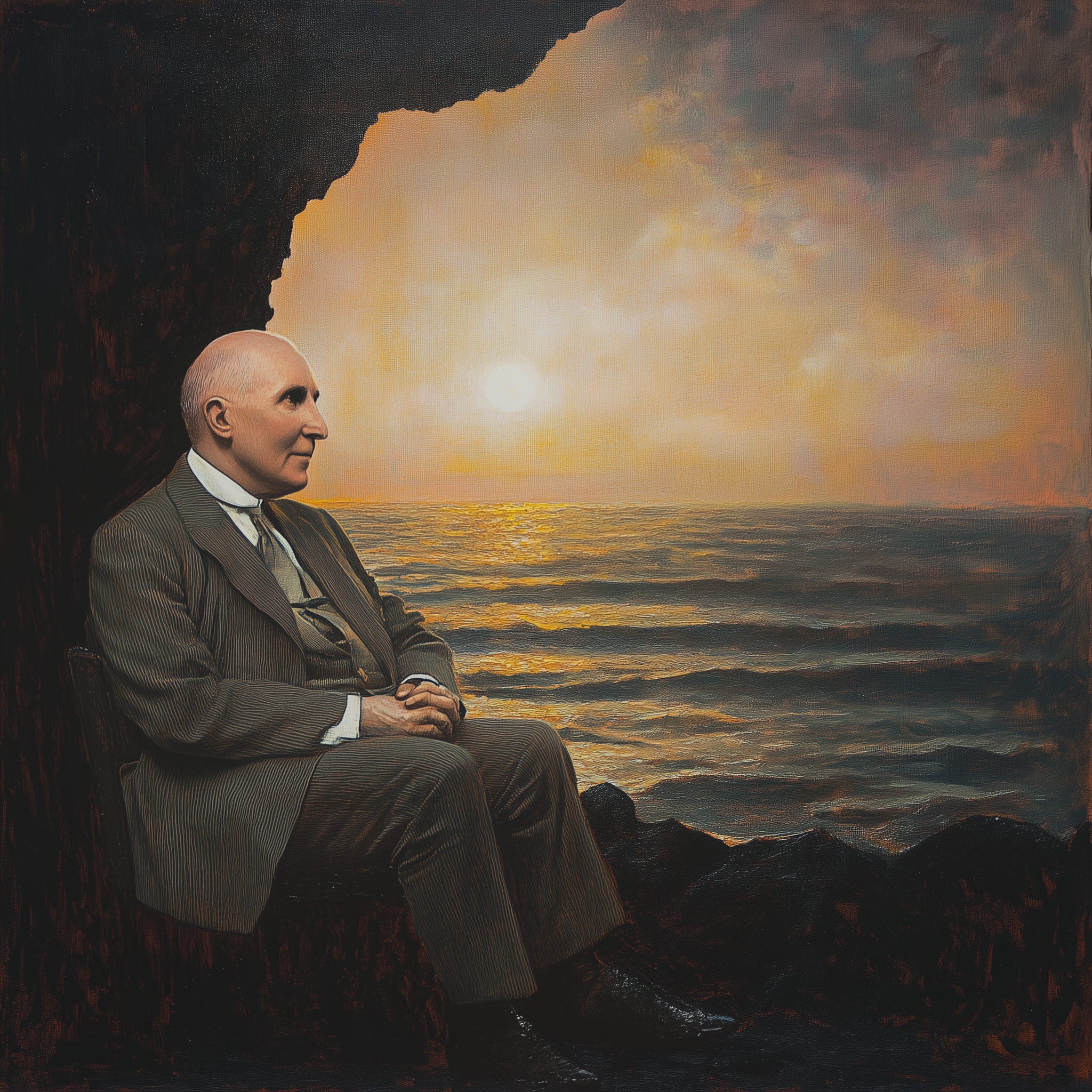
But let’s dig into this a bit more. On the question of whether “God…does not get to determine the essential rules of the universe,” here is Whitehead from Process and Reality, p. 40:
The things which are temporal arise by their participation in the things which are eternal. The two sets are mediated by a thing which combines the actuality of what is temporal with the timelessness of what is potential. This final entity is the divine element in the world, by which the barren inefficient disjunction of abstract potentialities obtains primordially the efficient conjunction of ideal realization. This ideal realization of potentialities in a primordial actual entity constitutes the metaphysical stability whereby the actual process exemplifies general principles of metaphysics, and attains the ends proper to specific types of emergent order. By reason of the actuality of this primordial valuation of pure potentials, each eternal object has a definite, effective relevance to each concrescent process. Apart from such orderings, there would be a complete disjunction of eternal objects unrealized in the temporal world. Novelty would be meaningless, and inconceivable.
Ben is of course correct that Whitehead assigns ultimacy to Creativity, rather than God (who is said to be the primordial creature of creativity). But Whitehead is clearly saying above that God is the reason there is any metaphysical stability amidst otherwise indeterminate creative flux, and the reason that the search for metaphysical generalities is possible for finite creatures like us.
Here is Whitehead addressing this issue in Religion in the Making, p. 104-5:
“Thus the purpose of God in the attainment of value is in a sense a creative purpose. Apart from God, the remaining formative elements would fail in their functions. There would be no creatures, since, apart from harmonious order, the perceptive fusion would be a confusion neutralizing achieved feeling. Here ‘feeling’ is used as synonym for ‘actuality.’
The adjustment is the reason for the world. It is not the case that there is an actual world which accidentally happens to exhibit an order of nature. There is an actual world because there is an order in nature. If there were no order, there would be no world. Also since there is a world, we know that there is an order. The ordering entity is a necessary element in the metaphysical situation presented by the actual world.
This line of thought extends Kant’s argument. He saw the necessity for God in the moral order. But with his metaphysics he rejected the argument from the cosmos. The metaphysical doctrine, here expounded, finds the foundations of the world in the aesthetic experience, rather than as with Kant in the cognitive and conceptive experience. All order is therefore aesthetic order, and the moral order is merely certain aspects of aesthetic order. The actual world is the outcome of the aesthetic order, and the aesthetic order is derived from the immanence of God.”
He adds later that “our knowledge of a discernment of ordered relationships, especially in aesthetic valuations…stretches far beyond anything which has been expressed systematically in words” (p. 143).
Now, Ben is not wrong to say that, as Whitehead puts it, “[God] is a necessary element in the metaphysical situation presented by the actual world.” But we must tread lightly here, as I do not think Whitehead is claiming some variation on the ontological proof (ie, that God’s existence is a metaphysical necessity). I read his speculative method as an application of William James’ radical empiricism, where God is to be known only as an experiential fact and not through logical proof. His point is that, in our finite reflection upon the conditions of this actual world, dispassionate reason leads inextricably to what he terms a “principle of limitation” or “concretion.” Here is how Whitehead puts it later in Science and the Modern World (p. 178):
“This attribute provides the limitation for which no reason can be given: for all reason flows from it. God is the ultimate limitation, and His existence is the ultimate irrationality. For no reason can be given for just that limitation which it stands in His nature to impose. God is not concrete, but He is the ground for concrete actuality. No reason can be given for the nature of God, because that nature is the ground of rationality.
In this argument the point to notice is, that what is metaphysically indeterminate has nevertheless to be categorically determinate. We have come to the limit of rationality. For there is a categorical limitation which does not spring from any metaphysical reason. There is a metaphysical need for a principle of determination, but there can be no metaphysical reason for what is determined. If there were such a reason, there would be no need for any further principle: for metaphysics would already have provided the determination. The general principle of empiricism depends upon the doctrine that there is a principle of concretion which is not discoverable by abstract reason. What further can be known about God must be sought in the region of particular experiences, and therefore rests on an empirical basis.”
I do not think we can square Whitehead’s statements above with Ben’s claim that moral, logical, and aesthetic order can be defined independently of God. Further, when it comes to the priority I believe Whitehead assigns to aesthetics over logic, I am just taking him at his word when he writes that, “while the harmony of logic lies upon the universe as an iron necessity, the aesthetic harmony stands before it [my italics] as a living ideal moulding the general flux in its broken progress towards finer, subtler issues” (Science and the Modern World, p. 18). Or, as he puts it rather plainly over a decade later in Modes of Thought (p. 62): “By reason of the greater concreteness of the aesthetic experience, it is a wider topic than that of the logical experience.”
In both logic and aesthetics, there is an interaction between the many and the one. The key difference between the two lies in the degree of abstraction. While logical reflection moves from the many to the one (details leading to a unity of understanding), aesthetic enjoyment begins with an overwhelming whole, from which details are later distinguished. This distinction marks logic and aesthetics as polar ends of how the finite mind approaches the infinite, each playing a role in the comprehension and appreciation of reality. But logic ultimately appeals to self-evidence in the same way aesthetic judgments do, suggesting to my mind at least that logic’s ultimate basis rests in aesthetic order.
Now, Whitehead is very clear that God does not create the eternal objects. But it seems to me he is just as clear that these eternal objects are barren inefficient disjunctions of which no sense can be made until and unless concretized by God’s primordial envisagement, an envisagement for which no reason can be given! The Schellingian in me sees this as deeply resonant with the understanding that God is a life, and not a system, the archetype of freedom, rather than simple necessity. We could distinguish here, as Schelling does, between the unprethinkable fact of God’s (and, relatedly, the world-order’s) positive existence, and the a priori nature of God’s essence. The divine essence may be a kind of necessity for reason, since it thinks negatively or by negation about what is possible; but negative reason remains entirely powerless before the thatness of actual existence.
…
There can be no final conclusions on these matters, but let me at least try to conclude this post. Whitehead’s idea of God’s primordial envisionment of possibility suggests that logical order is itself derived from a deeper aesthetic act, where divine love and the yearning after concrete fact creates, not the eternal objects themselves, but the intelligible order of the cosmos. Whitehead thereby assigns ultimate aesthetic power to God, making aesthetics first philosophy, such that logic and morality follow from aesthetic principles of harmony. This reframes our understanding of metaphysical order as a creative, aesthetic expression, rather than a system governed by necessity or logical rules alone.
Ben’s response, which argued that Whitehead gives priority to logical and metaphysical principles independent of God, brings out important tensions in interpreting Whitehead. Ben emphasized that God’s power in Whitehead’s thought is conditioned by metaphysical necessities, such as the principle of intensity of satisfaction. While Ben sees Whitehead’s framework as prioritizing logic over aesthetics, my interpretation suggests that Whitehead ultimately positions God as the reason for metaphysical stability amidst creative flux—an aesthetic ordering, rather than a purely logical one.
Thus, the core issue is not whether Whitehead prioritizes logic or aesthetics, but how he positions aesthetic value (ie, the aim at evermore intense forms of beauty) as the fountain from which logical and moral orders arise.


 Footnotes2Plato
Leave a reply to Matthew David Segall Cancel reply