
Below is a draft of a chapter for a book on radical and process theologies. My contribution is based on a conversation I had with Peter Rollins earlier this year:
Facing the Face Within: Christopoetics in an Unfinished World in Process
By Matthew David Segall
“…Is not the greatness of this deed too great for us? Must we ourselves not become gods simply to appear worthy of it?”
–Friedrich Nietzsche[1]
Ahead of turning to the body of this exposition, a word about my chosen form is warranted. I have written this essay in a confessional mode, not to indulge autobiography for its own sake but because the claim I wish to advance—that theology must become both self-deconstructing and participatory—cannot be made abstractly without contradiction. To speak of God is always already to speak from within the living entanglements of our personal, collective, and indeed, cosmic histories and futures.
The writer Ursula K. Le Guin coined the term “autocosmology” in her 1977 essay, “Do-It-Yourself Cosmology.”[2] By this she meant an approach to self-narration that situates our lives within the sweep of cosmic evolution, imagining ourselves not as accidental intrusions into an indifferent universe but as microcosmoi, mirrors of creation itself. To narrate one’s life in this way is to acknowledge that conscious human selves are not exceptions to but exemplars of cosmogenesis. Building on this insight, Brian Swimme and Carolyn Cooke have also described their work as a form of autocosmology, recognizing that the cosmos becomes conscious of itself in and through our acts of storytelling.[3]
What I am attempting below is a kind of autotheology, or perhaps more precisely an autocosmotheology: confessional God-talk that acknowledges its own cosmic conditions of possibility while also transcending them through acts of novel divine self-revelation. This places my experiment in the lineage of Friedrich Schelling, whose unfinished text Weltalter (The Ages of the World) sought to narrate the birth of God in human consciousness in the form of a self-composing cosmic poem.[4]
Process theologians including John Cobb, Jr.[5] and Catherine Keller[6] have been especially formative in shaping my sense of what theology can become when it dares to be relational, ecological, and erotically imaginative. Cobb’s insistence on theology’s artistic potentials and its responsibility to the earth’s suffering, and Keller’s dazzling explorations of entanglement and apophasis are core influences. Likewise, the geologian Thomas Berry and the evolutionary cosmologist Brian Swimme have inspired me to see theology not merely as commentary upon ancient books but as a poetic attempt to risk making meaning of what contemporary cosmology is discovering.[7] Theology can become a mode of storytelling by which the universe becomes conscious of itself. My own experiment in autocosmotheology owes much to these teachers, even as it attempts to risk its own confessional articulation of theopoetics in an unfinished world.
My decision to write confessionally is thus not merely stylistic but methodological. It enacts a conviction that theology always involves an interweaving of autobiography, cosmology, and poetics. To speak of God is also to speak of the world and of oneself as living elements in an ongoing story. Autocosmotheology is then not “a type of involuntary and unself-conscious memoir”[8] as Nietzsche said of all philosophies, but an earnest attempt, at least, to become a little bit more conscious of our creative freedom, and of our infinite responsibility to all who came before and will come after us.
Confession: The Face Behind My Face
I grew up with religiously mixed parents: an agnostic Jewish father and an evangelical Christian mother. This split inheritance tugged me in different directions, though in my adolescence I gravitated toward my father’s secular skepticism. By my early teens, my intellectual heroes included Stephen Hawking and Richard Dawkins. I wore my atheism as a badge of intellectual superiority. Of all the major religions, Christianity felt embarrassingly irrational, a religion fit for the especially gullible. I was convinced that science had closed the case on God, and that anyone still clinging to faith was simply afraid to face the truth.
But ideas continued to ferment within me. At seventeen, influenced by my high school psychology teacher, I began reading Carl Jung, Alan Watts, and Friedrich Nietzsche. I remained an atheist, but the edges of my confident materialism began to fray. I began to realize that religion could not be so easily dismissed. Human history, psychology, and culture were saturated with myth and symbol. I became aware of the dangers of hubristically pretending we might live without myth. I saw that even and perhaps especially in actively rejecting God, we remain haunted by what Jung called the God-image.[9]
By eighteen, immersed in the popular writings of Watts, I found myself attempting to practice various forms of Buddhist meditation. “Meditation,” I read, “is the discovery that the point of life is always arrived at in the immediate moment.”[10] As insightful as Watts’ interpretations could be, what drew me to the Barnes and Noble Buddhism I was unknowingly consuming was precisely its compatibility with my secular outlook. I later learned that religious scholars and philosophers refer to this as “Buddhist modernism.”[11] I didn’t realize it at the time, but I was appropriating a stripped-down exported version of Buddhist teachings that had been de-cosmologized, de-sacralized, and reinterpreted as a kind of anodyne self-help psychology. No karma and reincarnation, no Buddha-nature or Sambhogakaya, just mindfulness attention training and compassionate non-attachment within an ontological framework that squared with standard physicalist neuroscience and evolutionary biology. Christianity, by contrast, with its claims of virgin birth and bodily resurrection, still sounded to me like sheer superstitious nonsense.
Then, in my nineteenth year, my ethically committed, psychologically open, but scientifically neutralized worldview was shattered. I ate about 3.5 grams of psilocybin mushrooms for the first time alone in my dorm room one night. About forty-five minutes in, a forgotten but familiar light began to shine from behind my eyes, and a warmth began to rise in my chest. An urgent voice I had been ignoring began to become audible again. Colors intensified, shadows breathed. I took my final exhale as an atheist and my consciousness was turned inside out.
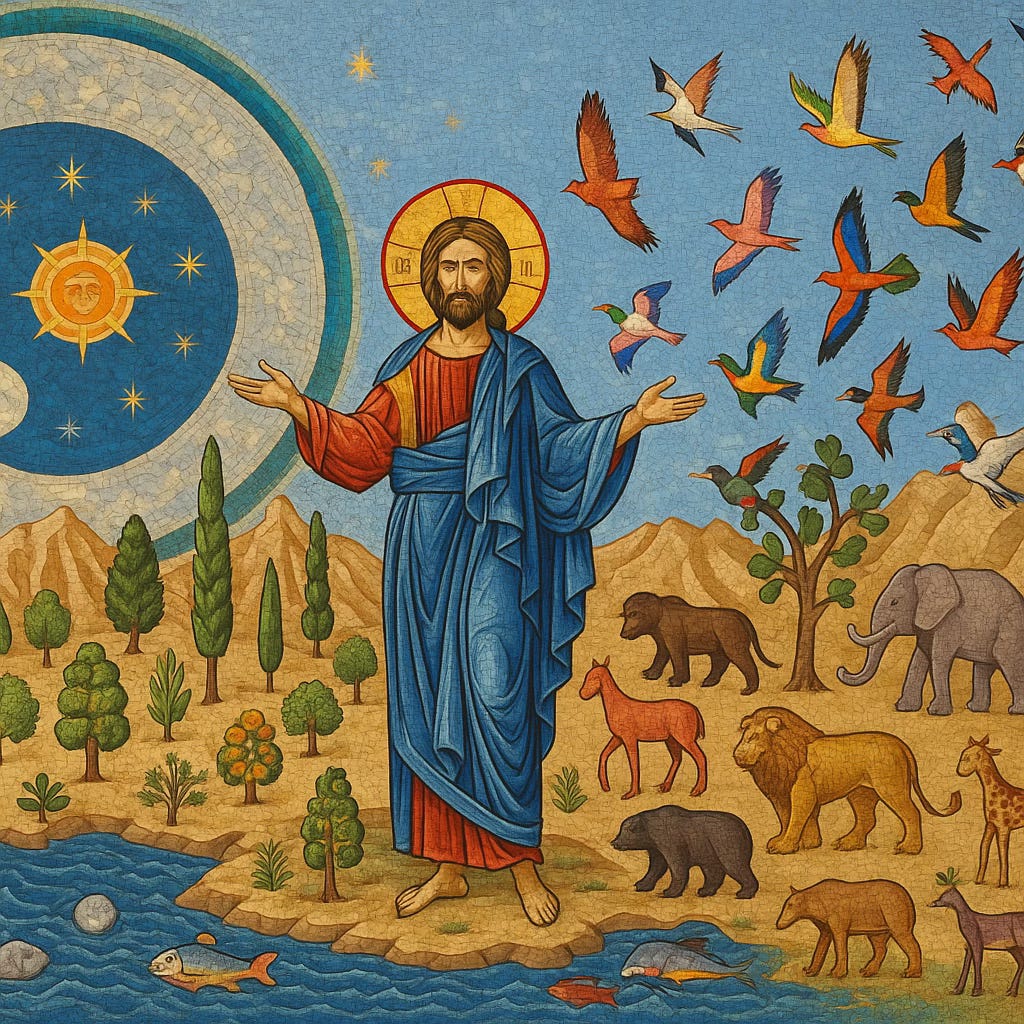
There is no other way to describe the experience but to say that I felt the face of Christ dwelling behind my own face. I felt myself seen through to the bottom and to the best. Love poured over the light and the dark in me, welcoming me body and soul into a new awareness of my role in the world and in the life of the divine. Along with a cosmic love came a fiercely insistent message: wake up. God sent not another angel to deliver this message but summoned the Christ impulse dormant in my own flesh to stir me awake to the fact that every soul is inspired, that a divine creativity swells within every human heart and spills over to swallow the face of Earth whole. Christ is literally dying to be recognized in us.
I did not receive this revelation as a gentle suggestion. It was an ontological shock, a humbling stumble over a stone I had rejected that forced a ground up reappraisal of my sense of ideal moral action and the meaning of my scientific knowledge. “Jesus said to them, ‘Have you never read in the Scriptures: “The stone the builders rejected has become the cornerstone” …?’” (Matthew 21:42). I had been mocking Christianity since I was a twelve-year-old boy, and now here was Christ, evidently alive, undeniably realer than real at least so far as my direct experience could show me. My skepticism had been crucified. The immediate mystical intensity of my vision of the living Christ within faded later that night, but the transformative effects of this participatory event on my further psycho-spiritual development remain undeniable to me even twenty years later.
I offer this story not as evidence but as confession. It motivates the central claim of this essay: that theology must be both self-deconstructing and participatory, personal as well as concretely universal. Theology cannot merely describe God from the outside, as if God were just another moral ideal or object of scientific inquiry. To speak of God is already to be spoken by God. When we theologize, we are also always autocosmologizing, not just reflecting upon but recreating the world with God.
The Crucifixion of Certainty
The early 2000s were dominated by the New Atheists, who mocked religion as simple-minded and stupid. The meme of secular materialism was ascendent. A generation of young people embraced disbelief with missionary zeal. But today the cultural tide has shifted. In recent years, it has suddenly become fashionable even for former New Atheists to convert to Christianity. The oscillation is revealing. But in many cases it bypasses the difficult work of genuine deconstruction. People leap from atheism straight into fundamentalism, or into aestheticized or racialized forms of “cultural Christianity.” I agree with radical theologian Peter Rollins that what is often missing in these public conversions is the crucifixion of certainty.[12]
Faith without deconstruction is shallow. To encounter God, one must first face the abyss of atheism, even nihilism. This is not a detour but a necessary passage, part of the initiatory pathway to free and loving human life. Kierkegaard called despair the sickness unto death, but also the condition for authentic faith. Nietzsche declared the old God dead, but his hammer also cleared space for a new kind of divine creation. Jung similarly insisted that we must descend into shadow before we can individuate.[13]
Rollins captures this insight in his pyro-theology: every idol must burn, our addiction to false certainties must be thrown onto the funeral pyre. Theology, he argues, must always remain a/theology. It must forever destabilize itself, refusing to settle on a final word.
The transformative potency of my own Christ encounter would have been impossible without first passing through the fires of atheism. Only because I had given myself fully to disbelief could I be surprised, pierced, turned inside out by what had arisen in me. The funeral of God made room within me to experience the mystery of Christ’s empty tomb. Atheism was a necessary process of crucifixion allowing me to outgrow my childish certainty. My faith arose experientially not as the opposite of reason (whether moral or theoretical, practical or speculative) but as its resurrection.
Whitehead’s Dipolar God and the Pyro-theological Gap
Where radical theology insists on the absence of being, process theology insists on relational becoming. Whitehead’s God is dipolar: primordial and consequent, eternal and temporal, Alpha and Omega. His process-relational God is no longer an all-powerful Creator but an all-loving Relator, the poet of possibilities who gently guides worldly creatures toward Beauty. God is a creature of Creativity like all others, albeit in the primordial nature axiologically preceding and so seeding history. The consequent nature is then God’s atoning response to what would otherwise remain the ruins of the past: “For the kingdom of heaven is with us today…[active in] the love of God for the world.”[14]
The primordial nature of God is an unconscious but value-laden prehension of pure potential, the realm of eternal objects irradiated by a “lure for feeling” that draws each occasion of experience toward novelty.[15] The consequent nature of God is the receptacle, the living memory of the universe, the “fellow-sufferer who understands.”[16] God is both the possibility of new creation and the one who feels every joy, every sorrow, every selfish betrayal and loyal self-sacrifice, and who weaves the partiality of the past into an ever-enriching Harmony of Harmonies.[17]
This dipolar envisionment prevents process theology from collapsing into either classical ontotheology or nihilistic atheism. God is not the Supreme Being, an unmoved mover, aloof and unchanging. Nor is God a hollow absence, no matter how hallowed. God is a cosmic participant in the emergence of spiral galaxies as much as in our own psychodramas, a catalytic agent beyond, between, and within us, both a transcendent lure and an intimate companion.
Despite the superficial appearance of conflict, Whitehead’s relationally constructive theology and Rollins’ radically negative theology converge in aim and effect. Rollins insists that God reveals only by concealing, such that all theology (i.e., all attempts to “know” God) must fail. Process theologians can agree, adding that the failure is fertile. The gap is not empty void but creative potency. The absence is itself the hyper-presence of possibility.
God, in this view, is not “large and in charge,” not the sovereign monarch pulling history’s strings from His eternal perch, safely tucked away behind an army of angels. God lives in and through the organic expressions of cosmogenesis as the poet of the world, ingressing novelty into every moment, suffering alongside us, rejoicing in each fragile achievement of value. God becomes conscious within us or not at all. To say that God participates in world evolution, living and dying in human hearts, is to say that conscious human beings are now charged with themselves becoming gods. God risks Godself, creating through cosmic incarnation, so that we may become as God. Or as scripture renders it: “I said, ‘You are gods, children of the Most High, all of you” (Psalm 82:6); “Jesus answered them, ‘Is it not written in your Law, “I said, you are gods”?’” (John 10:34).
Theopoetics: Idols, Icons, and the Magic of Speech
To speak of God is always to risk idolatry. But silence is not the only or most edifying alternative. Theopoetics offers another path. Rollins suggests theology should be iconic, always opening us beyond itself. An idol tries to trap God within our concepts, while an icon gestures past itself, beckoning toward mystery. Whitehead’s phrase “poet of the world” reminds us that theology, at its best, is poetic performance and not logical demonstration.
This matters because human beings cannot live without myth and symbol. Modern secularism pretends to outgrow religion and theology, but in truth it only represses them. What is repressed returns in distorted form: the fetishization of money, the rituals of consumerism, the liturgies of nationalism, the worship of celebrities. Even the myth of progress that is so central to contemporary techno-capitalist economics is a displaced (or demonically possessed) form of religious eschatology.
Myth and magic are ineradicable from human life. Only a death cult would attempt to eliminate them (or at least eliminate other people’s stories and spells, all while claiming its own are really “science” and “technology”). Our task is not to eliminate the role of narrative and liturgy in life but to integrate them consciously into our ecosocial coexistence here on earth beneath the sky. Theology, as theopoetics, seeks to redeem the symbolic essence of divine life from the sin of literalism. It takes up myth not as superstition but as imaginative ritual participation in a living cosmic process.
My experience was precisely the eruption of not just a living idea but the risen Christ into my life. What I had dismissed as superstition revealed itself as “hyper-presence.”[18] Rudolf Steiner called the Christ Event the turning point in time and insisted “Christian evolution has just barely begun.”[19] If this is so, then theology must itself evolve, becoming ever more imaginative, artistic, and participatory. Theopoetics celebrates God’s hyper-presence, not because poetry provides a privileged experiential access to God that reason lacks, but because secular conceptions of reason may have prematurely closed accounts on its nature and power. Though we may not be capable of knowing God, we can at least become Christ-like through kenosis.
Christ as Cosmic Archetype
Christ is not simply a historical figure. Christ is cosmic. Jung called this the archetype of the Self, the unifying pattern that integrates opposites, that holds together shadow and light, finite and infinite.[20] Steiner similarly envisions Christ as mediator between matter and spirit. My own encounter revealed Christ as a cosmic reality—a mystery not contained by any church, unowned by any corporation, nation, or ethnicity—an ontological disrupter and transformer of all fixed identities, everywhere turning hateful conflict into harmonious contrast. Christ now lives in every human soul, still being born and crucified in our midst.
Pierre Teilhard de Chardin saw Christ as the Omega Point, the telos of evolution, drawing matter into consciousness and consciousness into love.[21] Evolution, he argued, is a process of complexification and interiorization. As complexity increases, consciousness intensifies, and with greater consciousness comes compassion. Christ is the cosmic magnet, the attractor at the end of time.
Whitehead, too, envisioned God as both primordial possibility and consequent companion.[22] The Christ Event can thus be seen as a ripening of cosmic and cultural conditions, the moment when the eternal and the temporal mingled decisively, transforming the trajectory not of a single tribe but the whole of human consciousness and ultimately of the earth itself.
Christ is not confined to history. Christ is still incarnating, still emerging in culture, in politics, in the cry of the earth and the groan of creation (Romans 8:22), in art, still being crucified in our violence, and still resurrected in every act of love. Christ is the face behind every face.
Beyond Culture Wars: Toward Beloved Community
Christ-talk too often collapses into culture war. The right clings to worn out dogmas. The left recoils in disdain from the deeper moral sources of its own righteousness. Flashpoint figures like Jordan Peterson embody the paradox: railing against postmodern relativism while expertly embodying its logic, re-imposing patriarchal order to stave off chaos. His appeal to young men reveals the hunger for meaning in a misenchanted age, but his final solution is obnoxiously reactionary and exclusionary, far from an embodiment of the Christ impulse.
Josiah Royce imagined the “beloved community,” where individuals seek attunement to the “divine chorus” through “loyalty to loyalty as such,” undergoing not a gradual moral reform but a “transfiguring experience” or saving “rebirth.”[23] Martin Luther King Jr. carried this vision forward, grounding social justice in spiritual solidarity.[24]The Christ impulse is precisely this: to recognize the infinite value in every soul. To injure another in the name of justice undermines justice. Christian love is not fulfilled through cultural domination but by the creation of multicultural, concretely universal communities of kinship that include but transcend the familial.
A process or open and relational approach to political theology means not legislating morality from above but cultivating beloved community from below. Spiritual transformation cannot be imposed by the state. It must be incubated in the arts of relation: friendship, forgiveness, mutual recognition.
Theology as Autocosmology
Theology, then, is not simply speech about God. It is participation in God’s becoming. Every attempt to name God is also a contribution to, or derogation from God, and thus of the quality of our ongoing relations.
Theology must be self-deconstructing: apophatically aware of its inadequacy, always ready to burn its idols. But it must also be participatory: daring to create, to experiment, to risk novel phrases and metaphors. Theology is autocosmology: a theurgical medium through which the world and God grow ever more entangled.
My Christ experience was not just personal. It was also cosmological. It revealed not only a transpersonal hyper-presence behind my face but a potent pressure boiling in the depths of the world-soul. Christ was, and is, and will be ontologically shocking because Christ is the point where time and eternity meet and make love in us.
The Cosmic Word That Speaks Us
Process theopoetics is kenotic speech. It must empty itself, confess its failures, tremble before the mystery it dares to name. Yet in that trembling it participates in the divine life. The Word became flesh, and the Word still becomes flesh in us. To speak of God is to be spoken.
I return, then, to the face behind my face. To that unbearable, inescapable love. To the compassionate command to wake up.
Theology, if it is to be worthy of God, must not only describe the surface of the word. It must allow itself to be transformed in the cosmic depths of divine imagination. It must allow itself to be deconstructed and remembered, again and again, until every proposition becomes, not a death sentence, but a living symbol of the God who cannot be captured, but who, in love, refuses to let us go.
[1] Nietzsche, The Gay Science. Cambridge University Press (2011), p. 120.
[2] “Do-It-Yourself Cosmology” in The Language of the Night: Essays on Fantasy and Science Fiction. G. P. Putnam’s Sons (1979), pp. 121-128.
[3] Swimme, Brian Thomas. “The Birth of Autocosmology.” Starborne: The Journal of Autocosmology, no. 1 (Spring 2025), pp. 1-4. Accessed August 20, 2025: https://drive.google.com/file/d/1err029fHitoTOY4EMm6ANOVsfCW7MOU6/view
[4] Schelling, F. W. J. The Ages of the World. Translated by Jason M. Wirth, SUNY Press (2000).
[5] See Cobb, Jr., John. Christ in a Pluralistic Age. Westminster Press (1975).
[6] See Keller, Catherine. Face of the Deep: A Theology of Becoming. Routledge (2003), and Cloud of the Impossible: Negative Theology and Planetary Entanglement. Columbia University Press (2014).
[7] Swimme, Brian, and Thomas Berry. The Universe Story: From the Primordial Flaring Forth to the Ecozoic Era—A Celebration of the Unfolding of the Cosmos. Harper Collins (1992).
[8] Nietzsche, Beyond Good and Evil, Cambridge University Press (2002), p. 8.
[9] Jung, C. G. Psychology and Religion: West and East. Collected Works, Vol. 11. Translated by R. F. C. Hull. Princeton University Press (1958).
[10] Watts, The Essence of Alan Watts. Celestial Arts. (1977), p. 47.
[11] See for example Evan Thompson, Why I Am Not a Buddhist. Yale University Press (2020), pp. 19ff.
[12] See Rollins, Peter. The Idolatry of God: Breaking Our Addiction to Certainty and Satisfaction. New York: Howard Books (2013).
[13] Jung, C. G. Answer to Job. Translated by R. F. C. Hull. Princeton: Princeton University Press (1954).
[14] Whitehead, Process and Reality: An Essay in Cosmology. The Free Press (1978), p. 391.
[15] Whitehead, Process and Reality: An Essay in Cosmology. The Free Press (1978), p. 189.
[16] Whitehead, Process and Reality: An Essay in Cosmology. The Free Press (1978), p. 391.
[17] Whitehead, Adventures of Ideas. The Free Press (1933/1967), p. 296.
[18] See Rollins, Peter. How (Not) To Speak of God. Paraclete Press (2006), p. 24: “[Hyper-presence] means that God not only overflows and overwhelms our understanding but also overflows and overwhelms our experience.”
[19] Steiner, Rudolf. An Outline of Occult Science. Anthroposophic Press (1922), p. 212.
[20] Jung, C. G. Aion: Researches into the Phenomenology of the Self. Collected Works, Vol. 9ii. Translated by R. F. C. Hull. Princeton: Princeton University Press, 1959.
[21] Pierre Teilhard de Chardin, The Human Phenomenon, trans. Sarah Appleton-Weber (Sussex Academic Press (1999).
[22] For more on the convergences in Teilhard and Whitehead’s evolutionary theologies, see the present author’s chapter “Process Theology and the Modern World: Science, Religion, and Christology After Teilhard and Whitehead” in Whitehead and Teilhard: From Organism to Omega ed. by Andrew Davis and Ilia Delio/ Orbis Books (2025).
[23] Royce, Josiah. Problem of Christianity. Catholic University Press (1913/2001), pp. 196, 18; and The Problem of Loyalty in The Basic Writings of Josiah Royce, Volume 2: Logic, Loyalty, and Community. Fordham University Press (1908/2005), p. 869.
[24] See Kipton Jensen and Preston King, “Beloved Community: Martin Luther King, Howard Thurman, and Josiah Royce” in AMITY: The Journal of Friendship Studies (2017), 4:1, pp. 15-31.

 Footnotes2Plato
What do you think?