The Rosy Crux
The central issue is not simply whether Hegel is right, or whether we can derive a more empirically grounded metaphysics than absolute idealism from Darwin’s humble hypothesis of descent with variation. I agree with Charles Taylor that Hegel’s treatment of historical evolution is “disastrous.” By my lights what we are in urgent need of today is the healthy progeny of a happy marriage between the best of absolute idealism and radical empiricism. The crux is whether reality is finally intelligible as a self-enclosed rational substance, or whether every approximation to closure is an aesthetic achievement constructed within a wider, plural, unruly process of genesis that no system can finally contain.
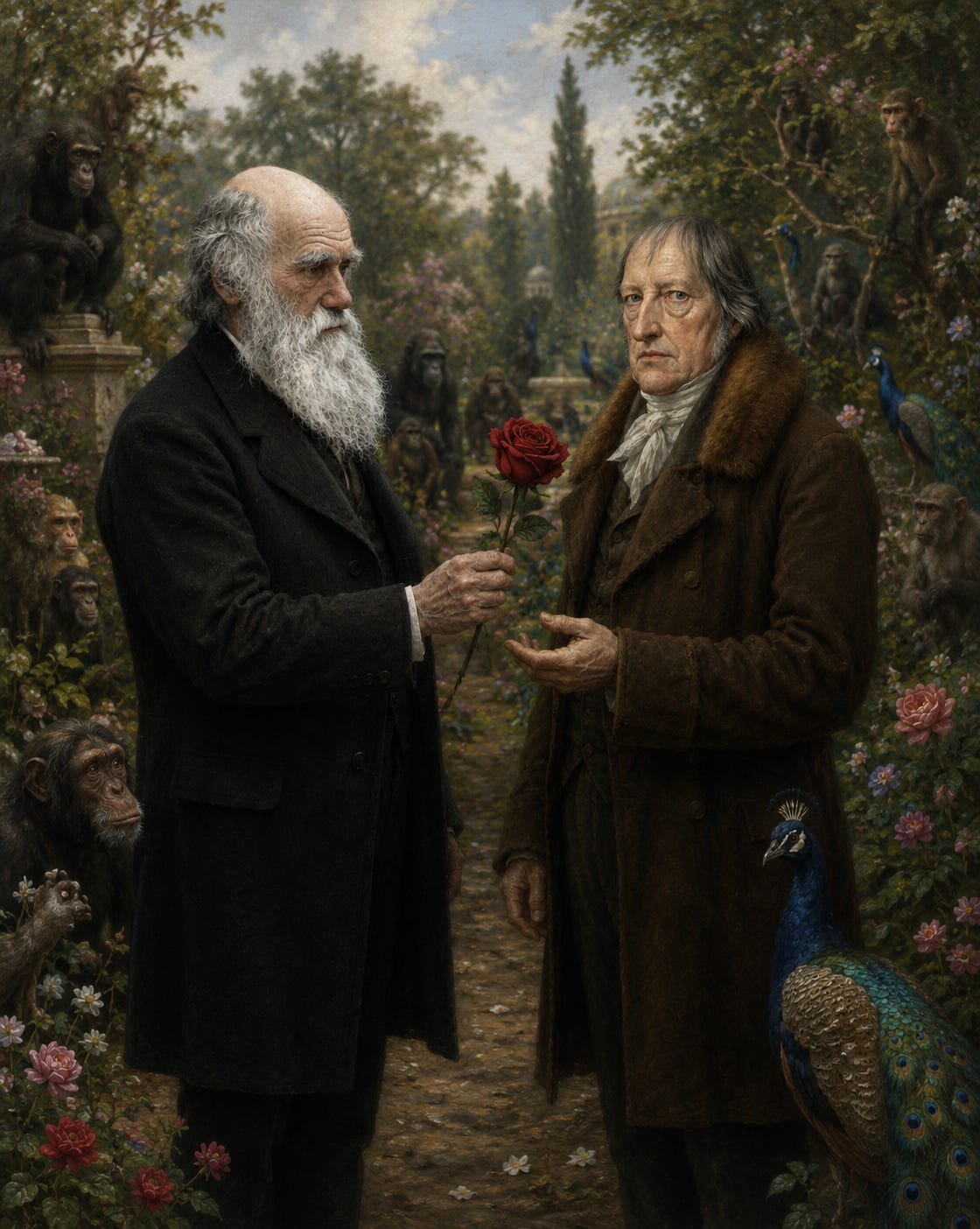
My friend the evolutionary biologist and philosopher of ontogenesis, Timothy Jackson, is on a mission to amplify the excessiveness of the genesis story. He prefers the term “variation” because it anchors the speculative problem of excessive indeterminacy to the concrete transformation of modeling techniques wrought by the rise of the historical sciences, especially evolutionary biology. Variation is not just a local principle inside Darwinian theory but is a generic, generative operation that any rational reconstruction of an object’s origins must presuppose but can never fully recuperate. Whenever we undertake the task of reconstructing the emergence of some objective product, the indivisible triad of variation, selection, and inheritance will arise together with complex circularity (ie, the first already presupposing the last). But this is because in such cases we are already looking backward from a particular constructed product. On the other hand, when we consider genesis in general, variation has ordinal priority. Its firstness is what prevents genesis from ever becoming arrested in some final completed crystal at the end of time.
Reading the early work (2015, 2016) of Montévil and Mossio (with Pocheville and Longo) has given me an opportunity to sharpen the theoretical edges of the concepts of variation and closure. They argue that variation should be treated not as an accidental disturbance of biological order but as a principle of biology just as fundamental as the principle of organizational closure. Organisms are not “generic” objects, like the idealized masses of mechanics or the charged particles of electromagnetic theory. Electrons are all interchangeable from the standpoint of Maxwell’s equations. Organisms, they argue, are “specific” objects, meaning they are historically individuated beings whose phase spaces are unprestatable, who each to varying degrees qualitatively differs from others and even from themselves across development, and whose functional transformations of constraints may alter the very terms by which their organization has been defined. Biology is not just a more complicated physics. They are in a sense defining biology as a science in which the exception can, within limits, be lawfully modeled, without ceasing to be exceptional.
But I still wonder if what seems exceptional about living organisms relative to mechanistic physics may turn out to be genetically and generically prior to the ahistorical models of physics.
Because I’ve been teaching Hegel this semester, I’ve often found myself trying to steel man his system against Tim’s criticisms of his widely alleged tendency toward theoretical closure. My ironic defense of Hegel is not a result of some sort of conversion experience to Absolute Idealism. Rather, I’m convinced my steel man will help temper the alternative ontogenetic approach Tim and I have been hammering away at for several years now. Also, it turns out Hegel is not as easy to dismiss as some caricatures of his thought suggest. Still, for now, I remain a process-relational philosopher inspired by Whitehead’s organic realism, which I believe provides a way to affirm the important truths won by both Hegel and Darwin.
The crux of the argument, as I see it, is not between a Supreme Reason that pre-determines everything and a corrosive irrationality that annihilates meaning at its roots. It is between differing ways of rendering Reason’s relation to its outside. Does Reason already contain its own outside as a moment of its self-development? Or does Reason itself evolve out of an ancient lineage of creatively varying evaluative and recollective feelings whose enabling conditions it can illuminate but never exhaust?
Hegel’s circle of circles that almost closes
Hegel would no doubt object that variation, as Tim has sought to (un)define it, cannot be treated as an immediately given minimal condition or ontological primitive. The minimalist definition of “differing-from” is already a determination, since it contains many other concepts including relation, negation, otherness, and contrast. Variation cannot simply be first, because to vary is to differ from something, even if that something is not yet an object in any stable sense. Variation already differs from alternative operations, such as identification or repetition. In Hegel’s Logic, being and nothing do not sit side by side like two objects. They are inherently unstable and instantly vanish into one another. Becoming is the unrest of their vanishing. So if one says, “There is an indeterminate no-thing whose only character is the operation of variation,” Hegel would likely reply: yes, but you have just rediscovered, in another idiom, the instability of pure immediacy. You have not reached a pre-rational primitive so much as the beginning of logic, the self-undermining of the indeterminate, the first operation of mediation. The moment one says “variation is,” one has already stepped beyond sheer immediacy into Hegel’s “diamond net” of determinate negation.
Annoyingly, then, Hegel would argue with good reason that variation is not prior to determination but an essential moment within it. The Logic continues from becoming to determinate being; only then is there “something,” which by way of further negation reveals its “other.” Hegel is not beginning with Something, Nothing, Subjectivity, or Identity in any determinate sense. He’s beginning by demonstrating the impossibility of any beginning that does not already imply its end. Grammar cannot be escaped, since any critique of grammar must still be grammatically conveyed, and any real translation between alternative grammars would already be a transformation of both. Even more annoyingly, Tim’s affirmation that variation has no determinate content and is no-thing reads for Hegel like a self-undermining reductio ad absurdum, a slide into abject nonsense.
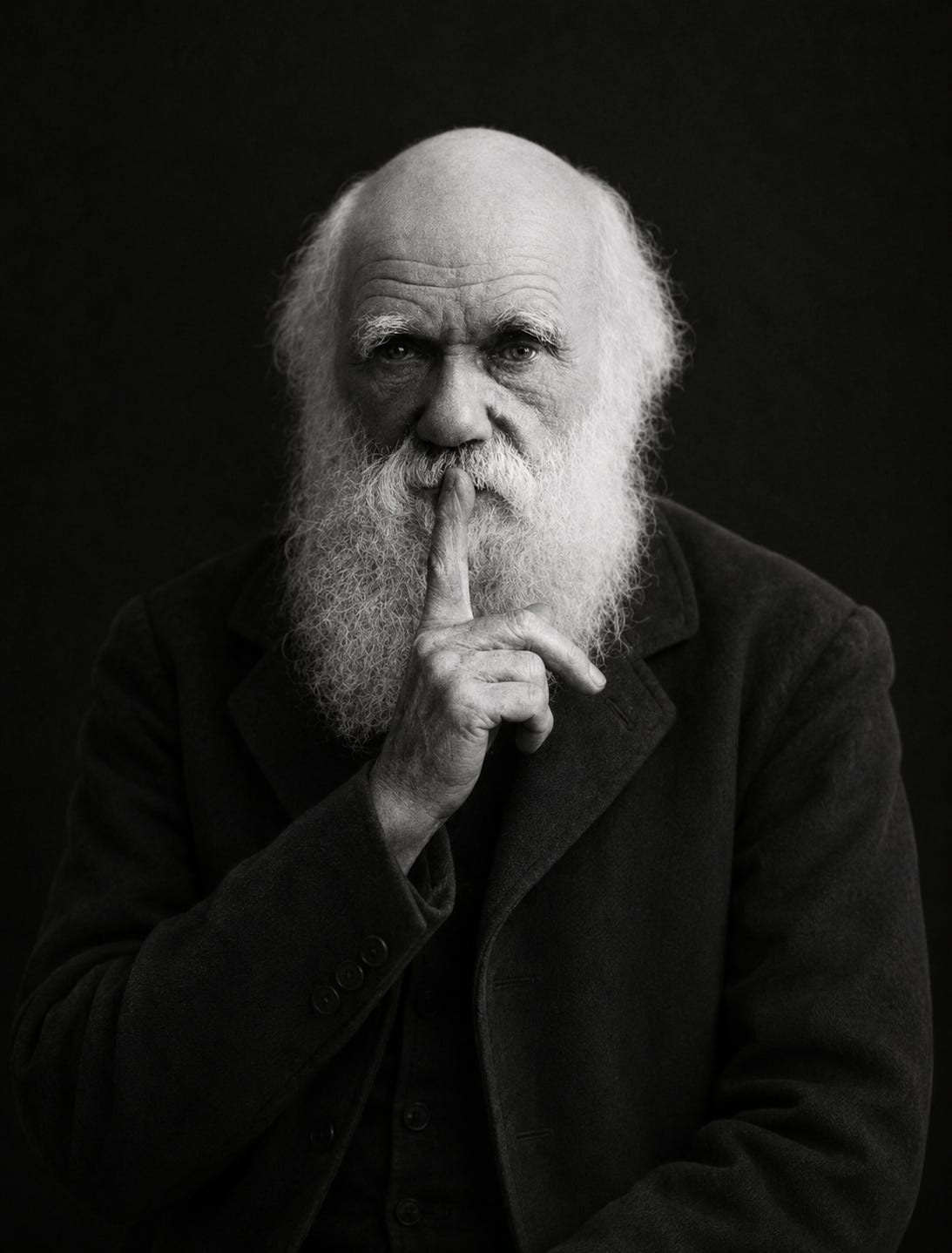
This is why I sometimes say only a confident silence slays Hegel’s dialectical dragon. He can only catch you if you open your mouth to utter a proposition. In fact, even just pointing gets your finger trapped. The Zen master may throw the stick down on his shoulder, blink unknowingly, or burst into laughter. Hegel cannot refute silence with an argument, because silence does not enter the courtroom of the Concept, and so cannot be sentenced. Mediation has no jurisdiction over the unsaid, which is less than nothing. Only once the Zen master offers a dharma talk on the superiority of silence does the Logic snare its prey. Hegel’s diamond net is not external to discourse. It is discourse discovering that it cannot help but mediate itself even and especially when it seeks to honor the dignity of immediacy with words.
Still, I am sympathetic to Tim’s resistance. The perniciousness of Hegel’s logical judo flip is that he (mis)appropriates negation—the failure of a finite concept to close upon itself—by turning it into the Concept’s final triumphant trump card. Every outside is assimilated into another inside. Any apparent remainder becomes another moment in the system, another crumb to be digested by the system’s infinite appetite for difference. That the wound of Reason has so far remained self-healing becomes eternal proof of the logical organism’s wholeness. Hegel becomes the supreme rationalizer: he turns the self-conscious limits of finite understanding into just another chapter in Reason’s absolute system of knowing.
Hegel is a thinker of dusk. The owl of Minerva flies only when a form of life has grown old. He is unsurpassed at reconstructing the meaning of a world once the dust has settled. But does the dust ever really settle? Can we ever arrive at The End? Or are we always on our way, forever kicking up a cloud of yet unthought possibilities? The brilliance of Hegel’s retrospective reconstruction tempts us to identify retrospective intelligibility with the forever futural and so incomplete wholeness/holiness of reality. The future is explicitly left unthought by Hegel, and yet the system often behaves as if no future could surprise it.
James Bradley’s reading of Whitehead as a transcendental cosmologist (1993) may be helpful here. The difficulty is not merely that Hegel closes the circle too soon, while Darwin or Whitehead leaves it open. The difficulty is how any philosophy of creative process or ontogenesis can affirm its own generic categoreal truth—that reality is composed of unique, once-occurrent events—if the real is ipso facto not grounded in eternal universal form. Whitehead states the problem with disarming honesty in Modes of Thought:
“From this doctrine (of forms of process), a difficult problem arises. How can we justify the notion of some general value of reasoning? Indeed, if the process depends on individuals, it varies according to the differences of individuals. Consequently, what has been said of one process cannot be said of another process. The same difficulty is encountered concerning the notion of the identity of an individual conceived as implicated in different processes. Our doctrine seems to have destroyed the very foundation of rationality” (MT 133).
The question is whether Reason survives after universality has been dethroned by creative variation or Deleuzean difference-in-itself. Hegel answers by pre-authorizing the Concept to recollect every difference into itself. Whitehead answers differently by resurrecting an analogical, experimental, and revisable method of reasoning, Reason as a disciplined relator of forms of process rather than a sovereign survey from nowhere.
Whitehead’s creative incompleteness
Whitehead is far more sympathetic to the variational impulse than Hegel. For Whitehead, the final real things are not substances enduring through accidental modifications, but relational acts of becoming, actual occasions arising and perishing within the wider, wilder operation of infinite modification he terms Creativity. Yet Whitehead is not satisfied with a spare metaphysics of bare variation. For him, any concrete creation—any creative act—inevitably requires the co-operation of valuation and memorization. Objectification, for Whitehead, is not merely the epistemic act of identifying or postulating invariants. Perished actual entities transition from subjects into “immortal objects” available as “real potentials” for later actualities. “Eternal objects” ingress into a concrescing occasion as adjacent alternatives relative but not reducible to that occasion’s inherited past and present standpoint. Another aspect of their relevance stems from their everlasting value as immediately envisaged by the primordial nature of God. Eternal and immortal objects function causally in actualities as data, as real potentialities with abstractly definable and physically determinable functions. But neither type of invariance, immortals nor eternals, is made up by us. If anything, it is rather we who are partially made out of them, in that they constitute our physical habits and characterize our enduring identity. Note that Whitehead distinguishes his eternal objects from classical “universals,” which is important since it is easy to misunderstand their role if they are collapsed into the latter. Whitehead:
“The explanatory purpose of philosophy is often misunderstood. Its business is to explain the emergence of the more abstract things from the more concrete things. It is a complete mistake to ask how concrete particular fact can be built up out of universals. The answer is, ‘In no way.’ The true philosophic question is, How can concrete fact exhibit entities abstract from itself and yet participated in by its own nature?” (PR 20)
Real potentials are that which allows us to recognize variation not just as an epistemic condition of evolutionary thinking but as an ontogenetic operation of actual becoming. Actual occasions are the final realities, but it is only by reference to eternals and in response to immortals that their creative variations occur.
Some objects are just epistemic abstractions, of course, and misplaced concreteness remains the great sin of human consciousness. But the objectification of entities, whether immortal or eternal, is not merely stipulative. It is how causal transmission works, each natural event always and everywhere involving the holy trinity of variation, valuation, and memorization. Evolution requires objects because evolution requires valuation and memorization. Neither the anamnesis of an original past nor the so-called Platonic heaven of Ideas is invented by some crime of conceptual reification. Valuation and memorization are (in their reformed Whiteheadian versions intended to be) felt ingredients in experience, a form in the flux, just as elemental as anything—or non-thing—else, including variation or creativity. In this sense, creativity might be understood not as mere variation stripped of secondness and thirdness, but as variation inseparable from valuation and memorization (or eternality and immortality).
Whitehead’s God, then, should not be conceived as a substance standing apart from eternal objects on one side and the concrescence of finite occasions on the other. God is not an external designer or sovereign engineer who miraculously intervenes by stamping His final forms on a dead world otherwise left to its own devices. Instead, divine agency is actualized only in and through actual occasions. God’s primordial nature is the ordering of eternal objects as relevant possibilities for finite becomings, but we must not imagine this as a finite set of eternal objects stored in an industrial-size Platonic freezer. The eternal objects are non-entities without God’s primordial conception and consequent reception of their ingression into temporal creatures. God’s consequent nature is not an afterthought added to an otherwise complete creation but the divine recollection of the world’s proliferation, the preservation and integration of finite satisfactions into an ever-widening, ever-diversifying harmony of harmonies. There is nowhere else for the superjective satisfaction of actual occasions to go, once they have perished as subjects, but into the consequent life of God. And conversely, there is nowhere else for God to be actual except in the initiation, lure, suffering, and fulfillment of finite occasions. God is ingredient in the world as the intensifying lure toward relevant novelty, and the world is ingredient in God as the achieved fact of creative advance. The God-world co-creative mutuality is not an external relation between two substances, but a dipolar process wherein divine and worldly becoming require one another. God gives the world possibilities to value without predetermining their actualization; the world gives God actualities to suffer with without exhausting divine possibility. The relation is not unilateral creatio ex nihilo, but mutual immanence: God as the primordial ordering of all potentiality and consequent feeling of every actuality, the world as the evolutionary adventure through which those potentials are proposed, tested, intensified, sometimes comically distorted and always tragically redeemed.
Whitehead’s God may be made otherwise intelligible as a cosmological transposition of the relation between variation and organization in theoretical biology. Creativity is metaphysically ultimate: the many become one and are increased by one. God is not ultimate in that same sense. God is the primordial ordering of relevance within Creativity, the valuation of pure potentials by which novelty may be more than arbitrary eruption. Thus God is metaphysically accidental relative to Creativity, but categorically indispensable if we hope to offer a rational account of the organization our cosmic epoch. God is not an exception to creative process but the primordial lure of process toward the intensification of contrasts.
But this divine ordering should not be treated as a completed closure. Whitehead’s God is dipolar. The primordial nature inspires intensity of experience by providing relevant novelty; the consequent nature receives, suffers, preserves, and reweaves actuality. God is not the finished totality of the universe but the growing memory of its incompletion in process of production. The consequent nature is raucous jazz ensemble, not an archive of dead facts. Whitehead:
“There is not one completed set of things which are actual occasions. For the fundamental inescapable fact is the creativity in virtue of which there can be no ‘many things’ which are not subordinated in a concrete unity. Thus a set of all actual occasions is by the nature of things a standpoint for another concrescence which elicits a concrete unity from those many actual occasions. Thus we can never survey the actual world except from the standpoint of an immediate concrescence which is falsifying the presupposed completion.” (PR 211)
Darwin and historical science
Darwin changes the philosophical situation not by offering a metaphysical system but by forcing thought to take genesis seriously. Historical science asks not merely what a thing is, but how it came to be. The question of genesis dissolves static essences. All enduring essences are understood to be constructions. Species are no longer eternal kinds imperfectly realized by individuals. They are relatively stable achievements of formation within ongoing and often hybrid lineages. Forms are made, inherited, shared, adjusted, lost, and transformed.
Darwin’s importance is not exhausted by natural selection. Darwin’s hypothesis marks a threshold in the emergence of historical reasoning. Geology, embryology, population statistics, comparative anatomy, evolutionary biology—all of these transformed our onto-epistemic situation. They disclosed that any biological objects and laws we attempt to classify are products of histories. Our classifications are themselves historically situated abstractions.
Evolutionary science reveal that no achieved form contains the sufficient reason for its own historical genesis. Every organism looks inevitable once it exists. A trait looks functional once a niche has selected it. But the actual genesis is far messier and full of unpredictable contingencies.
Randomness never means absolute chaos. Random means unprestatable relative to a theoretical framework. It denotes an indivisible remainder in causal reconstruction. Variation is always adjacent to a history. There has never been a now without a past. Every mutation, preference, and divergence from a norm occurs in a field already heavy with inheritance. It is not that evolution is blind chance but that its novelty cannot be exhaustively deduced from what came before.
History does make sense in retrospect; otherwise no historical science would be possible. But the retrospective sense of history must not be confused with the predictive possession of the future. Evolution teaches us that the past is ingredient in the present, and that the present shapes the future, but it also teaches us that the future is not contained in the present as a concept waiting to be deduced.
Theoretical biology: variation and closure
Montévil and Mossio’s account of biological organization helps sharpen this point. The theoretical objects of physics are usually generic. The apple, the anvil, and the asteroid can all be treated as the same sort of thing insofar as they obey the same equations under the relevant idealizations. Their historical individuation and context are bracketed, since all that matters is how invariant symmetries in their behavior unfold in a pre-given mathematical space. In biology, by contrast, because the objects of study are historical, their transformations are not merely changes of state within a fixed phase space. Development and evolution change the relevant space of description. Organisms do not simply move within fixed trajectories governed by the symmetries of invariant constraints; they vary their own constraints, redrawing the closure diagrams that would otherwise determine their trajectories.
Variation cannot be reduced to noise haloing invariant structures. A biological variation may be functional: it may change a constraint, rearrange the relation among constraints, or bring a new constraint into organizational closure. An organism persists not by remaining the same object under the same symmetries but by passing from one regime of closure to another. Its identity is not the conservation of a substance or essence but the continuity of a precariously self-maintaining adventure. The organism is a melody that survives by modulating to resonate with its environment, not a stone that persists by resisting alteration.
The companion concept to variation is constraint closure or organization. Montévil and Mossio distinguish “processes,” the ongoing thermodynamic flows of matter and energy, from “constraints,” the relatively conserved forms that channel those flows at relevant time scales. In organisms, constraints do not simply sit outside the processes they constrain, like an inclined plane guiding a ball. They depend upon other constrained processes for their own maintenance. Closure is the term for the mutual dependence whereby constraints maintain processes that maintain constraints. Biological self-determination is self-constraint, but self-constraint without isolation. Thermodynamic openness and organizational closure are not opposed concepts. On the organizational account, they are the left and right hands with which life continually remakes itself.
Their framework is an attempt to give biology a principle of stability or defining characteristic without betraying variation. Closure is not the conservation of a fixed set of invariant components nor even fixed constraints. It is the persistence of organizational mutuality through the alteration, loss, and acquisition of new constraints.
Montévil and Mossio are offering an epistemology of biology or theoretical framework for modeling organisms. They mark the living being as a distinctive kind of scientific object. At least in this earlier work, they had not taken the speculative step of asking whether the supposedly ahistorical generic objects of physics are themselves abstractions from a deeper historical and organismic flux. Their framework lets biology escape reduction to physics by showing that biological symmetries are local, contingent, and historically unstable. Whitehead wants to press further by arguing the invariant symmetries of physical models are not metaphysical ultimates, either. Perhaps they are the most generic social habits shaping our cosmic epoch, enormously stable relative to cellular life, but still achievements of evolutionary becoming rather than eternal laws standing outside history.
This is the sense in which biology should teach us a new physics. The point is not that physics should abandon mathematical idealization. The point is that we should not forget when we are working with idealizations. Physics has earned its tremendous theoretical power by modeling many phenomena as if they were ahistorical. Whitehead warns that the success of this method has seduced us into mistaking a method for an ontology. From the standpoint of a speculative biology enlarged into an organic cosmology, the law-like regularities physics discovers are better understood as widespread habits, stabilized routes of inheritance, enduring societies, patterns of process that have achieved such depth of repetition that they appear almost eternal to us. Biology does not suddenly add history to an otherwise timeless nature. Biology makes nature’s historicity visible because it amplifies the variational novelty that otherwise easily remains hidden within the extreme repetitiveness of most physical processes.
Variation, selection, inheritance—creativity, valuation, memorization
The biological triad of variation, selection, and inheritance can be mapped onto Peircean Firstness, Secondness, and Thirdness, and also onto Whiteheadian creativity, valuation, and memorization. Tim wants to preserve the ordinal priority of the operation of variation. I want to insist that the triad is concrete only in co-operation. There is never selection without inheritance, and never inheritance without some prior selection. Of course, selection cannot select without a distribution of variants, and inheritance would have no function if nothing changed.
If we are speaking methodologically, the ordinality is indispensable. For Tim, variation precedes selection in the logic of Darwinian explanation. There must be a distribution of differences before selection can act. But if we are speaking cosmologically, the order of the terms cannot be pried apart so neatly. A distribution of differences can only array themselves in relation to the horizon of relevance opened by the norms and aims of an organism. A variant is not merely sheer difference. To be a variant is to be a variant within a continuum of relevant alternatives. Difference must make a difference to someone. The contrast must be available for some mode of prehensive feeling, even if not yet conscious, cognitive, or deliberate.
Valuation in the Whiteheadian triad does not mean conscious deliberative judgment. There is not a little rational agent hidden inside the frog, the gecko, the cell, or the ribosome making choices. It is not a conscious judgment but an aesthetic and affective selectivity, such that an individuating entity or entitative process is never merely there for others as this or that objective chemical or physiological event, but also subjectively orienting around its own here. In Whiteheadian terms, every actual occasion is an act of prehension, of minimal perceptivity, with subjective form and subjective aim. It feels its world, inherits data, selects, excludes, integrates, and produces novelty. Grasping this requires overcoming the simplistic binary between rational agency and dead mechanism. Reality is made primarily neither of dead stuff nor tiny egos but of energetic pulses of emotion.
The objective and subjective sides intertwine without collapsing into one another. A point mutation in the nucleotide sequence may alter a pheromone. An organism may prefer the new smell. Chemical divergence and erotic preference are both characteristics in an unbroken evental nexus of actual occasions. A molecular change cannot become evolutionarily significant until and unless it is caught up in a field of attraction, recognition, or rejection. The pheromone is law-abiding molecule. It may also be an outlaw instigating a new ecology of desire.
I would not want to make subjectivity co-ultimate with creativity in a crude way, as some panpsychisms appear to do. Tim is right to resist any account that takes a derived category—subject, mind, language, matter—and elevates it into a sacred name for the whole. But I do think William James’s “pure experience,” and Whitehead’s related account of experience as the most general form of “togetherness,” point toward a vital field of relationality prior to any settled split between subject and object, mind and body. Variation is happening on both sides of any such apparent division. The internal/external distinction is itself a product of creative process. The more original situation is not a mind looking out at a world, but an event of becoming in which feeler and felt, activity and datum, aim and object, have not yet been cleanly cleaved but are grown together.
Whitehead: creativity without external design
Whitehead gives me a way to disagree with Hegel without merely reversing or ignoring him. He does not begin with substance, subject, matter, mind, or even God. His ultimate is Creativity. Creativity is not an entity. Nor is it a creator. It is the ultimate categoreal operation by which the many become one and are increased by one. Actual occasions are the final realities, and eternal objects are potentials for the characterization of actualities. Both are simultaneously conditioned by and conditions of Creativity.
Creativity is not mere under-determination or blind flux. It is the production of determinate actuality from inherited potentiality, the advance into novelty through concrescence. Actual occasions are not objects awaiting classification or categorization within an Encyclopedic system. They are unique acts of becoming, the each-form perpetually bursting beyond whatever All-form may yet have been imagined, compelling our Pluriverse to die and become again and again through each microcosmic recapitulation. Each occasion inherits a past, feels its possibilities, decides among alternatives, achieves satisfaction, and then perishes into objective immortality for future occasions.
This account is intended to avoid two equally bad options. On the one hand, we need not accept Hegel’s tendency to turn every remainder into more food to be metabolized in service of conceptual self-closure. On the other hand, we need not treat the remainder as some sort of absurd excess that makes all attempts at rationality a farce. The extra-rational is not the anti-rational. It is the aesthetic matrix out of which Reason grows. Conscious cognition is not the whole of reality; rational thought is special mode of intensified contrast available in the late phases of rare actual occasions, granting them the ability to illuminate earlier phases of their own concrescence.
This is also why I cannot bring myself to affirm variation as primary, as if separable from valuation and memorization. Creativity does not first vary, then later acquire value, then later acquire memory. In finite actualities, aim, habit, and novelty are distinguishable only as abstractions from a concrete act of becoming. There is no naked novelty, because novelty is always relative to the perspective of some occasion’s actual world. There is no blind inheritance, because inheritance is always selective. There is no vacuous valuation, because aims can only work with inherited data and alternative possibilities.
God is not the creator of Creativity. Nor is God a supernatural machinist responsible for designing biological machinery. God is the lure of relevance, the envisagement of possibility, the operation whereby eternal objects ingress into finite actualities without dictating the way beings become. Variation turns out never to have been blind, but this does not mean that a cosmic engineer had a blueprint. It means that becoming is intrinsically aesthetic, its beginnings intrinsically allured by ends.
God is organization writ large, closure cosmologized, but not as an organizational closure finally achieved. God is the both the ideal of intensified varieties of organization, and the tenderness by which the perpetual failure of closure contributes to the evolutionary realization of tragic beauty rather than meaningless waste.
Meyer and the temptation to complete the machine
In my conversation with the intelligent design theorist Stephen Meyer last week, he admitted that organisms are not adequately understood as machines. He recognized, at least in that moment, that the machine metaphor breaks down when confronted with the reality of the community of causes operative in living organization. Cells are not artifacts like clocks or computers, assembled partes extra partes. Organisms contain machine-like constraints on processes, yes; and organisms can produce machines. But organisms are not themselves machines.
The problem is that Meyer responds to the computational incompleteness of mechanism by positing a divine engineer outside the machine. He seeks a transcendent source of completion in an intelligent designer. An epistemic limit is repurposed as an opportunity for apologetics. In other words, God of the gaps.
But what if computational incompleteness is not a software bug in need of a deus ex machina pseudo-explanation but a constitutive feature of life itself? The success of effective theorization within bounded domains does not authorize us to project closure in some totalizing way. Reductive physicalism makes that mistake when it turns local idealizations of closed systems into an absolute causal reduction base. Intelligent design makes an equal and opposite mistake by patching local mechanistic failure by appeal to a transcendent demiurge.
The process theological response is different from both reductionism and creationism (to call a spade a spade). As with Hegel’s treatment of the true infinite, the truly transcendent is not separable from immanence but rather its superlative mode. A false transcendence stands over against the world as an external beyond, just as Hegel’s bad infinite stretches endlessly past the finite without ever overcoming its opposition to it. Genuine transcendence is not an escape to elsewhere. It is the finite’s own self-surpassing, the immanent process by which actuality exceeds itself from within. God is not outside the world-process as an alien cause imposed upon becoming, but is each worldly creature’s immanent lure toward intensity of experience. Divine transcendence does not take flight from finite occasions of experience but is the inexhaustible depth of possibility ingredient in each concrescence, and the consequent gathering up of their perished achievements into a more inclusive life. I relate to immanence and transcendence as the inhalation and exhalation of metaphysical discussion.
This is why process theology is so different from intelligent design. It does not infer God from gaps in the gears. It contests the metaphysical adequacy of mechanism from the start. Organisms are not flawed machines requiring an external engineer to wind their springs. Organism is the more concrete category, and machine is a derivative abstraction.
A machine has constraints imposed from without or assembled according to a design that remains external to its material functioning. An organism, by contrast, continually produces, repairs, and transforms the constraints that make its own processes possible. Its parts are not merely accidentally arranged but are bound into relations of mutual maintenance. This is why the machine metaphor misleads even when it is locally useful. It extracts one aspect of organismic life, constrained work, and forgets the open-ended circular genesis of the constraints themselves. Intelligent design mistakes an abstraction for the whole and concludes that an external intelligence must supply what the abstraction omitted.
An organic evolutionary theology instead begins by not omitting the reality. Life is not mechanism plus miracles. Mechanism is organism minus internal genesis. The machine is a frozen diagram of constrained process; the organism is constraint learning how to transform itself. The divine is no longer needed as a technician of last resort. God becomes the goad of the organism’s own adventure of continual self-surpassing, the depth of relevance by which variation is made viable.
Language, semiosis, and the danger of assimilation
Human language is a highly derived evolutionary phenomenon. Our specific forms of symbolic language are not plesiomorphic across lineages. If we call birdsong, whale clicks, pheromonal signaling, and photon wavelengths language, we risk taking a late human category and projecting it backward as the name of the whole.
But we don’t want to end up with the opposite extreme of imagining human language is in any sense alien in nature. There is a logos to our cosmos. Human words are a higher potentiation of semiotic processes that long precede them. The human mouth is not the first organ of meaning. Cells already mean. The world is not made of semiotically inert stuff that language later points at and bootstraps into meaning. It is relationally co-determined from the beginning, and at least since the emergence of living cells this co-determination becomes undeniably semiotic.
As Peirce argued, sign-processes are rooted in the relational structure of reality and become more explicit, recursive, and interpretive in life. In the physical world, there is relational co-determination. In the biological world, this becomes semiosis proper. In human language, semiosis becomes self-reflective, symbolic, historical, and potentially dangerously detached and self-enclosed.
Language can drive us mad. Western alphabetic abstraction can easily alienate itself from the ecologies that gave birth to it. It can mistake its own symbols for the real, putting its own false universals in place of concrete facts, destroying worlds in the process by imposing its own grammatical habits onto habitats that cannot bear them. The ecological catastrophe driven largely by the economic abstraction of purely symbolic general purpose money is Whitehead’s fallacy of misplaced concreteness at a civilization ending scale.
The alternative, to my mind, is not the wholesale condemnation of universality, but the urgent construction of a concrete universality: human thought coming into the service of the community of life on Earth, recognizing its dependence upon that life and its continuity with Gaia. This is what Hegel should have meant, even if he lacked the biological and ecological knowledge to say it. A truly concrete universal would not impose the Concept upon the creative contingency of life. It would learn to speak from within life’s differentiating plurality.
Inheritance and thinking otherwise
One of the deepest practical questions is how to think otherwise than the tradition without pretending we are not products of that tradition. Western philosophy, Christianity, monotheism, substance ontology, alphabetic abstraction—these are not costumes we can slip into and out of at will. They are conventions, yes; but since we are ourselves but precariously organized bundles of conventions, we are made of what we’ve inherited.
The evolutionary insight is that novelty never comes from nowhere. It feeds on inherited materials. This is true biologically and intellectually. We cannot step outside the lineages that formed us as if to judge them innocently. But nor can we ever simply repeat some alleged pure tradition, since there never was such a purity: all lineages are hybrids. To think at all is to repeat and to differ from the materials thought with. To think and speak philosophically is to surf the gradient between habit and novelty.
Whitehead helps me keep both sides of this tension alive. He gives us a metaphysics of conservation and revolution without requiring totalizing synthesis in either direction. Every occasion inherits a world it did not make. Every occasion responds by becoming something—a new value-experience—that did not previously exist. It thereby leaves a lesser or greater mark that remakes the world. The present is neither a deduction from the past nor a miracle decreed from above.
The ecological stakes: concrete universality or collapse
The stakes are not merely academic. The danger of misplaced concreteness has become planetary. Western languages and institutions remain attached to abstract universals that float above the living Earth while commanding its dismemberment. Forests are reduced to timber, animals to inventory, cells to factories, minds to computers, communities to competitive markets. The result is ecological devastation and social psychosis.
If Hegel’s concrete universal can still be saved, it must be reinterpreted ecologically. Concrete universality cannot mean the triumph of European Reason over its others, the West over the rest. It must mean the self-recognition of human thought as a Gaian expression. Human thinking becomes concrete only when it recognizes its co-dependence upon soil, air, light, bacteria, planetary cycles, and all the other modes of more-than-human semiosis within which it arises and perishes.
Philosophy can become an organ of planetary participation. It must learn not only to rise into the kingdom of abstraction but to descend into kinship with a democracy of fellow creatures. The descendental move is not some sort of Nietzschean irrationalism. It is Reason become more adequate to its earthly conditions. It is Reason remembering that its freedom depends on lungs, skin, microbes, watersheds, and ancestors human and non-.
Evolutionary theology and intelligent design
What, then, of theology? I do not think evolutionary theory disabuses us of the need for theology, soteriology, or the religious function. Theology as traditionally practiced must accommodate itself to evolution more than the reverse. We cannot insert God into the gaps of biochemical explanation, nor can we treat cosmological fine-tuning as a divine signature. But far from abolishing the religious question, our knowledge of evolutionary history only deepens it.
Teilhard de Chardin saw this. The past is the domain of historical science, while the future is the domain of religious longing. No doubt Teilhard’s own Omega Point risks overdetermining the future. But the basic intuition remains that the future is open and we must act. We must inherit the past in light of what we hope to become. Evolutionary cosmology cannot avoid questions of value, purpose, and salvation—not because God is needed as an explanatory cause in the past, but because the future summons our agency as intelligent designers.
This is why I continue to use dangerous words like God, the Good, and salvation. I do not use them to dogmatically close inquiry. I use them as regulative ideals, as lures. They inspire scientific inquiry, constrain speculative musement, and enrich prosaic life. They help form and transform us. The danger is that the Good, parochially misshapen, can dominate goods; fundamentalist God-talk can justify the use of police force against heretics; pursuits of ultimacy can harden into authoritarian prison cells. But the answer cannot be to abandon the language of ultimacy altogether. The answer is to pluralize and de-idolize it.
I don’t mean to leave the Buddhists out with all this God-talk. Buddhism is not metaphysics but mettā-physics (Pāli for loving-kindness), a discipline of compassion and goodwill meant to cure conceptual craving and heal suffering. Nāgārjuna’s arguments do not leave us with an ultimate explanation of what is real behind appearances. He gives us instead a way of loosening our grip on every reification, including the reification of self. And yet this does not mean selves are unreal in some trivial sense. Who suffers, otherwise? The self has real effects. The doctrine of no-self is soteriological before it is theoretical.
So when I ask what evolution teaches us in relation to ultimacy, I mean: what does evolution teach us about the passion of Christ and the compassion of Buddha? How does evolution teach us to die, in the Socratic sense? How does it teach us to die better, to die meaningfully, rather than to imagine we might escape death, as if death was not an essential phase in the ever-intensifying spiral of life? Immortality as an escape is a bad form of transcendence. Real transcendence is descent into infinite relation: an acceptance of creaturely participation in a creative advance that cannot be controlled, even by God.
We are not merely here to eat, shit, and fuck, however essential and in some cases even wonderful some of those functions may be. But neither were we parachuted onto the earth from God’s repair shop preinstalled with a fixed nature. We are evolutionary creatures who ask what it is all about because asking is one of the ways evolution becomes conscious of its own incompleteness.
Experience, speculation, and the justification of thought
Whitehead says in Process and Reality that the elucidation of immediate experience is the sole justification for any thought. A decade later, in Modes of Thought, he claims to be seeking evidence for that conception of the universe which justifies the details characterizing civilized phases of human society. At first this can sound like a reversal. In the earlier statement, experience justifies thought. In the later statement, speculative philosophy seems to justify our experience.
I do not think the statements conflict. They form the positive and negative poles of the magnet of philosophy. Experience justifies thought by giving it its evidence, its wounds and joys. Speculative thought justifies conscious experience only if it returns to experience with a cosmology adequate to the values by which life becomes more intense, truthful, compassionate, and beautiful. Speculation, like scientific inquiry, begins and end in experience. They do not justify experience from outside. They keep experience honest, helping us stay true to ourselves, one another, and the rest of the cosmic community.
We begin in experience. We enter into speculative musement in response to the surprise of what happens. We generate hypotheses about the conditions that make experience intelligible. Scientific inquiry tests and refines these hypotheses. The process never closes, never finishes, never achieves absolute knowledge. Categories are not imposed once and for all. They accrete historically through ongoing communal inquiry. We create them together, and they create us in turn.
Whitehead is asking after the categoreal conditions of possibility of our experience, but those conditions are not merely subjective forms imposed by a transcendental ego. They are cosmic conditions, forms of process, patterns of concrescence that make experience possible because experience is what the world is made of. His categories are therefore neither simply empirical generalizations nor eternal deductions. They are speculative lures tested by their capacity to illuminate the widest range of experience without pretending to have exhausted it.
Analogy is no longer just poetry but the disciplined way Reason travels across differences once univocal identity has been surrendered. Physics studies smaller, simpler, more repetitive organisms; biology studies larger, more historically contingent, more visibly individuated organisms; theology asks after the ultimate worth and destiny of the whole adventure. None of these domains can simply be collapsed into the others, but neither are they sealed off from one another. The speculative task is to find categoreal analogies tensile enough to reliably coordinate them and flexible enough to avoid forcing them into a single closed system.
This is the closest I come to affirming Truth: not a private possession, not a divine decree, not a final metaphysical system, but the participatory co-production of categories adequate to experience.
Truth in the Making
·
JAN 23

“…‘becoming’ is the transformation of incoherence into coherence.”
Truth is not a tally of votes, but neither is it the monologue of a sovereign monad. It is a shared comportment toward that which coordinates us. It is dialogical, democratic in the deepest sense, though not reducible to procedural consensus. Truth is a way of being in relation to what is most important in experience.
Experience is not mine or yours in the Cartesian sense. It is not a one-seat theater inside the skull. Experience is a mode of relation, a form of togetherness. Whitehead’s actual occasions are not substances having experiences; they are experiences becoming actual. The world is not built out of inert things later known by minds. The world is made of feelings, valuations, contrasts, and irrevocable decisions. The knowing mind emerges from the process and is not presupposed already at the beginning.
Conclusion: spiral genesis
Hegel is wrong to close the circle. Or rather, because he almost closes it and then treats that almost as absolute. Yet that he almost closes it remains significant. Without quasi-closure, there is no individual, organism, thought, language, science, or community. The circle must almost close. But it must not and cannot close completely. It spirals.
Darwin keeps the circle open historically. Peirce keeps it open semiotically. Whitehead keeps it open cosmologically. Peirce teaches us that inquiry begins in surprise and ends only provisionally in habit. Whitehead teaches us that creativity is ultimate, but every actual occasion is already an act of valuation and memorization.
Montévil and Mossio historicize biology against physics. Whitehead historicizes physics through biology. Their theoretical biology shows why organisms cannot be treated as mechanical objects in fixed phase spaces. Whitehead’s speculative organic cosmology extends this biological lesson into physics itself, so that even the apparently generic object is recognized as a high-grade abstraction from societies of occasions whose habits have become extraordinarily stable. The laws of physics are not abolished but naturalized more radically than mechanism permitted.
The result is not genesis without approximations to closure but genesis without final closure. There must be quasi-closures, local circles, organisms, languages, institutions, habits, selves, buddhas, worlds-in-the-making. Without them nothing could inherit anything, nothing could mean anything, nothing could be wounded or redeemed. But every closure is nested in a wider genesis that exceeds it. The circle lives only as a spiral.
Our task is not to choose between a meaningless evolution and an equally nihilistic theory of intelligent design. It is to articulate an evolutionary theology without miracles, a metaphysics of immanent purposiveness without need of a transcendent designer, a process-relational account of cosmogenesis in which human and other organisms are high grade achievements of creative feelings and aims that pervade nature to varying degrees at all scales. Such a theology would not prove God scientifically, but it would help us comprehend how talking animals, born of star death and cellular mitosis, have come to participate consciously in the creative advance of the universe.


What do you think?